
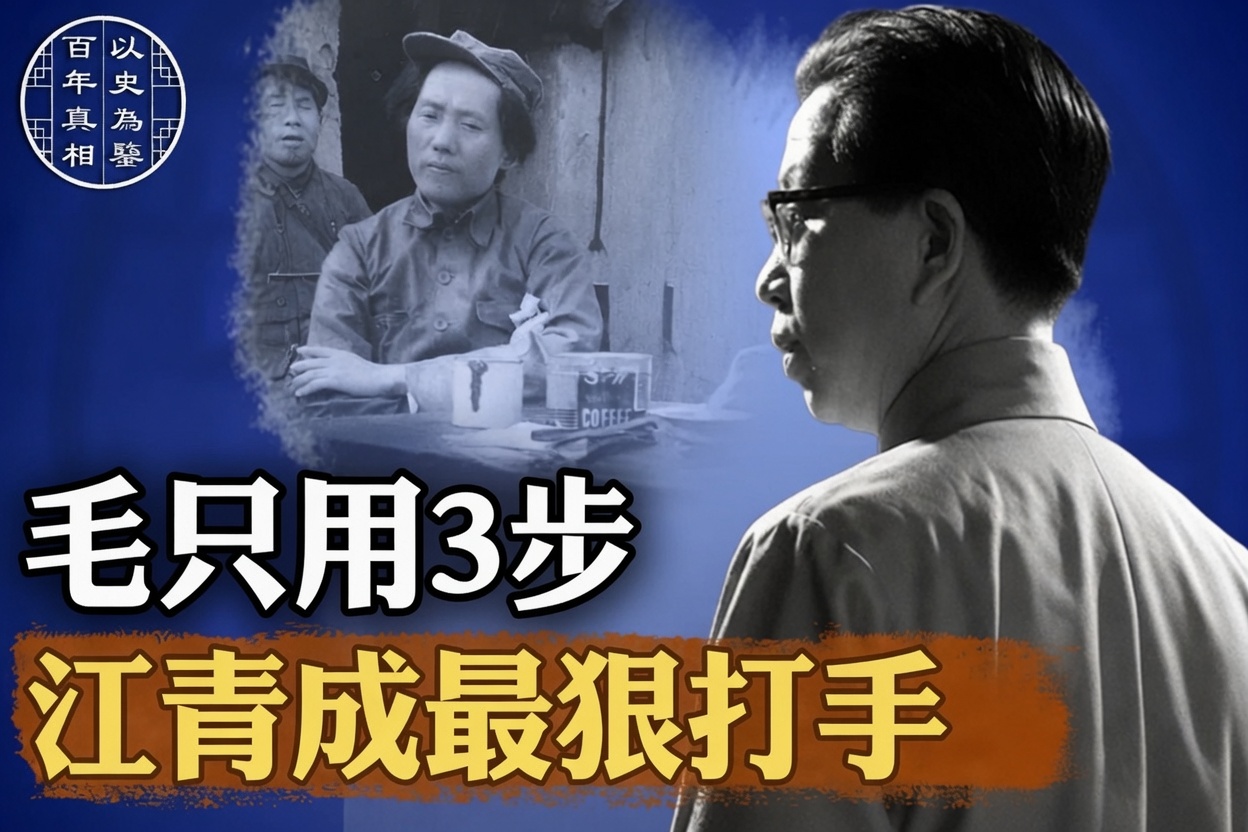
Audience friends, hello everyone! Welcome to watch “Century Truths”.
On January 25, 1981, Mao Zedong’s wife Jiang Qing was convicted by a special court of the Supreme People’s Court of the CCP for crimes such as “counterrevolutionary group, conspiracy to overthrow the government, counterrevolutionary propaganda and incitement”, and was initially sentenced to death, which was later commuted to life imprisonment after two years.
In the early hours of May 14, 1991, after serving 10 years in Qin Cheng Prison, Jiang Qing committed suicide by taking sleeping pills.
From being sentenced to the end of her life, she never admitted her guilt.
Jiang Qing once made a two-hour self-defense statement in court, during which a sentence shocked the world. She said, “I am Chairman Mao’s dog.”
Was Jiang Qing defending herself or revealing the deeper political truth of the CCP?
Today, based on memoirs by Jiang Qing’s secretary Yan Changgui and other sources, we will reconstruct the complicated and distorted power relationship between Jiang Qing and Mao Zedong.
Jiang Qing, originally a third-rate actress named “Lan Ping” in Shanghai. Due to too many scandals, she couldn’t survive in Shanghai and ended up in Yan’an, where she changed her name to Jiang Qing.
After arriving in Yan’an, Jiang Qing climbed to the highest peak of her life—Mao Zedong. In 1938, the 24-year-old Jiang Qing married the 45-year-old Mao, becoming Mao’s fourth wife.
After getting married, Jiang Qing didn’t immediately enter the core of the CCP’s power. During the war years, she mainly accompanied Mao, taking care of his daily life and assisting in some clerical work. Overall, Jiang Qing was relatively low-key during that era, keeping a low profile.
After the founding of the PRC in 1949, Mao Zedong took over the Zhongnanhai, and Jiang Qing became the “First Lady” of the CCP, gaining a higher status.
However, her presence in the power structure wasn’t strong. On one hand, she was in poor health, going to the Soviet Union four times for treatment; on the other hand, Jiang Qing hadn’t found a role suitable for herself in the political arena.
Opportunity soon came.
In 1951, the movie “The Life of Wu Xun” was released, sparking widespread discussion in society. Mao Zedong personally made criticisms of the film.
Jiang Qing’s keen political sense immediately went into high gear. She quickly seized this rare opportunity and requested to participate in the “Wu Xun Historical Research Team” organized by the Ministry of Culture and other units.
Jiang Qing not only participated in the research work in Shandong but also drafted the investigation report “Wu Xun Historical Investigation Record.”
This investigation report received great attention from Mao Zedong. After Mao personally revised it in 15 places, the report was published in the People’s Daily.
Months later, Jiang Qing was appointed as the director of the Film Department of the Propaganda Department, officially entering the CCP’s power structure.
Next, Mao Zedong consciously began to cultivate Jiang Qing, pushing her step by step toward the center of the political stage through three stages.
Firstly, in 1956, with the approval of the CCP Politburo Standing Committee, Jiang Qing became Mao Zedong’s secretary, helping collect and study international information.
According to the historical materials in “The Collected Works of Mao Zedong Since the Founding of the PRC,” there were 21 instructions involving Jiang Qing from 1958 to 1963. These instructions mostly directed Jiang Qing to read various international and domestic documents, covering political, economic, cultural aspects, etc. Some instructions also required Jiang Qing to “read at least twice,” “carefully read,” or “study.”
This was not just about cultivating Jiang Qing’s reading skills but also training her political intuition and ability to grasp political trends.
The second stage, Mao Zedong paired Jiang Qing with Lin Biao.
In 1964, China was on the verge of a storm. To completely overthrow Liu Shaoqi, the “socialist education movement” initiated by Mao Zedong was moving towards the “Cultural Revolution.” Jiang Qing’s life was at another crucial juncture.
On May 9, 1964, Deputy Chairman of the Central Military Commission Lin Biao made a speech on the army’s literary work.
After seeing it, Mao Zed, started to build a relationship between Lin Biao and Jiang Qing, making them his most important allies in launching the “Cultural Revolution”!
Mao first made comments on Lin Biao’s speech and specifically asked Jiang Qing to read it, then find Lin Biao to exchange opinions. He let Jiang Qing convey his attitude towards Lin Biao, fully supporting Lin Biao’s views, praising the timing of his speech.
On June 5, 1964, as per Mao Zedong’s instructions, Jiang Qing met with Lin Biao. Shortly after on June 23, at a Peking opera modern drama symposium, Jiang Qing delivered a speech titled “Discussing Revolutionary Peking Opera.” After seeing it, Mao Zedong once again gave affirmative comments, with five large characters: “Read, spoken well.”
By 1966, the brewing of the Cultural Revolution was reaching its climax, and Mao Zedong’s cultivation of Jiang Qing entered the third stage.
On January 21, through Lin Biao’s arrangement, Jiang Qing held a symposium on literary work for the troops. Afterward, a document titled “Minutes of the Symposium on Literary Work for the Troops Convened by Jiang Qing” was formulated.
After reading it, Mao Zedong personally added six words before Jiang Qing’s name. Consequently, the document was renamed “Minutes of the Symposium on Literary Work for the Troops Convened by Comrade Lin Biao Entrusted to Comrade Jiang Qing.”
This not only marked the first appearance of Jiang Qing’s name in an official CCP document but also indicated that Jiang Qing had begun to meddle in military affairs, controlling the ideological direction of the military through the field of literature and art.
Mao Zedong revised this document three times, suggesting it be submitted for approval in the name of the Central Military Commission to the CCP Central Committee. On April 10, 1966, under the name of the CCP Central Committee, this “Minutes” was officially released.
Through these series of actions, Mao Zedong finally connected Jiang Qing-Lin Biao-the Central Military Commission-and the CCP Central Committee, significantly elevating Jiang Qing’s position within the party.
And Jiang Qing was about to become the “flag bearer” of Mao Zedong’s Cultural Revolution, where her remaining life would be closely tied to the revolution.
Historians generally believe that the most important trigger for the Cultural Revolution was the article published by the Shanghai Wenhui Daily on November 10, 1965 – “Critique of the New Version Historical Drama ‘Hai Rui Dismissed from Office.'”
This article, ostensibly written by Yao Wen-yuan, was actually based on Jiang Qing’s intentions under Mao Zedong’s guidance. In the end, it was Mao who finalized after repeated revisions. Therefore, Mao was the mastermind behind the scenes, Jiang Qing was the direct executor, and Yao Wen-yuan was just the front-line soldier wearing the yellow coat.
The article’s writing was strictly confidential, so upon its release, the CCP Central Propaganda Department and the Beijing Municipal Party Committee were extremely shocked.
On the surface, the article criticized Wu Han, the Deputy Mayor of Beijing and a Ming Dynasty expert. However, it was, in reality, paving the way for the political purge behind him.
One can imagine, for Mao Zedong to launch the Cultural Revolution, he needed the support of the military, but the army was meant to stabilize the power base. Therefore, dirty work couldn’t be delegated to the military, necessitating someone else to run errands and execute orders. Jiang Qing was that person who could implement Mao’s entire Cultural Revolution strategy and political tactics without compromise.
Mao instructed Jiang Qing to criticize Wu Han to overthrow the leading Beijing faction headed by Peng Zhen. Furthermore, it aimed to bring down Liu Shaoqi, the Chairman of the CCP, and Deng Xiaoping, the General Secretary of the CCP Central Committee.
In the six months following the publication of the article “Critique of the New Version Historical Drama ‘Hai Rui Dismissed from Office,'” Jiang Qing shuttled back and forth between Beijing and Shanghai, bridging and paving the way for Mao Zedong’s layout, fermenting the various political emotions needed for the Cultural Revolution.
On May 16, 1966, Mao Zedong issued the “May 16 Notice,” defining the dissenting voices of the Beijing Municipal Committee against this article as “shielding the bourgeoisie” and “preparing public opinion for bourgeois restoration.”
The Cultural Revolution was finally moved from behind the scenes to center stage.
The “May 16 Notice” proposed cleaning out the “representatives of the bourgeois class within the party” and re-establishing a “Cultural Revolution Group” subordinate to the Politburo Standing Committee.
This was, in essence, a “total mobilization order” for the Cultural Revolution personally issued by Mao Zedong, with a political program for purging internal party opponents.
According to Mao’s confidant Wang Li’s recollection, from September 1967 to September 1971, fourteen central task groups were established. The management of these task groups, including who was appointed to oversee them and select personnel, was suggested by Zhou Enlai and approved by Mao Zedong and Lin Biao.
Jiang Qing participated in several task groups, such as Liu Shaoqi task group, Luo Ruiqing task group, and so on. The first person responsible for these task groups was Mao Zedong, followed by Zhou Enlai, and Jiang Qing was effectively in the third position.
Furthermore, according to Jiang Qing’s secretary Yan Changgui recollection: “On August 4, 1967, Chairman Mao wrote a letter to Jiang Qing, proposing to give guns to the leftists and arm them. This letter was conveyed to the Political Bureau through Jiang Qing and was implemented throughout the party and country.”
During the Cultural Revolution, many regions of the country witnessed armed conflicts, resulting in many deaths. This was directly related to Mao Zedong’s letter. Jiang Qing was inevitably implicated!
Yan Changgui said: “Jiang Qing’s political career mainly took place during the Cultural Revolution. She was Mao Zedong’s steadfast collaborator and supporter in launching the Cultural Revolution. Mao Zedong’s every major strategic deployment regarding the Cultural Revolution…Jiang Qing actively responded, fully implemented them. Therefore, Mao Zedong praised Jiang Qing for her significant achievements in the Cultural Revolution, especially in criticizing Liu Shaoqi and Lin Biao.”
Now, let’s revisit the opening statement of the program, where Jiang Qing said: “I am Chairman Mao’s dog.”
Yan Changgui has an evaluation of this statement. He said:
“Although this statement is vulgar, it is a true portrayal of Jiang Qing’s relationship with Mao Zedong. Mao Zedong fully utilized this ‘dog’ during the ‘Cultural Revolution’ and treasured her. Jiang Qing, as Mao Zedong’s ‘dog,’ on the one hand, leveraged the power of her master, and at the same time, remained loyal to her ‘owner,’ never uttering a word against Mao Zedong until her suicide in 1991.”
However, the historical outcome is that – after the end of the Cultural Revolution, Jiang Qing became one of the main figures to be held accountable. The once influential “flag bearer” of the Cultural Revolution ultimately became an important figure bearing historical responsibility.
She was both an aggressor and a scapegoat. If Jiang Qing was the ringleader of the “Jiang Qing Counterrevolutionary Group,” then who was the true “backstage” of this group? This question is actually known to everyone.
Well, that concludes today’s program. Thank you for watching.
If you enjoyed our program, don’t forget to like, subscribe, and share.
See you next time.
– Production Team of “Century Truths”