
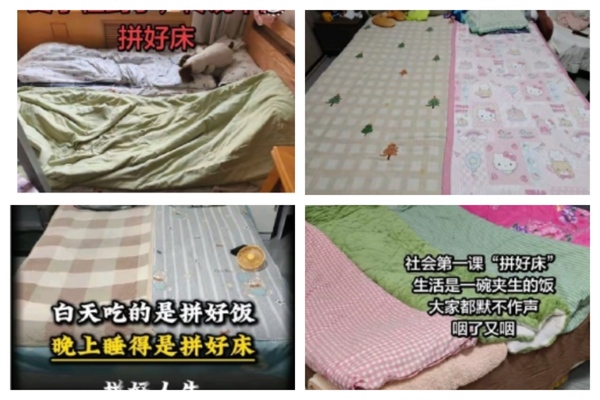
In the face of a slowing economy and uncertain job prospects in China, an increasing number of young people are resorting to unimaginable ways to save money, such as sharing a bed with strangers. The term “splicing beds” has emerged, reflecting the reality that Chinese youth are forced to change their lifestyles for survival. Not only has “splicing beds” trended on Weibo, but it has also attracted attention from foreign media.
According to a report by Reuters on July 29th, faced with an uncertain future, saleswoman Winnie Zeng from China decided to share a bed with a stranger to cut living expenses. The 25-year-old Miss Zeng, hailing from Wuhan, invited another young woman of the same age to move into her bedroom, allowing her to save 450 Chinese yuan (about $66) in rent per month and retain about three-quarters of her 4,000 yuan monthly income.
The act of two strangers sharing a room, even sleeping in the same bed to save money, a situation that seemed inconceivable in the past, is now becoming a symbol of the economic pressures many Chinese young people are facing.
“This is for survival,” said Miss Zeng, emphasizing that without savings, she would be extremely vulnerable if she lost her job. She spends a significant amount of time each day live-streaming on social media to showcase and sell various consumer goods for her company.
Besides seeking savings in rent, Miss Zeng also practices a frugal lifestyle, like cooking at home and avoiding buying expensive clothing.
China’s economy continues to weaken, with youth unemployment rates particularly high. More and more young people are seeking various forms of “sharing” to cut costs, not only with carpooling and shared meals, but recently the term “splicing beds” has ignited the internet.
In late June, a topic labeled “splicing beds have truly exceeded my understanding of hardship” briefly trended on Weibo, garnering over 14 million views, and related content on Douyin received nearly 40 million views.
Search results on Xiaohongshu (Little Red Book) for “splicing beds” yield over 37,000 posts. Some tenants, including Miss Zeng, have posted information to find roommates or people willing to share beds.
While “splicing beds” remains a minority practice among China’s approximately 260 million renters, Reuters noted that this phenomenon reflects China’s economic reality: consumers continue to spend cautiously, and many young people are increasingly worried about job stability.
“The starting salary is very low, but the cost of living is high—you can only make compromises,” said Miss Zeng. “People say that society has fallen to such a point, which is absolutely true.”
Quoting Mingwei Liu, director of the Global Labor and Employment Research Center at Rutgers University, Reuters stated, “This reflects an increasingly harsh reality: some young people lack a sense of belonging in the city, stable long-term employment, and clear income prospects.”
Liu added that if this mindset spreads, it could inhibit household spending, real estate demand, and marriage rates, posing long-term challenges to the economy.
China’s data released this month shows economic growth slowing to the lowest level in over three years, primarily due to weak consumer spending weighing down overall economic performance.
Miss Zeng’s apartment has five bedrooms, each rented to different tenants. She and her new roommate have rented one of the rooms.
Her room features a built-in wardrobe and a double bed, along with a bedside table and a small desk. A drying rack partially blocks a small window with metal bars.
The two agreed to a trial period of living together for eight days before deciding on long-term cohabitation. Miss Zeng expressed that the living arrangements have been quite harmonious so far.
“It feels good to come home knowing someone is waiting for you,” she said.
However, for many people, Reuters noted that this trend is more about economic necessity than seeking companionship.
39-year-old Beijing resident Morgan Pan’s current annual income is less than half of the 30,000 to 40,000 yuan annual salary he had when working at an artificial intelligence startup. The startup has now entered bankruptcy proceedings.
To reduce rent and utility costs to around 1,200 yuan per month, Pan has recently started sharing a bedroom with someone. His roommate is also struggling financially after a failed investment in a restaurant.
Pan said there is nothing heartwarming about his situation; all he feels is “life pressure.”
Another Beijing resident surnamed Wang, who lost his job due to the closure of a civil engineering company he worked for last December, is currently seeking a roommate to share a monthly rent of 1,750 yuan.
Wang stated, “I haven’t found a suitable job yet and can only find ways to alleviate my financial pressure.” He has also not found a roommate willing to share the room with him.
Tech blogger “马上谈” remarked, “Two to three people sharing a bed? I thought it was a joke, but it turned out to be true. This situation is quite common in Beijing, Shanghai, and Guangzhou… Sharing meals during the day, sharing beds at night, young people of this generation, you are truly suffering… Where is the problem? The society allocates too little to young people, which may also be a reason for declining marriage and birth rates.”