
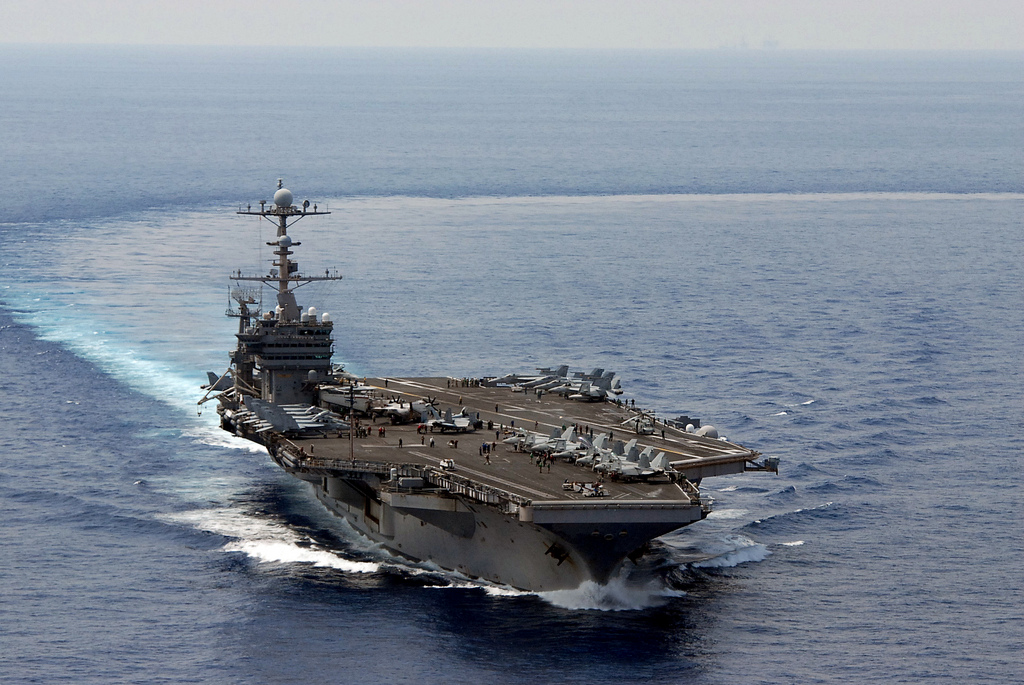
Last week, clashes occurred multiple times between the Philippines and China in the South China Sea at Ren’ai Reef and Scarborough Shoal. Subsequently, the USS George Washington aircraft carrier strike group deployed in the Indo-Pacific region has entered the South China Sea.
According to a report on the USNI News website on July 27th, after nearly two months of operations in the Philippine Sea, the aircraft carrier strike group led by the USS George Washington (CVN-73) crossed the Luzon Strait last week.
US Ambassador to the Philippines Lee Lipton posted on social media platform X last Friday (July 24), stating, “The USS George Washington Carrier Strike Group, with advanced combat capabilities including F-35 fighters, is upholding freedom of navigation and overflight in the South China Sea region. We object to excessive maritime claims worldwide.”
The carrier strike group consisting of the USS George Washington aircraft carrier, USS Robert Smalls missile cruiser (CG-62), USS Shoup (DDG-86), and USS Benfold (DDG-65) destroyers conducted joint training with the Japan Maritime Self-Defense Force’s JS Yūdachi (DD-103) destroyer last Friday. Prior to this exercise, JS Yūdachi had engaged in maritime cooperation activities in the South China Sea with Philippine escort vessels and the US littoral combat ship USS Santa Barbara (LCS-32).
Last Saturday, the USS Santa Barbara conducted replenishment operations at sea with the Australian Navy’s HMAS Supply (A195) near Scarborough Shoal in the South China Sea.
The Philippine military stated that on Monday (July 20) near Second Thomas Shoal, Chinese Coast Guard personnel forcibly approached Filipino vessels, brutally beating two naval sailors with sticks, causing them injuries that required medical evacuation, and damaging a rubber boat. This skirmish marks the most serious conflict between China and the Philippines to date.
US Secretary of State Marco Rubio revealed that the incident at Second Thomas Shoal also involved direct US military intervention.
Rubio told reporters during the ASEAN Foreign Ministers’ Meeting last week, “We are committed to supporting our treaty allies, and obviously we have done a lot of work. In fact, there was a US Coast Guard ship in the region at the time, which acted as a buffer between the two sides, helping ensure injured personnel were rescued and taken for treatment.”
These Sentinel-class patrol ships had previously been deployed in the Middle East but have since been redeployed to Southeast Asia following the US-Iran conflict.
Shortly after the Second Thomas Shoal incident, Philippine fishing boats operating near Scarborough Shoal were harassed and obstructed by Chinese patrol vessels. The Philippines released related videos on Friday, showing Chinese ships using high-pressure water cannons and engaging in dangerous maneuvers.
Following a series of events between China and the Philippines, US aircraft carrier strike groups have been deployed in the South China Sea for extended patrols. Last fall, in response to further Chinese claims on Scarborough Shoal and the aggressive actions of Chinese Coast Guard vessels, the US deployed two aircraft carriers to maintain a presence west of Luzon Island.
China claims sovereignty over nearly the entire South China Sea based on the “Nine-Dash Line,” which overlaps with exclusive economic zones of countries like the Philippines and Vietnam, leading to disputes. On July 12, 2016, the Permanent Court of Arbitration in The Hague ruled that China’s claims under the “Nine-Dash Line” in the South China Sea have no legal basis. Beijing, however, refuses to recognize the ruling and has increased deployments of Coast Guard ships and militia forces in the South China Sea.