
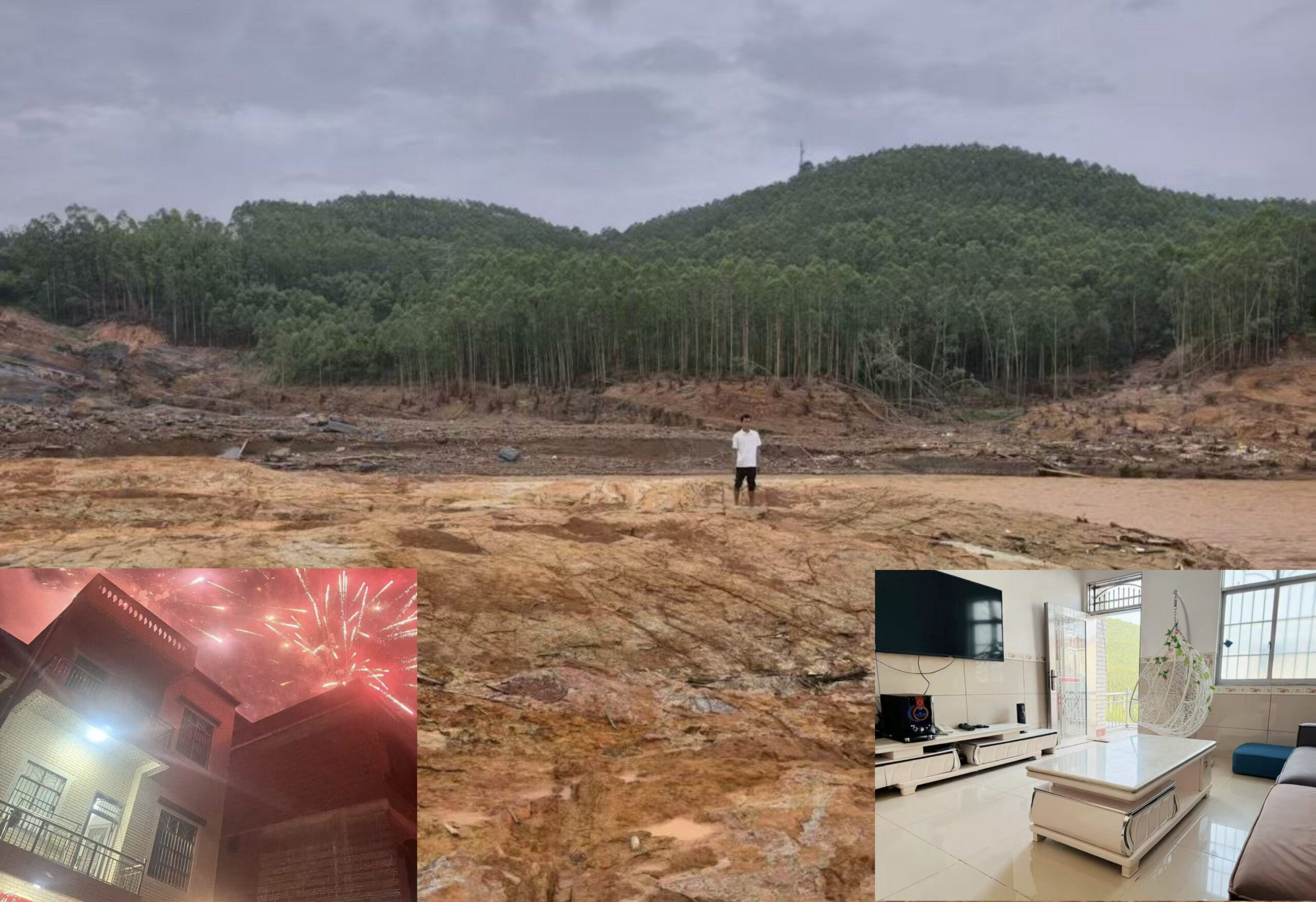
Dozens of reservoirs in Hengzhou, Guangxi collapsed one after another due to heavy rain, causing floods for nearly 20 days. The worst-hit Dutian Village saw houses destroyed and farmlands washed away. Local villagers accused the government of evacuating them from temporary shelters and failing to provide promised subsidies, leaving them displaced with no hope of rebuilding their homes.
From July 4th to 6th, heavy rainfall hit Guangxi, leading to the collapses of several reservoirs including Liulan Reservoir, Yunbiao Reservoir, and Gandao Reservoir in Guigang City, triggering a chain reaction that resulted in a massive flood disaster affecting more than ten reservoirs of various sizes in the surrounding areas.
On July 21st, news of the collapse of two reservoirs in Duzhu Village, Yunbiao Town emerged. Although officials denied the reports, they admitted leakage issues at the Baifunshan Dam in Duzhu Village.
The collapse and overflow of local reservoirs affected multiple villages in School Yi Town, Yunbiao Town, Maling Town, Taowei Town, and Shitang Town in Hengzhou City, leaving many villagers trapped by floodwaters. Despite the receding waters, the downstream villagers’ plight has just begun, with Dutian Village in School Yi Town being hit the hardest.
When the floods approached, the situation for Zhang Wenhui (pseudonym) and his family in Dutian Village became extremely dangerous as the reservoir dam faced their home directly. They managed to evacuate in time but at the cost of losing their entire home.
Surveying the aftermath, Zhang Wenhui described the devastating scene where over a hundred households were severely impacted, with dozens of homes entirely swept away, including his own newly renovated three-story house worth hundreds of thousands of yuan. The emotional toll was heavy for him as he struggled to come to terms with the loss of everything he had built.
As the villagers in Dutian Village continue to grapple with their grief, practical challenges loom large. Nearly three weeks have passed, yet they still cannot find a permanent place to live.
According to Zhang Wenhui’s account, the displaced villagers were initially accommodated in a local school after the disaster, but this temporary arrangement was abruptly terminated to make way for the school’s reopening. Now, they are residing in a private residence in School Yi Town instead of a government-provided shelter.
The scarcity of available accommodation in the town has left them scrambling to find suitable housing, with hotels already fully booked. Zhang Wenhui expressed the difficulties faced by families with elderly members and children, emphasizing the urgent need for stable housing options.
The plight of the disaster victims in Guangxi extends beyond temporary shelter to financial concerns. They rely on government assistance to cover their living expenses and hope for the promised aid to materialize.
Despite the Central Government allocating 200 million yuan to support Guangxi in disaster recovery, citizens have raised concerns about the disparity between this amount and the substantial aid pledged to Africa by Chinese leader Xi Jinping. There is skepticism surrounding the actual implementation of the promised support in Guangxi.
For Zhang Wenhui and many others, the financial aid promised by the local government has yet to be received, leaving them struggling to make ends meet. In the absence of adequate support, they rely on donations from individuals and charitable organizations to sustain themselves.
Beyond the immediate challenges of securing food and shelter, villagers like Zhang Wenhui face the daunting task of rebuilding their livelihoods and communities. The loss of their farmland, which was their main source of income as jasmine flower farmers, has left them without a steady income.
Reflecting on the disaster, Zhang Wenhui questioned whether it was solely a natural calamity or partly a man-made catastrophe. As someone familiar with the operations of the reservoir due to living in its vicinity for a long time, he believes that better water management could have mitigated the severity of the floods and prevented the widespread destruction.
While appreciative of the assistance from various sectors of society, Zhang Wenhui expressed disappointment with the government’s response, describing it as lacking urgency and coordination in the post-disaster recovery efforts. As they look towards the future, villagers like him hope for concrete rebuilding plans and support from the authorities to help them recover and regain their footing.