
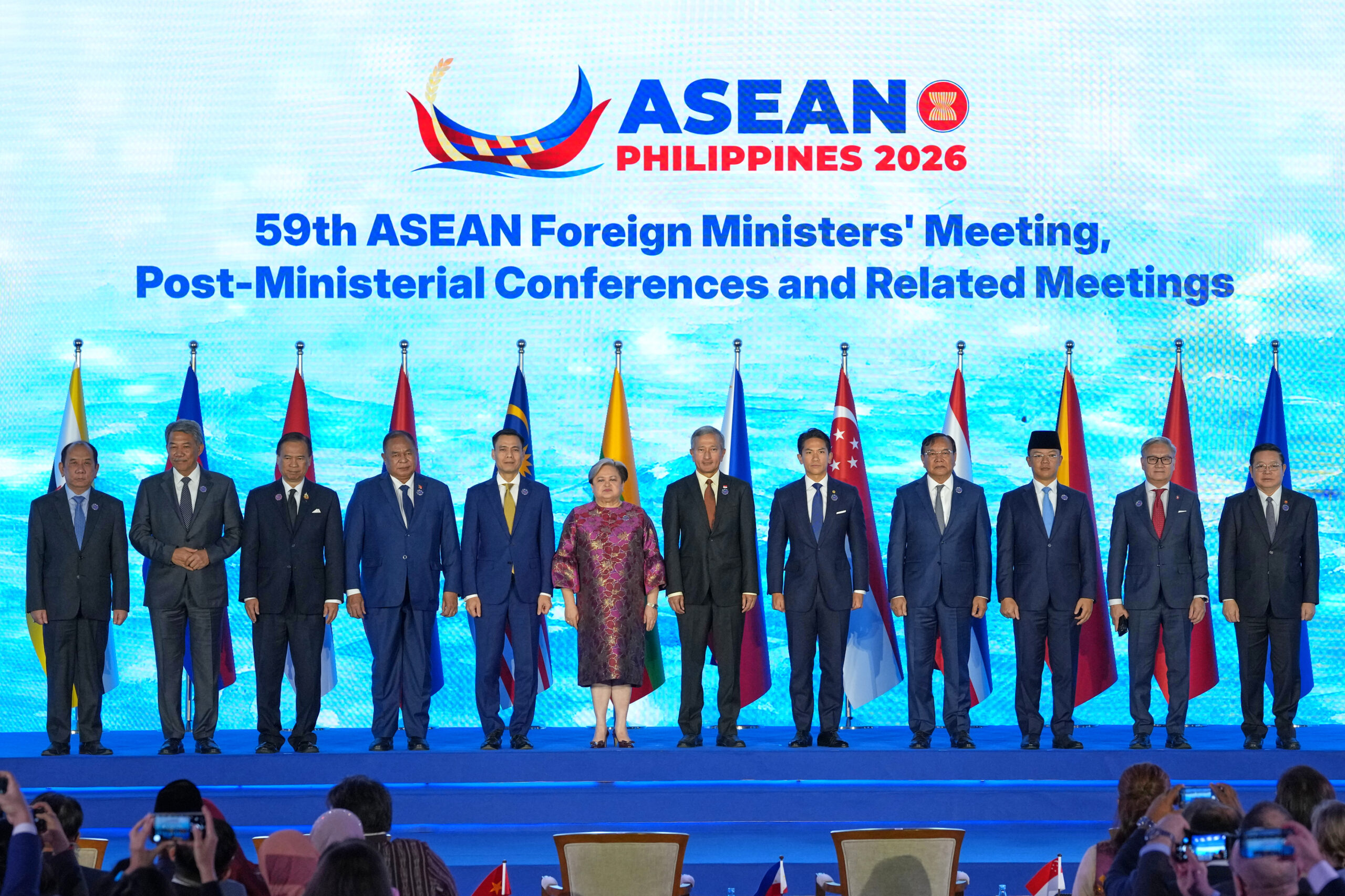
On Tuesday, the 59th annual meeting of the Association of Southeast Asian Nations (ASEAN) Foreign Ministers officially opened in Manila, the capital of the Philippines. Regional security issues such as the Middle East conflict and tensions in the South China Sea were the focal points of discussion.
The ongoing turmoil in the Middle East has raised concerns among international observers regarding energy supply through the Hormuz Strait, inflation, and the global economy. The recent announcement by Iran-backed Houthi rebels in Yemen to impose a naval blockade on Saudi Arabia escalated the risk of conflict further.
According to a statement released by ASEAN foreign ministers after a closed-door meeting, they expressed deep concerns over the situation, stating that it severely undermined key mediation efforts and reduced the prospects of peacefully resolving issues through dialogue and diplomatic means.
The combined GDP of ASEAN countries amounts to 3.8 trillion US dollars. As a region heavily reliant on oil imports, Southeast Asia is highly susceptible to the impact of supply shortages. Therefore, countries are committed to accelerating the implementation of an ASEAN oil-sharing mechanism to alleviate related disruptions.
Within the region, ASEAN faces various challenges. During the meeting, foreign ministers will discuss the conflicts in Myanmar to advance a stalled peace initiative. The civil war in Myanmar, which began with a military coup five years ago, is estimated to have claimed the lives of 100,000 people.
The South China Sea dispute also remains a focal point of discussion at this ASEAN Foreign Ministers’ Summit. Despite nearly a decade of efforts, ASEAN continues to work towards finalizing a Code of Conduct with China to prevent further escalation of disputes in the South China Sea.
Just a day before the summit commenced on July 20, the Philippines accused Chinese coast guard personnel of using wooden batons to strike a Filipino navy member’s head near the disputed Second Thomas Shoal (known as Ren’ai Reef in China), resulting in injuries and damage to a Philippine naval rubber boat.
China’s coast guard dismissed the accusation as “untrue,” with Beijing authorities summoning the Philippine ambassador on Tuesday to address the issue.
Following the incident, the US State Department condemned China’s “dangerous and provocative actions” in the South China Sea, specifically targeting what it described as a “worrisome pattern of Chinese provocations against legitimate Philippine maritime activities.”
Both US Secretary of State Pompeo and Chinese Foreign Minister Wang Yi will attend the summit, with the potential for sideline meetings. Representatives from countries such as India, Japan, Australia, South Korea, Russia, the UK, and the EU will also be present at the conference.
Upon arriving in Manila on Tuesday, Pompeo published a commentary in a Philippine newspaper, indirectly criticizing Beijing while reaffirming America’s commitment to freedom of navigation. He warned that this freedom is “wholly unguaranteed.”
Pompeo cautioned in his article, “If this vital waterway falls under the control of a powerful nation that seeks to use trade as a geopolitical weapon, the sovereignty, security, and economic prospects of the United States and ASEAN nations will face grave new threats.”
Pompeo reiterated that the 2016 South China Sea arbitration ruling is final and binding. He explicitly stated that the US would fulfill its obligations to its allies when they face “new threatening threats to our common interests.”
In July 2016, the Arbitral Tribunal rejected China’s claims of extensive sovereignty in the South China Sea. However, China has continuously refused to acknowledge the ruling.