
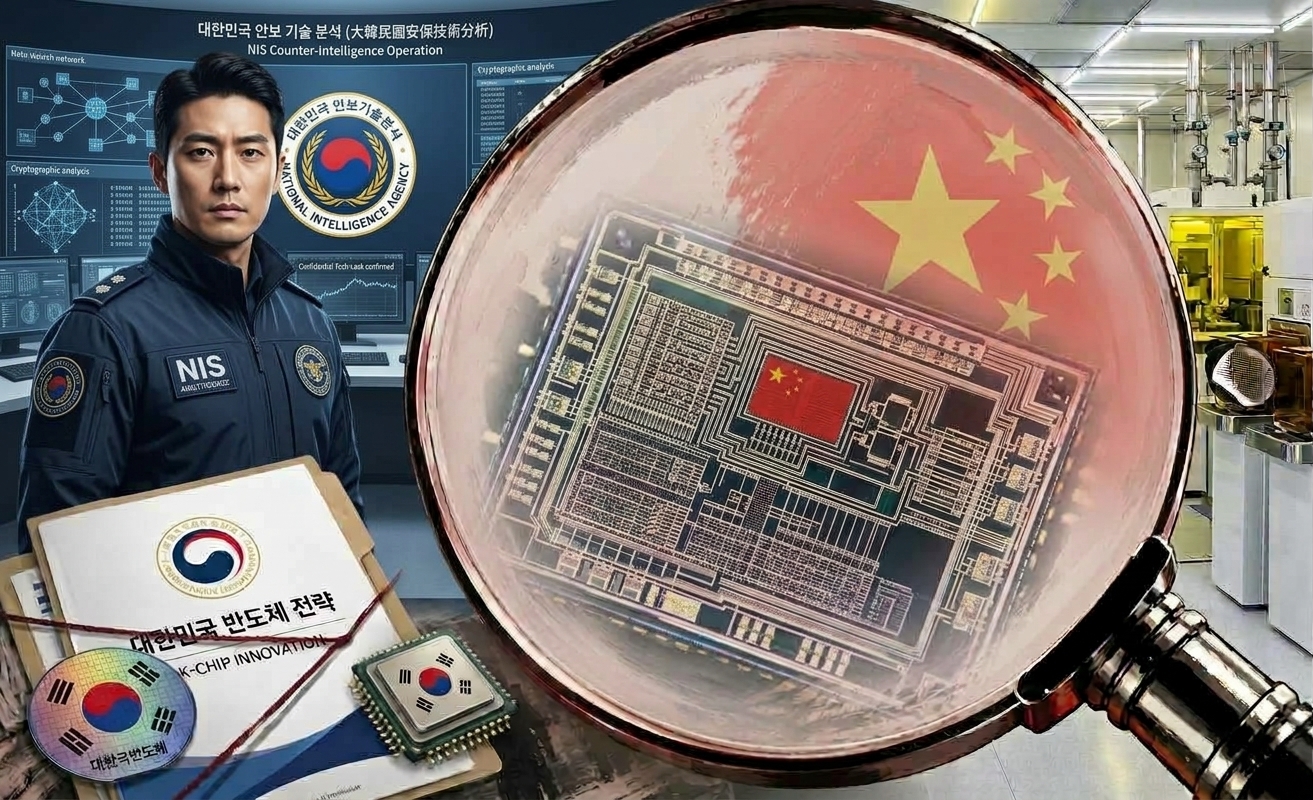
On Thursday (October 1st), the Korea Joongang Daily, an English media outlet in South Korea, reported that the South Korean intelligence agency has warned top scholars in the semiconductor and battery fields to be cautious of recruitment invitations from China due to the increasing risks of technology leaks.
Industry and academic sources revealed that the South Korean National Intelligence Service is closely monitoring around 80 top Korean scholars identified by the Chinese government as recruitment targets, in an effort to prevent the leakage of advanced technologies.
A professor who preferred to remain anonymous stated, “I heard that professors in the semiconductor field make up the majority on the list, with professors from other fields such as batteries also included. The National Intelligence Service has been advising them to be cautious of recruitment invitations from Chinese entities.”
For a long time, China has been attracting scientists and technical experts through various programs, most notably the “Thousand Talents Program” initiated in 2008. This program aims to attract overseas talent by providing research funds, settling expenses, and other incentives.
Scholars from South Korea indicated that being approached by Chinese companies for job offers has become a regular occurrence.
Lee Byoung-hun, a semiconductor engineering professor at Pohang University of Science and Technology who previously worked in chip research at Samsung Electronics and IBM, mentioned, “I receive recruitment emails from various regions in China, including Zhejiang, every week. They offer an annual salary of 300 million South Korean won, performance bonuses equivalent to the annual salary, research funds of around 1 billion South Korean won per year, and even provide housing and a car.”
Lee Byoung-hun noted that aside from the risk of leaking sensitive information, the research environment in China, along with the policies of preferential treatment and compensation offered to researchers, are “quite enticing” for academics in South Korea.
However, China’s ambitions extend further. It has been reported that individuals listing prior work experience at Samsung Electronics or SK Hynix in their LinkedIn profiles – regardless of their position – receive numerous contacts from Chinese companies and headhunters.
“It’s not just engineers, but also marketing and sales personnel,” stated an official from the South Korean semiconductor industry. “Every position holds experiences or information sought after by Chinese companies.”
Headhunters particularly target South Korean technical personnel who are about to leave their positions and offer high salaries to those finding it challenging to secure new jobs in South Korea.
A former senior executive at Samsung Electronics who worked in China mentioned that during downturns in the semiconductor industry that lead to more executives leaving, Chinese headhunters capitalize on the situation, as departing executives are often psychologically vulnerable.
Of course, transitioning to a foreign company does not necessarily mean technology leaks are inevitable. The concern lies in the unauthorized acquisition and utilization of certain trade secrets or core technologies.
Kang Ki-joong, the President of the Korean Association for Industrial Security and a former judge at the Patent Court, stated, “Based on (court cases that have been litigated), many individuals do not just leave with their experiences in mind; they download, copy, or organize data (from previous employer companies) and take it with them.”
The judge further added that sometimes relying solely on memory recall does not exempt individuals from charges of breaching trade secrets; for example, pieces of information may be publicly available, but once combined, they may be considered confidential information that should not be disclosed.
According to data from the South Korean National Police Agency, in 2025, authorities uncovered 179 cases of technology leaks, with 33 cases involving leaks to foreign entities. Among these foreign leaks, 18 cases (54.5%) were directed towards China.
Reports suggest that what Chinese companies truly seek to acquire are the decades-worth of technical expertise accumulated by South Korean companies. They understand that despite using similar equipment, the yield can significantly differ due to a company’s fine-tuned processes at every step and their ability to trace the root causes of defects.
Lee Byung-chull, the founder and first chairman of Samsung Electronics, remarked, “Technology is the result of countless trial and error, requiring investments, time, and manpower. For (Communist) China, attracting key talent allows them to bypass this process, making it a profitable deal even if they pay several times the salary compared to what they would receive in South Korea.”
Moreover, South Korean engineers who are hired by Chinese companies might in turn become new “bait” to lure their former colleagues to switch companies.
It was noted that once these South Korean engineers share their technical knowledge and experiences, their status within Chinese companies could diminish, leading some to shift roles into becoming recruiters who earn commissions by introducing former colleagues to Chinese companies.
South Korean companies are implementing measures such as house calls, blocking phone camera access, document classification, and controlling external transfers to prevent information leaks. They require departing employees to sign confidentiality agreements and demand key personnel to sign non-competition agreements. This is because once technology leaks occur, the losses may be irreparable.