
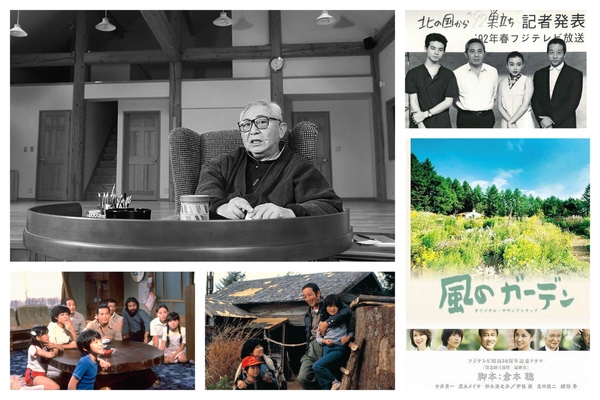
Renowned Japanese playwright So Kuramoto passed away at his residence in Furano City, Hokkaido, on September 18 due to multiple organ failure, at the age of 91. Throughout his life, he created numerous popular television dramas, with “From the Northern Country” being the most well-known, not only widely loved in Japan but also becoming a classic in the history of Japanese television dramas.
On the morning of September 28, the Kuramoto Foundation, of which So Kuramoto served as chairman, officially released a death notice and stated that the funeral had already taken place.
Born on January 1, 1935 in Shibuya, Tokyo, Kuramoto was originally named Shigeru Yamatani. The Yamatani family had been involved in publishing medical magazines and selling new medicines for generations. His father, Taro Yamatani, founded a publishing company specializing in natural sciences and was also a haiku poet who studied under the renowned poet Akiko Mawarisan.
From his high school days, Kuramoto was deeply immersed in drama creation, which affected his academic performance. After repeating a year of school, he was admitted to the Aesthetics Department of the Faculty of Letters at the University of Tokyo and joined the literary department of the “Nakama Theater Group”, starting to write scripts.
On October 14, 1958, his first radio drama, “The Fire of Yuki” (originally titled “Shishi”), was broadcast on Akita Broadcasting under his birth name. In January 1959, he produced the serial radio drama “This Sun” (adapted from Masakazu Makizumi’s work) for “Every Day Broadcasting” under the pseudonym “So Kuramoto”. After graduating from university, he participated in a recruitment event for recent graduates jointly hosted by Fuji TV, Nippon Broadcasting, and Bunka Broadcasting.
In 1959, Kuramoto began working for Nippon Broadcasting and became a freelance playwright after leaving in 1963. In 1977, he relocated to the more remote Furano City in Hokkaido.
In October 1981, his drama set in Furano, Hokkaido, “From the Northern Country” (“Kita no Kuni Kara” in Japanese) was aired on Fuji TV. Starring Kunio Tanaka, Hidetaka Yoshioka, and Tomoko Nakajima, the drama tells the story of Kurobe Goroh’s life when his wife leaves home and he returns to his hometown Furano with his son, Jun, and daughter, Kei.
Initially struggling to adapt to a life without electricity and running water in Hokkaido, the siblings gradually adjusted and developed a deep bond with the land and its people as the story unfolded.
“From the Northern Country” was widely loved by Japanese audiences, and special editions aired until 2002, spanning over twenty years. Furano also became a famous film and tourism destination in Japan because of this production. Data from Furano City showed that when “From the Northern Country 2002 Testament” was broadcast, the number of tourists to Furano City reached 2.49 million, setting a record high.
In the mid-1980s, “From the Northern Country” was introduced and dubbed by China Central Television as “Northern Love”, accumulating considerable popularity in China and becoming one of the important works for Chinese viewers to become familiar with Japanese television dramas.
Following “From the Northern Country”, Kuramoto created two more dramas set in Furano, “Gentle Hours” starring Satoshi Terao and Kazunari Ninomiya, and “Courtyard of Wind” starring Kichi Inai, collectively known as the “Furano Trilogy”.
Additionally, his works such as “Dear Father” and “Town of Tranquility” received critical acclaim, earning numerous awards in the Japanese television drama scene. The film “Station”, directed by Yasuo Masakai, written by Kuramoto, and starring Ken Takakura, also won multiple awards at the Japanese Academy Awards.
Kuramoto, along with deceased playwrights Taichi Yamada and Kubonokazuyuki, is known as one of Japan’s “Three Great Playwrights”, holding a significant position in Japanese film and television creation history.
He dedicated himself to nurturing young creators for many years. In 1984, he founded the “Furano Seminary” in Furano to cultivate playwrights and actors, with many later active creators in the Japanese film, television, and stage scenes having connections to the theater group or seminary.
Even in his later years, Kuramoto never ceased creating. The film “Silence of the Sea” (originally titled “Sea of Silence”) released in 2024 was scripted by him. His works spanned over half a century, with the memories of Furano left by “From the Northern Country” becoming an irreplaceable cultural symbol in the history of Japanese television dramas.