
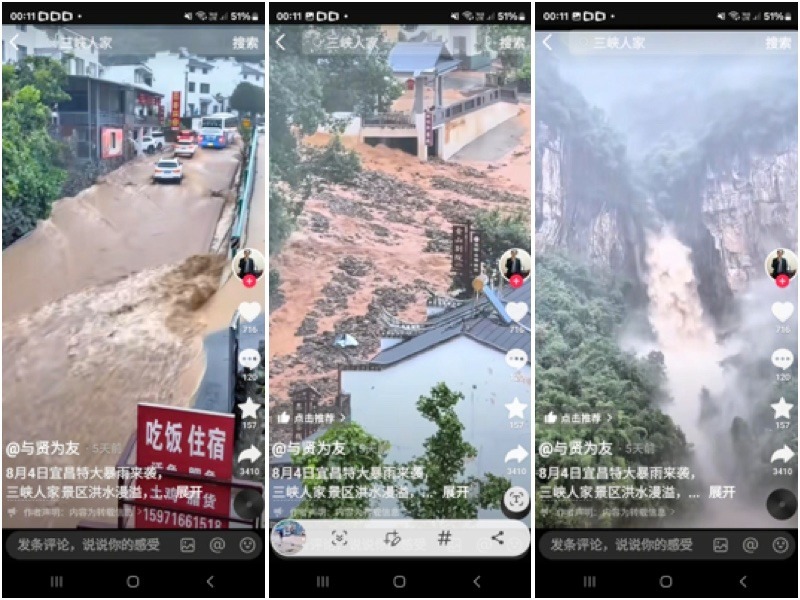
Recently, the Three Gorges Reservoir area in Yichang, Hubei Province, was affected by the typhoon “White Dolphin,” prompting the region to enter a state of emergency response. Measures taken included school closures, work stoppages, park closures, and train suspensions.
In the days leading up to the typhoon, the Three Gorges Reservoir area had already experienced heavy rainfall, triggering flash floods in Yiling District, Zigui County, Dianjun District, and other areas. Multiple landslides occurred along the national highway leading to the Three Gorges, leading to temporary closures of tourist attractions and stranding hundreds of visitors. Concerns about further potential disasters in the Three Gorges Reservoir area were heightened.
On August 10th, the Yichang Education Bureau issued an urgent notice regarding the typhoon “White Dolphin,” declaring a state of emergency and instructing all educational administrative departments and schools to take preventive measures. Measures included having flood prevention personnel on duty around the clock, suspending offline classes for kindergartens, primary and secondary schools, vocational schools, and training institutions on August 11th to 12th, halting campus construction work, and relocating personnel in slope and riverside construction areas.
The Yichang Emergency Management Bureau warned of heavy rain, showers, and possible localized heavy rainfall brought by the outer circulation of the typhoon “White Dolphin.” Due to previous continuous rainfall in the area, the soil saturation level was near capacity, increasing the risks of flash flooding, landslides, mudslides, and urban flooding.
Tourist attractions such as the Three Gorges Dam, Three Gorges Town, Qingjiang Gallery, and Three Gorges Waterfall were closed. Thirty-two trains passing through Yichang East Station were suspended, campus construction was halted, and construction workers in slope and riverside areas were relocated.
Fortunately, the actual rainfall on August 11th in Yichang did not reach the worst-predicted levels of localized heavy rainfall exceeding 150 millimeters. As of the morning of the 12th, the strongest rainfall and major evacuation efforts in Hubei were concentrated in Xiangyang and Shiyan, while the Meteorological Bureau also warned of scattered moderate to heavy rains and isolated heavy rainfall in Yichang on the 12th and 13th. The risks of flash floods, landslides, and medium-sized reservoirs were still present due to the saturated soil from previous rainfall. It was anticipated that the weather would significantly improve by the 14th.
Yichang has garnered significant attention due to the presence of the Three Gorges and Gezhouba projects, as well as a large number of small and medium-sized reservoirs, hilltop ponds, hydroelectric stations, and water diversion projects scattered throughout the region. Public data revealed that Yiling District had 60 reservoirs and 58 hydroelectric stations, while the Hubei Province Water Resources Department stated that Yichang completed reinforcement and fortification work on 160 small reservoirs during the 14th Five-Year Plan period.
Reports from the Three Gorges Daily on August 12th disclosed that Yichang city had four at-risk reservoirs, each with a tailored risk mitigation strategy. Seventeen reservoirs in key rainfall areas were pre-discharged to prevent flooding. Additionally, 335 rooftop ponds were included in the reservoir responsibility system, with facilities designed to control water levels below the overflow level.
According to the Hubei Provincial Department of Water Resources, in early August, the Three Gorges Reservoir had already encountered the first flood of the year, resulting in a discharge of 30,000 cubic meters per second and an additional 1.386 billion cubic meters of flood storage capacity being opened in advance. With the arrival of the typhoon “White Dolphin” while previous floodwaters had not fully receded, the region faced the combined pressures of upstream inflow, reservoir area rainfall, local flash floods, and downstream discharge.
During late July, when heavy rains occurred, inspections of 126 reservoirs and 51 high-level dams were conducted by the water resources departments in Yichang. Eight reservoirs were reported to be “overflowing normally,” though specific details such as the names and location of the overflowing reservoirs, discharge time and flow rate, the inspection of reservoirs and hydroelectric stations in Yiling and Zigui before the rainfall, and the status of reservoirs nearing or exceeding flood levels, as well as pre-discharge measures and notifications to downstream villages in Letian Creek, Longjin Creek, and Hengxi River, were not disclosed.
Furthermore, it was reported by the Yangtze River Power Company that starting from July 28th, the daily outflow from the Three Gorges Reservoir had increased from approximately 14,000 cubic meters per second to around 19,000 cubic meters per second, with an additional 1.386 billion cubic meters of flood storage capacity being made available. The peak inflow to the Three Gorges Reservoir on August 4th was reported to be about 38,000 cubic meters per second.
The Three Gorges Town, located downstream of the dam and upstream of the Gezhouba Dam, witnessed firsthand the impact of the water situation, which not only depended on heavy rainfall but also on the hourly inflow and outflow volumes of the Three Gorges Reservoir. Additionally, factors such as the water levels before and after the Gezhouba Dam, the duration of rising water levels between the two dams, the time taken for local torrential mountain floods to reach the area, and the discharge records of small and medium-sized reservoirs, hilltop ponds, and hydroelectric stations were crucial.
On August 4th, flooding and landslides in the Three Gorges Reservoir area were still being cleared up, and the lingering effects of the 13th typhoon “White Dolphin” began to surface in Hubei.
A meteorological blogger in China had previously warned that the real hidden crisis in Hubei was the potential impact of new rainfall on recently affected and unstable regions: the collapsed slopes along the G348 road may face renewed landslides; tributaries like Letian Creek and Longjin Creek could see flash floods again; saturated hillsides in Zigui and Three Gorges could trigger delayed landslides; debris and fallen trees might clog culverts and drainage ditches once more; small and medium-sized reservoirs may overflow again due to their unreduced water levels; if simultaneous discharge from the Three Gorges Reservoir, Gezhouba Dam, and local torrents coincided, it could exacerbate pressure between the two dams and at the docks.
On August 5th, within a single day, the province of Hubei issued 102 weather alerts for heavy rain, thunderstorms, and severe convective weather. Enshi and Yichang had multiple locations under red-level alerts for heavy rainfall.
According to Jingchu Net, the frequent issuance of such alerts indicated a regional disaster development involving flash floods, landslides, flooding in small rivers, and urban and rural waterlogging during that period.
On August 4th, the Three Gorges Reservoir area experienced an abrupt flood event, causing landslides along the G348 national highway leading to the Three Gorges and the specific national highway to the Three Gorges. Yichang’s Zigui County took immediate measures by implementing a “five-stop” protocol: halting work, production, classes, transportation, and business operations, engaging in search and rescue operations and personnel evacuation.
Video footage from the scene showed flash floods carrying mud and debris washing over roads, villages, houses, and factories. Amidst the flooding, numerous waterfalls emerged due to the raging water, creating a surreal sight. Descriptions shared on local social media platforms explained that the scenes, mistaken for waterfalls by outsiders, were, in fact, the result of surface runoff and tributary flash floods. The videographer humorously remarked that this was a unique interpretation of Three Gorges.
Several tourists shared their experiences on social media, indirectly criticizing the disorganized management of tourist spots.
One visitor filmed a video where they complained that despite heavy rain on the morning of August 4th, the tourist area remained open for ticket sales and allowed visitors to enter the mountains, only to announce the closure of Longjin Creek shortly after they arrived. The visitor lamented, “I was most looking forward to Three Gorges Town, but instead, this was the experience.” Another visitor recounted driving for over an hour to reach the vicinity of the Three Gorges Dam, only to find rising waters along the route, forcing them to turn back. They claimed they had not seen any closure notices from the tourist site. In the video shared, “brownish floodwaters surged over roads and structures, carrying a large amount of sediment.”
One tourist expressed disappointment after taking a week off work for a trip but being stranded once they reached Three Gorges Town. With roads covered in mud, debris, and fallen rocks, mountain slopes continued to erode, making it impossible for vehicles and visitors to leave.
As water levels rose and waves intensified, the cruise ships at Three Gorges Town ceased operations. Four hundred sixty-two tourists were left stranded at the pier, cut off by landslides blocking land routes and waterways becoming unnavigable. Following this, ships were dispatched by the Yiling District to transport these tourists, arranging accommodations and offering refunds. Official media outlets extensively covered the incident, reporting that all stranded tourists had safely returned by the afternoon of August 5th.
The landslides were not entirely unforeseen. On August 3rd, the Hubei Provincial Department of Natural Resources had flagged the eastern part of Xingshan County, the southeastern part of Zigui County, and the southwestern part of Yiling District in the Three Gorges Reservoir area as high-risk geological disaster zones prone to collapses, landslides, and mudslides. Local authorities and industry departments were required to inspect critical hazard points and provide warnings to vulnerable residents on a household level.
On August 4th, the area under alert expanded to include large parts of Xingshan, Zigui, and Yiling Districts. The evening warning raised the risk of collapse, landslides, and mudslides to “high” within the southwestern part of Yiling District.
However, despite the warnings, Three Gorges Town continued selling tickets, checking tickets, and ferrying visitors up the mountain on the morning of August 4th. Some visitors were only notified of Longjin Creek’s closure after they had entered the area. Several hours later, severe landslides occurred along G348. The official announcement for the comprehensive closure of the tourist site was only made as “temporarily suspended for August 5th.”
Critics argued that full refunds, free hotel stays, and ship transfers were offered to appease tourists, but these measures did not address the central question: why did the tourist site remain open for ticket sales when the danger had been forewarned? Only after visitors entered the area, experienced landslides, and the traffic was cut off by the disaster did an evacuation take place.
On the evening of August 5th, CCTV reported on the situation in Zigui, stating that there were “currently no casualties,” and search-and-rescue operations were ongoing.
However, a local netizen publicly revealed on social media on the 7th that her husband’s aunt was swept away by the flood in Jiuli Yingbin Third Road, Maoping Town, Zigui County, and had not been found. The aunt’s family members were negotiating in the Three Gorges area. Residents recounted that during the flood, some vehicles were swept away with passengers still inside.