
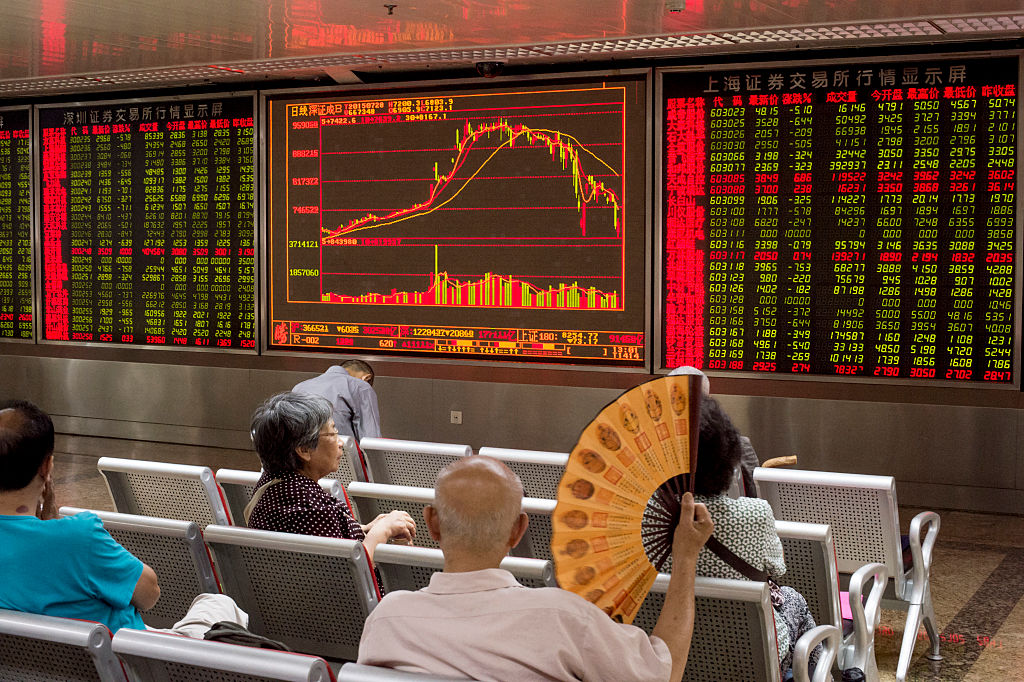
On August 13th, the A-shares in mainland China suddenly turned bearish before the market closed, with all three major indices falling and over 4300 stocks declining. Market analysts believe that the increasing trading volume during the decline indicates a rise in selling pressure and insufficient buying funds, leading to elevated risks of the recent high-flying stocks experiencing a downturn.
According to a report by “Daily Economic News,” the Shanghai Composite Index fell by 0.5%, the Shenzhen Component Index dropped by 0.87%, the ChiNext Index fell by 0.45%, and the STAR 50 Index also decreased by 0.75%.
A-shares opened with gains on that day, but suddenly turned bearish in the final half-hour before closing. The total turnover in the Shanghai and Shenzhen markets amounted to 2.55 trillion yuan, an increase of 398.5 billion yuan compared to the previous trading day.
The report mentioned that up until the time of reporting, there was no significant negative news directly explaining the cause of this downturn. Based on the analysis of trading changes, the increased trading volume during the downturn before closing reflects a surge in selling pressure and a lack of funds to support further buying. As a result, some investors who increased their positions that day ended up facing losses.
The precious metals sector led the declines, with stocks like Xiaocheng Technology, Zhaojin Gold, and Hunan Silver seeing significant drops.
Shares of TAL Education Group hit the limit down at the closing bell, ending at 11.62 yuan with a 9.99% decrease. Prior to this, the stock had hit the daily limit up nine times in the past 13 trading days, leading to a cumulative surge of 136.01% from July 24th to August 12th.
TAL Education Group issued a risk warning announcement on the evening of August 12th, stating that its stock had recently been identified as a focus of monitoring by the Shenzhen Stock Exchange. If the abnormal price surge continues, the company might apply for a trading halt for verification. The company also mentioned that the stock turnover rate has been high recently, posing risks of market overheating and irrational speculation.
Citing real-time monitoring data from Wind, “Securities Times” reported that the electronic and non-ferrous metal sectors saw net outflows of over 24.5 billion yuan and 9.1 billion yuan respectively on that day. The net outflows from sectors like consumer electronics and semiconductor storage exceeded 10 billion yuan each.
A report by “Financial Investment News” quoted Chen Yuheng, a senior investment consultant at Jufeng Consultancy, as saying that some stocks with significant recent gains were the first to decline, triggering profit-taking by short-term funds. Despite the increased trading volume that day, it mainly occurred during the downturn before closing, indicating more selling pressure and a lack of willing buyers.
Securities analyst Wang Xiaoli stated that the Shanghai Composite Index failed to sustain several morning gains and did not quickly recover after the afternoon decline, suggesting weaker buying power. She believes that in the short term, the Shanghai Composite Index may continue to decline.
After TAL Education Group hit the limit down, several other popular stocks that had experienced significant gains recently also followed suit, signaling the end of a nine-day consecutive uptrend in the micro-cap stock index. The report from “Caixin” implies that the short-term risks for high-value stocks are on the rise.