
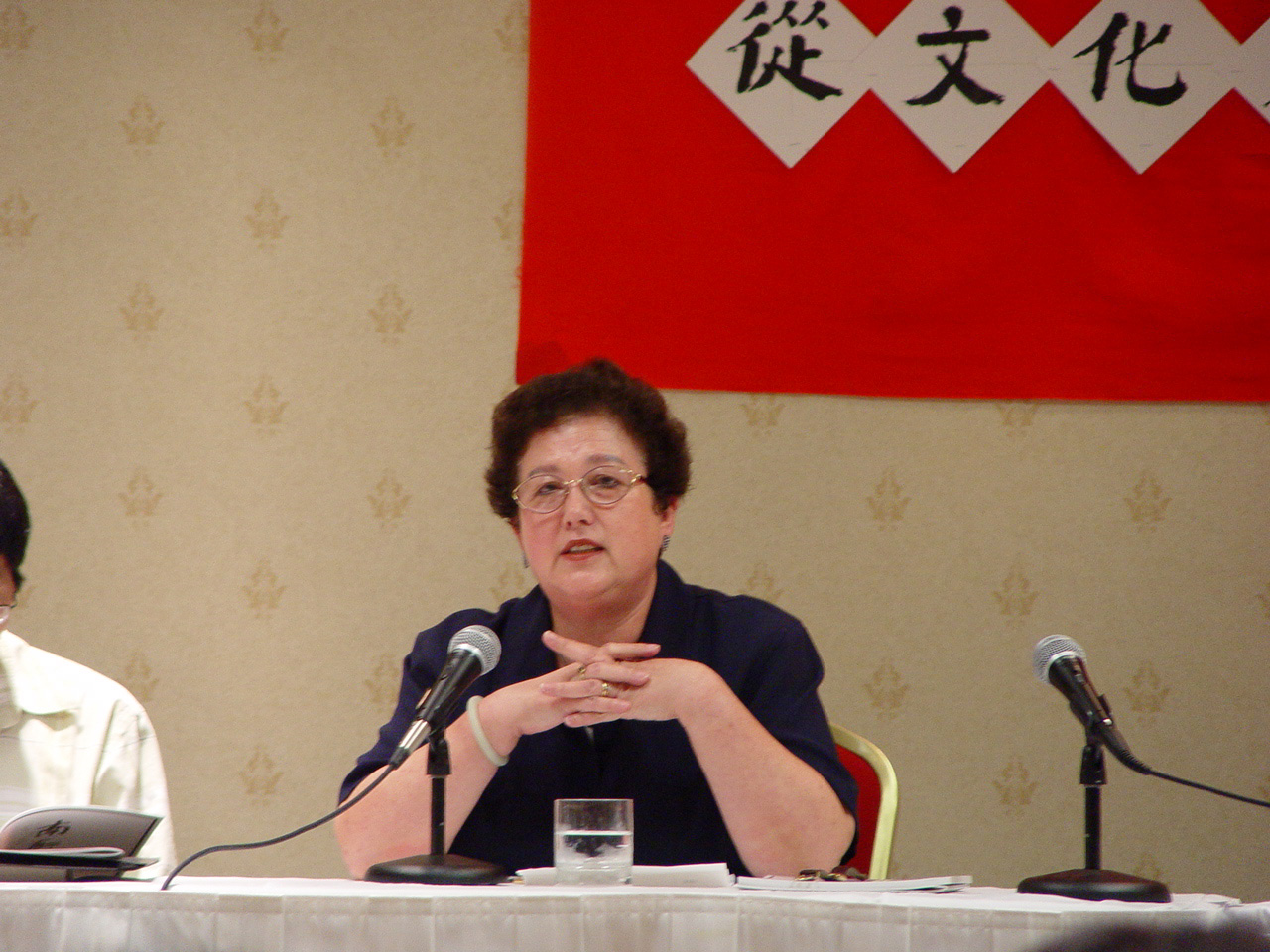
On August 8th, Voice of America (VOA) published an interview with writer Han Xiu. During the interview, she stated that because the Chinese Communist Party (CCP) does not use the official name of the Republic of China (ROC), the ROC continues to exist, and the conflict between the two sides is like a battle between humans and ghosts. She believes that traditional culture has a detoxifying effect when it takes root in one’s heart.
Han Xiu (Teresa Buczacki) is a Chinese-American writer born in Manhattan in 1946. She spent 30 years in China from 1948 to 1978 and faced many hardships before returning to the United States in early 1978. Among the American citizens stranded in mainland China since 1949, Han Xiu was the first to return to the United States.
In the interview, Han Xiu talked about her connection with Taiwan. In the summer of 1982, her American diplomat husband was stationed in Taipei, and at the age of 36, she accompanied him to Taiwan and entered a university to study.
She commemorated an article by Lao She titled “The Lone Figure by the Taiping Lake,” recommended by her teacher Li Chaozong and later serialized in a supplement of the United Daily News. She said, “Kindness, peace, and benevolence towards others embody Taiwan today.”
Han Xiu later worked at the U.S. Embassy in Beijing as the wife of a diplomat, teaching Chinese language and literature to American diplomats. U.S. Marines patrolled day and night to prevent Chinese staff from approaching the classrooms because the content she taught was classified information for American diplomats learning about Chinese language and culture.
At that time, American diplomats began to pay attention to playwright Gao Xingjian, who was suppressed by the CCP.
She recalled her grandmother’s words during the Sino-Japanese War: “We only have one country, which is the Republic of China; we only have one leader, Chairman Chiang.” She said her grandmother’s views on Chiang Kai-shek, the United States, and her father were completely different from CCP propaganda. “I trust my grandmother, not them,” she added.
After coming to Taiwan, Han Xiu visited the National Palace Museum and acquainted with the then-director Qin Xiaoyi. She described Qin Xiaoyi as a very refined and upright Chinese person who showed her special kindness. Qin Xiaoyi shared many tales of the love-hate relationships between the Kuomintang and the CCP. In his opinion, Chiang Kai-shek was a compassionate soldier facing a demon of faith-based violence and countless murders.
During the interview with Voice of America, she recounted a story: General Zhang Lingfu was forced to commit suicide when the CCP army used human shields.
Han Xiu also mentioned that Chiang Kai-shek took 640,000 national treasures when retreating to Taiwan. She believed that it was fortunate to have taken them, as they would have been destroyed during the Cultural Revolution, leaving China with no cultural foundation. She and her husband were among the only foreigners allowed to enter the underground treasure vault of the National Palace Museum in Taiwan.
“But on the other side of the strait, destruction was allowed,” she sorrowfully noted.
Han Xiu emphasized that the CCP did not retain the official name of the Republic of China. However, she believes that because of this mistake by the CCP, the Republic of China continues to exist.
Han Xiu once lived in Kaohsiung, Taiwan, where her husband was the director of the American Institute in Taiwan (AIT) branch.
She expressed that cultural figures who migrated to Taiwan, such as Zhu Xin’ing and Si Ma Zhongyuan, enriched Taiwan’s cultural landscape with Chinese literature, demonstrating that Taiwan’s roots are deeply embedded in traditional Chinese culture.
Han Xiu stressed, “The most important thing is not to reject traditional culture or deem it outdated. It represents thousands of years of Chinese wisdom from which we can learn many things.”
According to Han Xiu, the positive values brought about by traditional culture can counteract and even eliminate many evils. For example, if the simple ethical concept of “filial piety” truly takes root in one’s heart, individuals would refrain from betraying their fathers or striking their mothers, even in extreme environments like the Cultural Revolution. “Many beautiful things, once rooted in our hearts, have a detoxifying effect.”
Han Xiu also believes that integrating both Chinese and Western cultures is the most powerful way to combat authoritarianism. The values and spirit of America, along with the traditional Chinese values of filial piety, are equally vital.
She would like to tell the Chinese people that traditional culture is crucial, as is their role in this world. It is not only about surviving today but also about looking towards tomorrow and seeing what contributions the Chinese people can make to the world.