
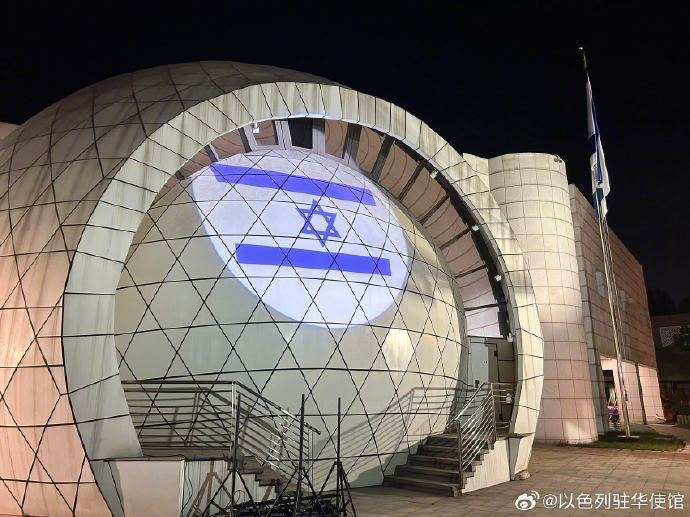
The consulate general of Israel in Chengdu was officially closed recently. Experts believe that the main reasons behind this decision involve political, strategic, and practical interests. The catalyst for this closure was the Hamas attack on Israel, which led to a loss of mutual trust between the two parties due to China’s position. The closure of the consulate reflects a crack in the Israel-China relationship, with only downgraded diplomatic operations currently being maintained.
On August 5th, Gadi Harpaz, the Consul General of Israel in Chengdu, announced the official closure of the consulate through a farewell message on the official WeChat public account.
The consulate general of Israel in Chengdu was established on November 17, 2014, with jurisdiction over Sichuan, Chongqing, Guizhou, and Yunnan.
In his message, Gadi Harpaz looked back on his five-year tenure, reminiscing about the countless wise, sincere, and wonderful friends he had made. He expressed, “Although my work in Chengdu is coming to an end, my appreciation and love for this land and its people will never fade.”
The visa center of the consulate general of Israel in Chengdu announced on June 26 that all consular services would cease on July 15, 2026.
Israeli officials did not provide specific reasons for the closure of the consulate.
The closure comes at a time when tensions between the two countries have escalated due to the situation in the Middle East.
Chen Wenjia, a Taiwan national security strategist and Vice President of Kaohsiung University, told Epoch Times that the closure of the consulate was the result of Israel considering political, strategic, and practical interests.
The first and most direct trigger was the Hamas attack on Israel in 2023, after which China clearly sided with Palestine and did not publicly condemn Hamas. This lack of condemnation greatly displeased Israel, leading to a nearly complete breakdown of political trust between the two.
The second reason is the escalating strategic competition between the U.S. and China. The U.S. has long pressured Israel to limit its cooperation with China in high-tech and dual-use technology fields, prompting Israel to reduce its presence in China.
The third reason is that the consulate general in Chengdu had limited scope for economic and personnel exchanges with the southwestern region of China. In the context of cooling relations, cutting the consulate with low marginal benefits was a practical choice.
Chen Wenjia stated, “This is not simply a diplomatic adjustment, but a concrete manifestation of the cooling bilateral relationship.”
For decades, Israel and China have had a close relationship where Israel provided China with advanced technology in various fields, including defense.
In 2014, the U.S.-China Economic and Security Review Commission reported that Israel was a major supplier of advanced military technologies to China. Tel Aviv supplied the Chinese navy with target interception and fire control equipment, cruise missiles, radar systems, airborne radars, optical and telecommunication equipment, drones, flight simulators, and tank thermal sights. Israel also assisted China in the development of surface-to-air missiles.
Trade between the two countries has also expanded continuously, with 2018 being a record year for Chinese investments in Israel. However, in 2019, as tensions between the U.S. and China intensified, Israel reduced its cooperation with China, especially in infrastructure and technology.
In October 2023, the extremist organization Hamas launched a terrorist attack on Israel, marking a significant turning point in bilateral relations. The attack resulted in approximately 1,200 deaths and over 250 abductions. China has consistently refused to condemn Hamas and instead criticized Israel, leading to a sharp deterioration in China-Israel relations.
A survey conducted by the Institute for National Security Studies (INSS) in Tel Aviv in April 2024 showed that more than half of Israeli respondents believed that China was hostile or unfriendly.
Shen Mingshi, a researcher at the Taiwan Institute for National Defense Security, told Epoch Times that the closure of the consulate general in Chengdu indicates that the relationship between Israel and China has developed cracks or even ruptured.
He analyzed that the apparent reason for Israel closing the consulate should be an adjustment of external resources, such as closing consulates that may have had limited effectiveness. However, the actual situation with the Chengdu consulate is related to the changing landscape of Israel-China relations.
Shen Mingshi said that since the conflict between Israel and Hamas, China has been trying to woo Arab countries diplomatically. China has also criticized Israel’s military actions at United Nations meetings, which Israel could not accept. Additionally, it is believed that the Chengdu consulate felt pressure from Chinese nationalism when discussing the Middle East situation on social media platforms. In the development of China’s so-called Great Western region, the western provinces and cities are not major trading partners, and Israel has limited trade opportunities there.
Chen Wenjia stated that the Israel-China relationship is transitioning from a period of cooperation to strategic distancing, with both sides downgrading diplomatic operations.
“In the past, Israel and China quietly cooperated in areas such as technology, defense, and agriculture, but now, due to intense geopolitical pressures, especially from the U.S., Israel cannot maintain the same level of balance. In the future, the two countries will maintain limited economic and trade ties, shrinking security cooperation, and lower political trust. Economic and trade relations will continue but with more caution, while sensitive technological cooperation will be largely restricted,” he said.