
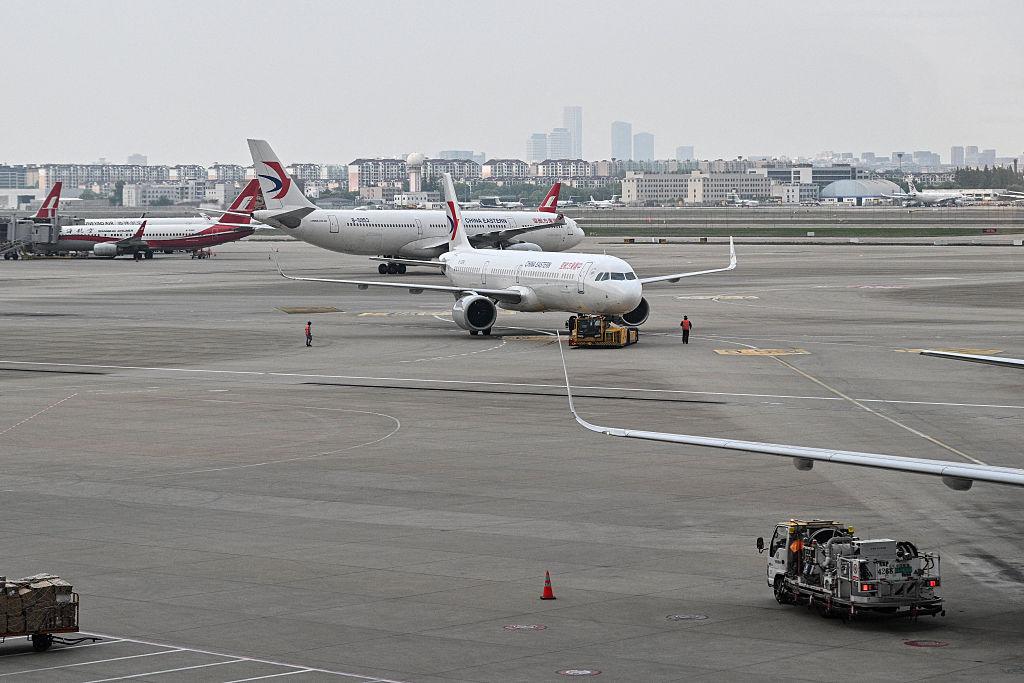
In July, the passenger transportation volume of civil aviation in mainland China is expected to reach a historic high, while the average ticket price for domestic economy class has dropped to 834.7 yuan, hitting a new low for July in recent years post-pandemic. Several airlines have mentioned that during the first week of the summer travel season, they mostly operated at a loss, with this year’s revenue falling below expectations.
According to a report by “First Financial” on August 1st, the aviation data agency “Flight Manager” estimated that the passenger transportation volume of civil aviation in mainland China in July was approximately 74.476 million, an increase of 3.7% year-on-year, reaching a historical high for the same period.
During the same period, civil aviation executed an average of over 17,100 passenger flights per day, a 1.3% increase year-on-year; domestic and regional flights increased by 1.3%, while international flights decreased by 1.5%.
However, in July, the average ticket price for domestic economy class was only 834.7 yuan, including fuel surcharges, a decrease of 0.7% year-on-year, which is 7.1% lower compared to the same period in 2019 before the pandemic.
Among the top 20 domestic flight routes in terms of passenger traffic, only 3 routes have an average ticket price exceeding 1000 yuan; 16 routes have seen a year-on-year decrease in ticket prices, with 8 routes experiencing a decrease of over 10%.
The decrease in airfares has sparked discussions among netizens. Some have remarked, “This is really cheap,” expressing their desire to travel while prices are low. Some passengers have also shared experiences of purchasing tickets in advance, only to find that prices dropped significantly just before departure, such as a 1000 yuan price drop for a return ticket from Urumqi and about a 200 yuan reduction for a ticket from Shenzhen to Chengdu.
Multiple airlines have indicated that the summer travel season began later this year, with most of the first week operating at a loss. It was not until mid-July that passenger flow and ticket prices started to recover. Some airlines have labeled this year’s summer travel season as the cheapest post-pandemic period for air tickets.
Earlier, the “21st Century Economic News” reported that Yang Han, a researcher at Qunar Big Data Research Institute, stated that primary and secondary schools in many regions did not start their summer vacation until around July 10th, causing airlines to start operating additional flights earlier in July for the summer season. This led to an abundant supply of flights and dispersed passenger flow in early July, consequently lowering ticket prices.
Moreover, some airlines believe that this year, passengers are more price-sensitive. A marketing executive of an airline mentioned that any increase in ticket prices results in a significant change in passenger load, with some passengers possibly choosing high-speed rail or self-driving as alternatives.
Parash Jain, the Global Transportation and Logistics Research Director at HSBC, mentioned to Reuters on July 17th that the “negative wealth effect” arising from China’s economic slowdown is altering consumer behavior, with potential ticket price hikes suppressing demand and encouraging short-haul travelers to switch to high-speed rail.
Airlines are concurrently facing rising aviation fuel costs. In July, the ex-factory price of aviation kerosene in mainland China was 8030 yuan per ton, representing an increase of around 50% compared to the same period last year.
Starting from August 5th, the fuel surcharge for domestic flights in mainland China will be reduced once again. “First Financial” reported that even with the adjusted fuel surcharge, it still cannot fully cover the increase in aviation fuel costs.