
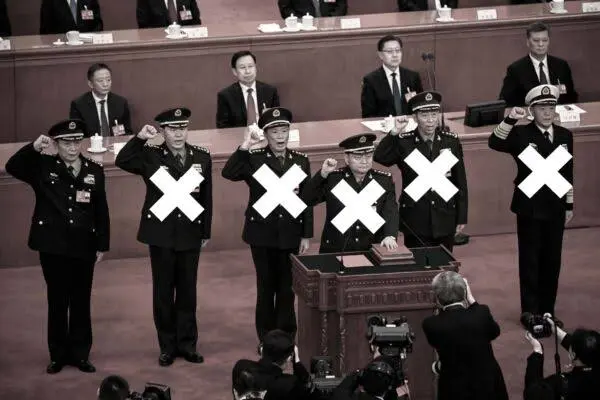
On July 30th, the Chinese Communist Party Politburo decided to convene the Fifth Plenary Session of the Twentieth Central Committee in October, with the theme of “strictly governing the Party.” Many commentators believe that Xi Jinping may finalize the cases of Zhang Yuxia and Liu Zhenli before the Fifth Plenary Session.
On January 24th, a spokesperson for the Chinese Ministry of National Defense announced that Zhang Yuxia, a member of the Political Bureau of the Communist Party and Vice Chairman of the Central Military Commission, and Liu Zhenli, a member of the Central Military Commission and Chief of Staff of the Joint Staff Department, were suspected of serious violations of discipline and law and were being investigated.
The day after Zhang and Liu were formally investigated, the Chinese military newspaper published an editorial accusing them of five serious crimes: “seriously betraying the trust and responsibility of the Party Central Committee and the Central Military Commission, seriously violating and sabotaging the system of the Chairman of the Military Commission, seriously exacerbating the political and corrupt problems that harm the absolute leadership of the Party over the military, undermining the image and credibility of the military leadership, seriously affecting the political foundation of military unity and progress, causing great destruction to the political construction, political ecology, and combat readiness of the military, and having an extremely negative impact on the Party, the state, and the military.”
Over six months have passed, and the investigation into the cases of Zhang and Liu remains shrouded in secrecy. Their positions remain unchanged, and even their status as National People’s Congress deputies has not been revoked. While there have been various rumors and leaks overseas regarding the cases of Zhang and Liu, the Chinese official authorities have not confirmed any of them.
So, what exactly did Zhang Yuxia do wrong?
Based on relevant reports from domestic and international sources and my observations of infighting within the top echelons of the Chinese Communist Party, I will share my perspectives.
On January 25th, the U.S. “Wall Street Journal” published an article alleging that China’s top military leader, Zhang Yuxia, was accused of leaking nuclear secrets to the United States. The report claimed that on January 24th, some of the highest-ranking Chinese military officials attended a closed-door briefing.
According to sources, the most shocking accusation revealed at the closed-door briefing was that Zhang Yuxia had leaked core technical data of China’s nuclear weapons to the U.S., including missile guidance system parameters and key technology for miniaturizing nuclear warheads. Some evidence came from Gu Jun, former Deputy Party Secretary and General Manager of China National Nuclear Corporation, which oversees both civilian and military nuclear programs. Gu Jun was officially removed from his position on January 19th.
After Zhang Yuxia was formally investigated on January 24th, the “Wall Street Journal” report on why Zhang Yuxia was removed from office was published on January 25th. Obviously, this was a deliberate leak authorized by the party aiming to bring down Zhang Yuxia.
This leak follows a common practice in the Chinese Communist Party’s history of denouncing fallen high-ranking officials as “colluding with foreign powers.” Throughout the history of the CCP, figures like Xi Jinping’s father Xi Zhongxun, Marshal of the Party Peng Dehuai, Chief of the General Staff of the PLA Su Yu, and General Secretary of the Central Committee Zhao Ziyang have all faced similar accusations. The facts have shown that these kinds of accusations are often unfounded.
The allegation of Zhang Yuxia leaking secrets immediately raised widespread doubts. Han Lianchao, a former Chinese Foreign Ministry official, pointed out that “the severity of the accusation does not match the level of official notification. Another suspicious aspect is that, as the head of the Central Military Commission, Zhang Yuxia is privy to the most confidential information in the military, including the nuclear retaliation command flow, far exceeding the classified information known to Gu Jun of the nuclear industry group. Even if there was leakage, there is no reason for him to ask Gu Jun for it. Even if there was a breach of ‘nuclear secrets,’ a catastrophic event that leads to the destruction of the party and the country, the CCP’s handling would undoubtedly go down the same path as the Lin Biao incident in 1973. However, obviously, this approach has not been taken.”
Veteran journalist Yui Ita explained, “From the perspective of news generation, this report in the ‘Wall Street Journal’ appears to be a typical case of ‘export for domestic consumption.’ Using foreign media to release information and shape the narrative is a common tactic employed by the CCP to manipulate public opinion. The focus is not on whether a particular report is true or false, but rather if it serves a certain political need. Therefore, this is not just about the characterization of Zhang Yuxia but also a carefully designed propaganda narrative.”
Others have commented, “In fact, whether it’s ordinary overseas individuals, American think tanks, or experts from other countries, they all find this story unbelievable. With Zhang Yuxia’s background as a ‘second-generation red’ and his high position, how would you motivate him to betray nuclear secrets? It’s completely meaningless and absurd.”
Zhang Yuxia, a second-generation red and the first general of the Chinese Army, holding high positions in the Central Military Commission and bestowed with wealth and power, why would he betray his country by selling nuclear secrets? The accusation is incredibly ludicrous.
On July 16th, Taiwanese independent commentator Cai Shengkun revealed that he had recently received information indicating that Zhang Yuxia initially refused to admit to the charges brought against him by the authorities, still not admitting guilt or cooperating. However, when the investigators threatened to involve his son in the investigation, Zhang Yuxia eventually changed his stance.
“It is said that Zhang Yuxia has admitted to attempting to launch a coup, pressuring Xi Jinping to relinquish power, and a series of other issues.” “Zhang Yuxia has clearly acknowledged that there was a plan to force Xi Jinping to abdicate,” and he has received support from senior CCP figures, “including Wang Qishan, Zeng Qinghong, and some elderly comrades within the party.”
However, Cai Shengkun stated that he could not verify the authenticity of the information and was only relaying the leaked information.
Regarding this leak, I believe the likelihood is slim.
If Zhang Yuxia truly wanted to stage a coup, Xi Jinping would have likely been already imprisoned. As the First Vice Chairman of the Central Military Commission with 58 years of military experience, Zhang Yuxia could have easily overpowered Xi Jinping.
It is because Zhang Yuxia did not intend to overthrow Xi Jinping that he has become a target for Xi to eliminate.
The power struggle between Xi and Zhang began shortly after the conclusion of the 20th National Congress of the Chinese Communist Party in 2023. Following the eruption of the Rocket Army scandal in 2023, Xi Jinping, with the strong support of his close confidants in the military – Central Political Bureau member and Vice Chairman of the Central Military Commission He Weidong and Central Military Commission member and Director of the Political Work Department Miao Hua – began the process of using anti-corruption campaigns to remove Zhang Yuxia.
After a group of senior officials closely associated with Zhang Yuxia, including Central Military Commission member, State Council member, and Minister of National Defense Li Shangfu, were detained, Xi secretly started investigating Zhang Yuxia’s issues in March 2023.
With Zhang Yuxia’s close associates, including Central Military Commission members, State Council members, and Defense Minister Li Shangfu among others, being taken down, Xi initiated the investigation into Zhang’s case through his allies and senior military officials.
Zhang Yuxia was cornered by Xi, He, and Miao, who served as his political support during the 58 years of his military career. If Zhang Yuxia had wanted to overthrow Xi, who was in command of the Central Military Commission, it would have been a walk in the park.
Because Zhang Yuxia had no intention of toppling Xi, he found himself in the crosshairs of Xi’s attacks. Xi’s sudden assault on Zhang, after the 20th Central Committee, could be attributed to Zhang’s forceful counterattacks against Xi, driven by self-preservation and not a desire to oust Xi.
At the time, Zhang Yuxia’s real thoughts likely revolved around retiring by the time of the 21st National Congress of the CCP in 2027, and he probably hoped for Xi’s dignified exit after completing his ‘triple tenure.’ However, Xi’s aspirations clashed with Zhang’s desires, as Xi aimed for a ‘quadruple tenure’ or even a lifetime presidency.
Following the 4th Plenary Session in October 2025, rumors of Xi possibly relinquishing or partially relinquishing power began to circulate. However, during the session, Xi retained all three of his top positions – General Secretary of the Central Committee, President of the country, and Chairman of the Central Military Commission.
This indicates that Zhang Yuxia had no intention of toppling Xi. His actions were likely driven by self-preservation and a robust pushback against Xi’s domineering behavior, rather than a bid to overthrow Xi.
After Xi fell ill and was hospitalized in July 2024, Zhang Yuxia saw it as an opportunity to mount a counterattack. Supported by some CCP elders, red descendants, and senior generals, Zhang Yuxia became a crucial figure in influencing CCP politics. He made two significant moves: forcing Xi to investigate Miao Hua in November 2024 and He Weidong in March 2025.
Following the downfall of He and Miao and a batch of senior generals associated with them, who were part of Xi’s inner circle, Zhang Yuxia faced a considerable backlash. The simultaneous downfall of these senior generals dealt a significant blow to Xi.
Not long after the 4th Plenary Session, rumors began to swirl that Xi might relinquish or partially relinquish his power. However, the reality was that Xi retained all his three supreme positions, marking more than two months since the session ended.
It suggests that Zhang Yuxia had no intentions of taking down Xi. His focus was likely on his self-preservation and implementing a robust counterattack against Xi’s overbearing tactics without aiming to push Xi out of power.
Xi and Zhang’s power struggle began shortly after the 20th National Congress. One notable incident occurred in 2023, the Rocket Army scandal erupted, and Xi, backed by his trusted political allies He Weidong and Miao Hua, began the process of toppling Zhang Yuxia under the guise of an anti-corruption campaign.
Zhang Yuxia’s close confidants, such as Li Shangfu, a Central Military Commission member and Defense Minister, and a group of generals ranging from high-ranking officials to generals and colonels, were taken down. They were all carefully selected and promoted by Xi, contributing to a severe blow to Xi’s authority.
By late 2025, Zhang Yuxia had amassed considerable evidence against Miao Hua, Xi’s second-ranking officer in the military hierarchy. This included revelations of extensive corruption involving high-ranking officials, showcasing a web of bribery and deceit that reached the upper echelons of the military.
The authenticity of these claims was unverifiable, but monitoring personnel changes within the Chinese military indicates a systemic purge among senior officers. From the 20th Party Congress to the present, at least 46 generals have faced repercussions, a highly irregular situation within the history of the Chinese military and worldwide military history.
This indicates that the senior officers promoted through Miao Hua’s influence may have engaged in corrupt practices, including bribery. The downfall of Miao Hua and individuals like He Weidong could have exposed a deep-seated network of corruption within the military establishment.
Several other high-ranking generals experienced similar fates. Xi’s ambitious plans for prolonged tenure and a potential lifetime appointment prompted him to target Zhang Yuxia as a significant obstacle to his political ambitions.
Xi’s meticulous planning and relentless pursuit of power motivated his sudden attack on Zhang Yuxia and Liu Zhenli at the end of January 2026, using fabricated accusations of undermining the military commission system to eliminate his adversaries.
Xi’s decision to make Zhang Yuxia a scapegoat for his own failings as the Chairman of the Central Military Commission highlights the ruthless tactics employed by Xi to maintain control. Zhang became a sacrificial lamb in Xi’s quest to consolidate power and eliminate dissent.
The significant reputation and affiliations of Zhang Yuxia, differing from his colleagues in the Chinese military, led to his swift downfall. Foreign experts characterized Zhang as a rational and objective military leader, contrasting with the prevailing political climate under Xi.
In conclusion, the accusations levied against Zhang Yuxia were a blatant attempt by Xi Jinping to shift blame and dismantle potential obstacles to his ambition for prolonged power within the Chinese Communist Party. Zhang’s removal was a strategic move by Xi to eliminate dissent and shore up his authority within the party, even if it meant sacrificing a distinguished military leader for political gain.
These events shed light on the deep-seated power struggles and corruption within the Chinese military hierarchy, further exemplifying Xi Jinping’s iron-fisted rule and ruthless tactics to maintain his grip on power.