
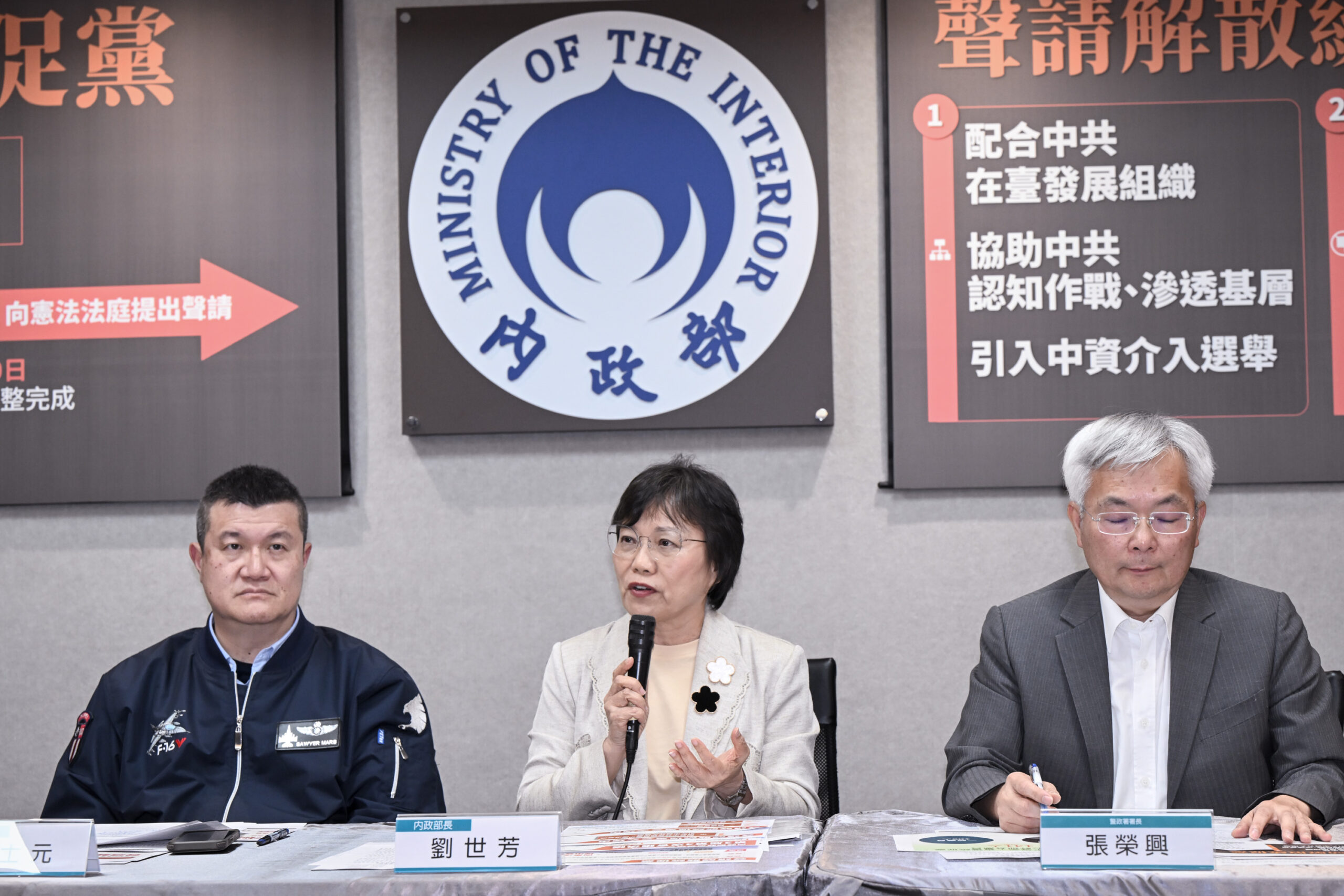
The Ministry of the Interior of the Republic of China (Taiwan) will file an application to the Constitutional Court in early August to declare the Chinese Unity Promotion Party unconstitutional and dissolved. National security personnel stated that the unconstitutional dissolution of a political party is not unprecedented in Taiwan; the Unity Promotion Party has been involved in accepting funds from the Chinese Communist Party, assisting in intelligence gathering on Taiwan, and multiple party members being involved in serious crimes, making dissolution a necessary measure.
The Ministry of the Interior of the Republic of China held a press conference on the “Application for the Unconstitutional Dissolution of the Chinese Unity Promotion Party” on the 30th. Minister Liu Shih-fang stated that several core members of the Chinese Unity Promotion Party have violated the National Security Act, Anti-Infiltration Act, Act Governing Relations between People of the Taiwan Area and the Mainland Area, Presidential and Vice Presidential Election and Recall Act, Public Official Election and Recall Act, Organized Crime Prevention Act, and Criminal Code, endangering national security, social stability, and the fairness of elections. The Ministry of the Interior has collected relevant evidence and will apply to the Constitutional Court for the dissolution of the Chinese Unity Promotion Party.
The Ministry of the Interior pointed out that Article 5 of the “Additional Articles of the Constitution of the Republic of China” explicitly states that the purpose or actions of a political party shall not endanger the existence of the Republic of China or its free and democratic constitutional order. Those in violation shall be considered unconstitutional. According to Article 26 of the Political Parties Act, the competent authority, the Ministry of the Interior, should present relevant evidence to the Constitutional Court of the Judicial Yuan for the dissolution of unconstitutional political parties.
The Ministry of the Interior explained that the case of the unconstitutional dissolution of the Chinese Unity Promotion Party was approved by the Political Parties Review Council on January 2, 2025, and instructions were given to extensively collect evidence. After compiling relevant evidence, the Ministry of the Interior believes that the party’s purpose and actions have endangered the existence of the Republic of China and its free democratic constitutional order.
Firstly, the Unity Promotion Party is implicated in accepting instructions from the Chinese Communist Party, establishing organizations in Taiwan, recruiting mainland Chinese to participate in related activities, facilitating the travel of current and retired military personnel to China, developing a spy network, introducing Chinese capital into elections, assisting candidates with campaign events and bribery, treating voters to trips to the mainland as bribes, instigating protests to disrupt candidate campaigns, and helping the CCP operate radio stations for cognitive warfare and infiltrating civilian groups, temples, and other activities in support of united front work.
Secondly, engaging in cross-border suppression to silence Taiwan’s democratic atmosphere, including incidents such as Denise Ho being splashed with red paint, the bloody incident in National Taiwan University’s “Chinese Singing Contest,” and the violent treatment of Joshua Wong at the airport.
Thirdly, several members of the Unity Promotion Party have been engaged in organized crime for a long time, involving cases brought under the Act Governing Relations between People of the Taiwan Area and the Mainland Area, the National Security Act, and the Anti-Infiltration Act.
In addition, the founder of the Unity Promotion Party, Chang An-le, is the spiritual symbol and chairman as outlined in the party’s constitution. He has openly proclaimed himself as a “fellow traveller of the Chinese Communist Party” and declared the establishment of a “red team” to promote CCP ideology.
The Ministry of the Interior emphasized that the constitution guarantees the people’s freedom to organize political parties, but the organization and operation of political parties should abide by the constitution and laws to uphold the free and democratic constitutional order. As the competent authority of political parties, the Ministry of the Interior must take necessary democratic defense mechanisms to safeguard the existence of the Republic of China against political parties that endanger the free and democratic constitutional order.
Finally, the Ministry of the Interior urged that political parties engaging in political activities should comply with the constitution, the Political Parties Act, and relevant laws and regulations, avoid accepting instructions, commission, or funding from foreign hostile forces, engage in organizational activities that harm the Republic of China, and work together to uphold Taiwan’s freedom and democracy and promote the healthy development of party politics.
According to a report from the Central News Agency, national security experts pointed out that the dissolution of a political party due to violent crimes being found unconstitutional is not unique to Taiwan. Many democratic countries worldwide have dissolved parties deemed to be threats to the constitutional order through judicial means. Upon closer examination of the behaviors of these dissolved parties in other countries and comparing them with the Unity Promotion Party, the necessity of dissolution becomes apparent.
Using the example of the Basque political party Batasuna as an example, international observers have viewed it as the political wing of the Basque terrorist organization ETA, frequently inciting security incidents and social terror, even attempting to harm constitutional police officers, military officers, and government officials. Successive Spanish governments have considered this party a prime security concern, and the Supreme Court eventually ordered its dissolution, officially terminating all activities in 2013.
National security experts pointed out that the ruling of the South Korean Constitutional Court stated that the real purpose and intentions of the Unified Progressive Party were in line with North Korea’s strategy towards South Korea, aiming to subvert South Korea’s existing freedoms and democratic system, even attempting to amend the South Korean constitution, thus violating the fundamental order of democratic countries’ political parties, leading to its dissolution.
Analyzing the court rulings on the dissolution of political parties in various countries, national security experts stated that the core basis for dissolution is to “endanger national security” and “undermine the democratic system,” rather than simply being due to political positions conflicting with the government. The case of South Korea’s Unified Progressive Party involved secret meeting recordings and evidence of concrete plans to damage infrastructure, while the case of Spain’s Batasuna involved long-term overlaps in funding and personnel with a terrorist organization.
National security experts observed that the Unity Promotion Party has long been undermining Taiwan’s democracy and rule of law, assisting the CCP in absorbing retired military personnel, infiltrating temples, and endangering national security. From cadres to associates, many individuals and cases have been convicted. The Ministry of the Interior’s application to the Constitutional Court for the dissolution of the Unity Promotion Party is a necessary step to reassure the public.
In conclusion, the Ministry of the Interior called on political parties to fully comply with the constitution, the Political Parties Act, and relevant laws and regulations, refrain from accepting instructions, commission, or funding from foreign hostile forces, engaging in organizational activities that endanger the Republic of China, and work together to uphold Taiwan’s freedom and democracy for the sound development of party politics.