
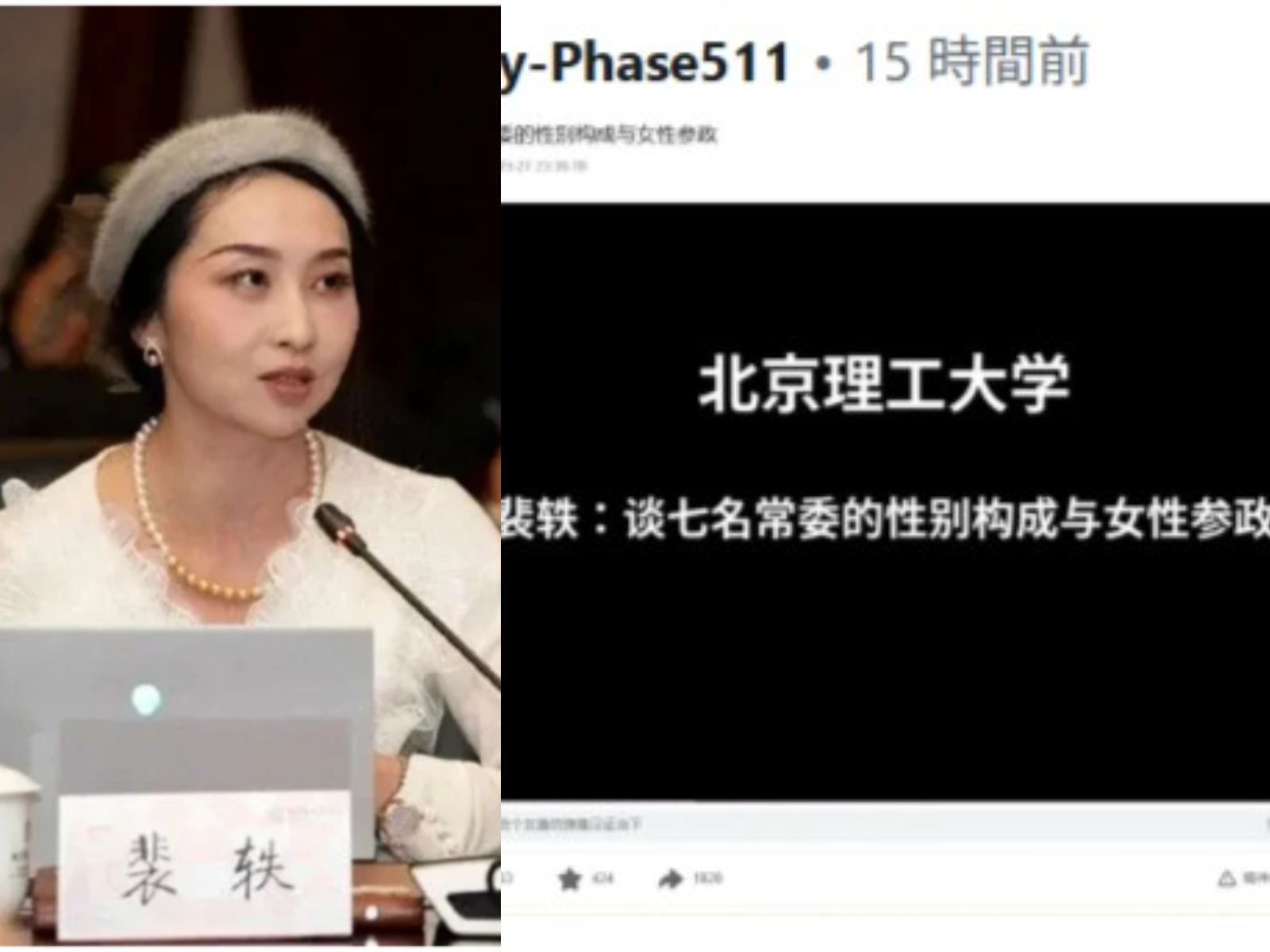
【Epoch Times October 1, 2026】 – Beijing Institute of Technology announced on September 29 that Assistant Professor Pei Yi from the Law School of the university has been officially dismissed for promoting “extreme feminism” and other behaviors. The news quickly spread on social media platforms with related keywords such as “Assistant Professor Pei from Beijing Institute of Technology Dismissed,” sparking heated discussions both domestically and internationally.
Beijing Institute of Technology is one of the “Seven Sons of National Defense” universities in China. According to the announcement from the institute, Pei was found to have “seriously violated the professional ethics and code of conduct for teachers,” leading to the decision to revoke her qualifications as a graduate supervisor, terminate her teaching position, and dismiss her from employment.
However, the announcement did not specify the exact reasons for the severe punishment, leading to widespread speculation in the public. Reports indicated that Pei Yi had offered an elective course titled “Protection of Women’s Rights in the Digital Age” this semester. In the course enrollment notification, she advised students that the course may be “controversial” and suggested that students who are only seeking credits or causing trouble should drop the course early.
Some students and netizens misinterpreted this statement based on the popular internet meme “People can eat chocolate without consequence, but dogs can die from eating chocolate,” arguing that Pei Yi implied that those who could accept her course were “people,” while the ones who couldn’t were “dogs,” questioning her for potentially insulting males. This later escalated when netizens uncovered Pei’s past social media posts supporting the idea of “men being inferior,” fueling further public outrage.
In response, Pei Yi clarified that she was referencing the famous movie quote “Life is like a box of chocolates” from “Forrest Gump” and not using the internet meme in a derogatory manner. However, her explanation did not quell the online criticism from some netizens, leading to the suspension of her course by the university.
As the story unfolded, a leaked video and screenshots from Pei Yi’s class indicated that the controversy over her remarks may have just been a surface trigger, with the underlying cause potentially lying in her discussion of women’s participation in politics at high levels, challenging a political taboo within the Chinese Communist Party’s highest echelons of power.
The video showed Pei Yi discussing the topic of “increasing women’s participation in politics, and implementing women’s political rights” in class, bluntly stating, “Without political rights, it’s all just empty talk, everyone.” She then asked her students, “Among the seven Standing Committee members, how many should be women?” Students answered with “three” or “four,” to which Pei Yi countered, “Why can’t it be seven?”
She cited the perspective of the late U.S. Supreme Court Justice Ginsburg, who once remarked that all nine Supreme Court Justices should be women. When questioned about being too extreme, Pei Yi challenged by pointing out that when there were nine male justices, nobody found it extreme, questioning why it would be extreme for all justices to be female.
Through these discussions, Pei Yi aimed to prompt her students to reflect on the fact that if all seven Standing Committee members were men, wouldn’t that also be considered extreme? She emphasized that “if we truly seek equality, it should be based on merit, not just promoting individuals based on gender,” further delving into the negative impact of childbirth on women’s career advancement and political progression.
A screenshot circulating online from her class presentation displayed the title of the PowerPoint presentation as: “Pei Yi: Discussing the Gender Composition of the Seven Standing Committee Members and Women’s Political Participation.”
On September 26, a report letter regarding Pei Yi circulated on social media, not only complaining about her remarks but also categorizing her support for the “MeToo movement” and advocacy for feminism as “improper political discourse,” urging relevant authorities to investigate whether Pei Yi was suspected of “endangering the state ideology security.”
The exposure of this report letter led many netizens to question whether Pei Yi’s dismissal was truly due to issues of “professional ethics” or “insulting men,” or rather her discussions about the “Seven Standing Committee Members,” crossing political red lines set by the Chinese Communist Party and Xi Jinping. Some netizens even opined that “if national security didn’t intervene, Beijing Institute of Technology wouldn’t have acted so swiftly.”
In response to the incident, some expressed deep concerns regarding the current academic and freedom of speech environment in universities through lengthy online articles. They emphasized that if such issues cannot be discussed in university classrooms, the real question shouldn’t be about whether Pei Yi was truly advocating for “feminism.” It should be about what topics can be discussed, who determines them, based on what criteria, and where the boundaries lie. These writers straightforwardly conveyed that having a wrong viewpoint in a lecture isn’t dreadful, but rather the fear that everyone knows what is “correct” without questioning the “why.”
They highlighted that universities should teach individuals not to never speak incorrectly, but that when they do, they can be debated and corrected. Different viewpoints should be open to debate, sharp issues to research – that is what universities should embody, according to their interpretation.
The article concluded with a lament, expressing hope that the fire ignited at Beijing Institute of Technology wouldn’t end with just one teacher. It suggested reflecting on whether universities are protecting professional ethics or dictating boundaries. It further hinted at the idea of universities not merely advising students not to touch the “tiger’s butt,” but encouraging them to ask, “Why can’t we touch it?” – this, perhaps, epitomizes what a university should represent.
Public records indicate that the “Seven Sons of National Defense” refer to seven key military-industrial technical universities directly under the former Chinese Communist Party National Defense Science, Technology, and Industry Commission (now under the Ministry of Industry and Information Technology). These seven universities, including Beijing University of Aeronautics and Astronautics, Beijing Institute of Technology, Nanjing University of Science and Technology, Nanjing University of Aeronautics and Astronautics, Northwestern Polytechnical University, Harbin Institute of Technology, and Harbin Engineering University, are currently included in the U.S. Commerce Department’s “Entity List” due to their strong national defense research backgrounds.