
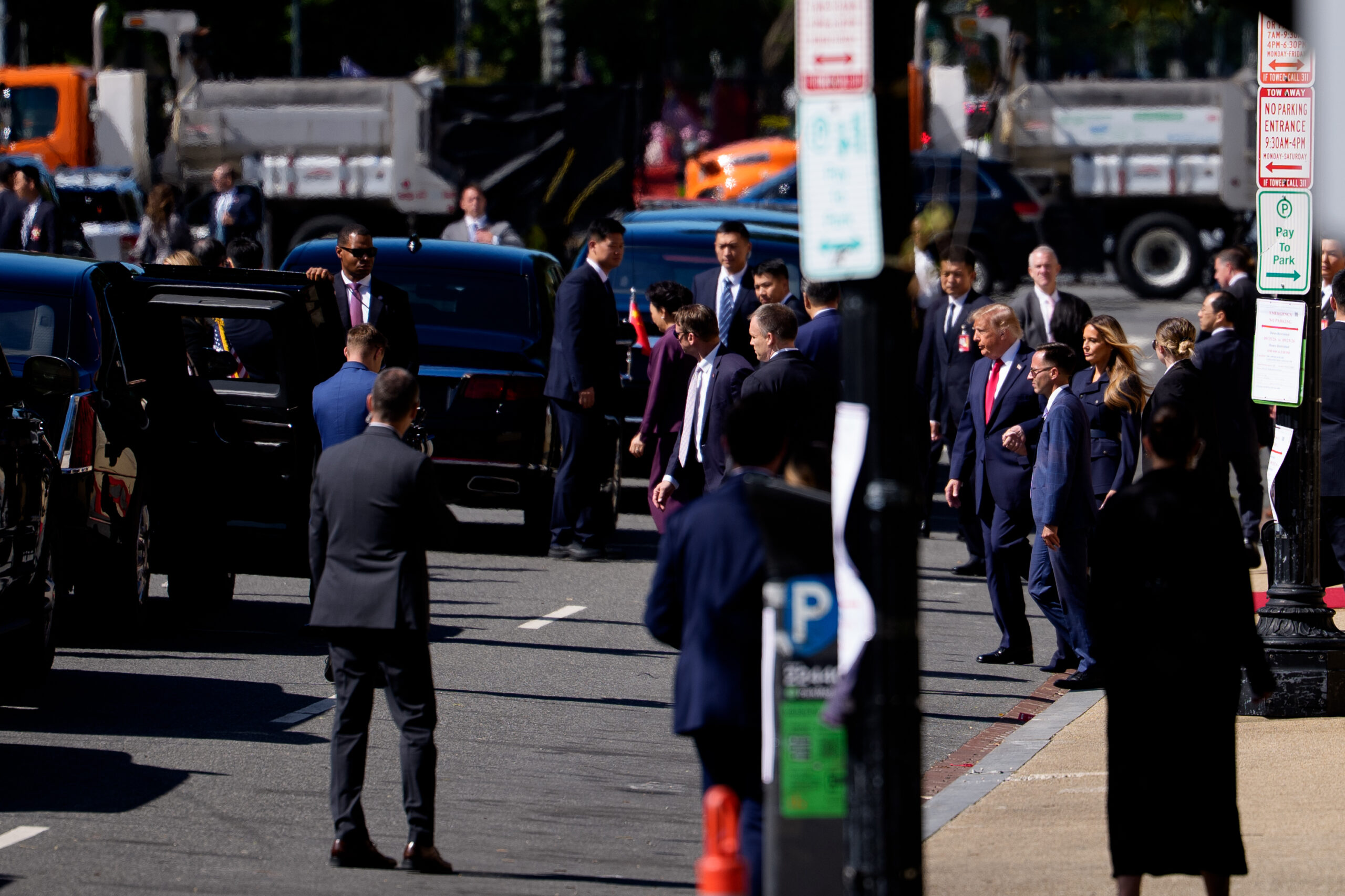
During his recent visit to the United States, Chinese Communist Party leader Xi Jinping was seen tightly holding hands with his wife, Peng Liyuan, on multiple occasions. Peng has been jokingly referred to as Xi’s “crutch.” There have been speculations about Xi’s health condition, as he has shown a strong reliance on Peng’s connections. According to former CIA officials, Xi’s reliance on Peng goes beyond mere etiquette, as Peng has extensive networks within the military, which Xi heavily relies on for resources.
Xi Jinping and Peng Liyuan visited Washington, D.C. in late September. On various occasions, including when boarding and disembarking the plane, as well as when climbing the steps of the National Archives, Xi was seen tightly holding Peng’s hand. Overseas media and internet users have dubbed Peng as Xi’s “human crutch,” sparking speculations about Xi’s health and the power dynamics in the Chinese leadership. The Chinese state media, however, deleted all images of Xi holding his wife’s hand.
The Wall Street Journal reported on September 29 that Dennis Wilder, a former senior China analyst at the CIA, stated that Peng Liyuan’s role extends beyond being the First Lady. She holds deep networks within the Chinese military, and Xi Jinping heavily relies on her network resources.
Public information reveals that Peng Liyuan holds a civilian official rank equivalent to that of a major general. In 2012, she was appointed as the Dean of the Academy of Arts of the People’s Liberation Army, holding a senior military rank among the top artistic talents in the military. During the 2017 military reforms, the academy was merged into the National Defense University.
Wilder pointed out that Peng Liyuan’s actual work is part of the military officer evaluation system, responsible for reviewing the management layer of the Chinese military. Before Xi Jinping came to power, Peng Liyuan, who is nine years younger than him, traveled with a performance troupe to various military regions for many years, attending banquets and befriending senior military officials. In other words, she has a “map” of who is loyal and who is disloyal.
Legal expert Yuan Hongbing, residing in Australia, disclosed on February 23 that Xi Jinping has long been running a “husband-wife shop” within the military. Peng Liyuan holds a significant title as a full-time member of the Central Military Commission’s Cadre Inspection Committee. Prior to the fall of high-ranking officers in the Chinese military, her opinion was extensively sought for promotions. This practice has sparked strong dissatisfaction among military leaders.
In early May 2024, a photo circulated on social media showed Peng Liyuan in military uniform with the insignia of a major general, with the caption indicating her role as a full-time member of the Central Military Commission’s Cadre Inspection Committee, conducting research on talent development at a military school.
After Xi Jinping took office, he reformed the military by consolidating the seven military regions into five theater commands and transferring the authority for officer promotions to the Political Work Department of the Central Military Commission. The Central Military Commission’s Cadre Inspection Committee was established in 2016, responsible for overseeing military promotions. Peng Liyuan served as a full-time member, participating in personnel decisions within the military. At that time, the aforementioned photo raised speculations about Peng Liyuan secretly wielding military power and even preparing to succeed Xi Jinping.
Moderate military figure Zhang Yuxia was seen as an obstacle to Peng Liyuan’s purported influence over military affairs.
Independent commentator Du Zheng previously analyzed in the “Shang Bao” that Zhang Yuxia had a serious conflict with Vice Chairman of the Military Commission He Weidong and the Director of the Political Work Department of the Military Commission, Miao Hua. He Weidong and Miao Hua were seen as closely aligned with Peng Liyuan, serving as her operatives in military personnel matters.
On October 17, 2025, the Chinese Communist Party officially announced the expulsion of nine senior officers, including Vice Chairman of the Central Military Commission Cadre Inspection Committee, He Hongjun, due to severe violations of discipline and law. He Hongjun was viewed as the specific executor of personnel matters within Peng Liyuan’s system.
After the downfall of Miao Hua and He Hongjun, the Military Commission’s Political Work Department, which oversaw personnel matters, underwent restructuring. Rumors circulated online that Peng Liyuan had to temporarily step back from military personnel-related affairs at that time.
Yuan Hongbing previously revealed that shortly after He Weidong and Miao Hua were removed from their positions, powerful military leader Zhang Yuxia openly criticized the Military Commission for serious errors in appointing senior military officers during the expanded conference. Zhang’s actions were seen as a direct challenge to Xi Jinping’s supreme authority over military appointments.
Du Zheng stated that with Peng Liyuan’s covert support, Xi Jinping, with the help of Zhang Shengmin, the secretary of the Military Commission’s Discipline Inspection Commission, managed to secure the removal of Zhang Yuxia and his ally Liu Zhenli in late January 2026.
Following the downfall of Zhang Yuxia and Liu Zhenli, there were intensive personnel changes within the military, with key officials being replaced in the Beijing Garrison, Shanghai Garrison, and the General Command of the Tianjin Armed Police.
Wilder told the Wall Street Journal that Peng Liyuan is the most influential woman in China since Jiang Qing.
Peng Liyuan has been occasionally rumored to have aspirations for political power, drawing comparisons to Jiang Qing, Mao Zedong’s wife, and was once speculated to enter the Politburo.
Independent commentator Cai Shenkun previously analyzed that while there are no immediate signs of Peng Liyuan entering the Politburo and taking on important roles, as a native of Shandong, Peng Liyuan may already have recommendation privileges in personnel matters, given the appointments and promotions of many Shandong officials. While privately visiting and researching, Peng Liyuan has been contacting and evaluating officials. Shandong-affiliated officials are known for their loyalty to the top echelons of the Communist Party.
Dong Jun, a Shandong native, was appointed as the Minister of National Defense after the ousting of former Defense Minister Li Shangfu. It was rumored that Dong Jun, who was promoted three ranks in three years during the beginning of Xi Jinping’s administration, benefited from his connection to Peng Liyuan, also a Shandong native.
Du Zheng analyzed that amidst deepening crises both nationally and internationally, Xi Jinping aims to ensure that he is not held accountable after stepping down or even in the event of his death during his term. He may have secretly identified a successor, and the possibility of Peng Liyuan succeeding him cannot be ruled out. If Peng Liyuan assumes power in the future, the main threat would stem from Xi’s loyalists.
Yuan Hongbing, a scholar in Australia, believes that it is unlikely for Peng Liyuan to take a prominent public role, but she indeed holds significant influence over military personnel matters under Xi Jinping.