
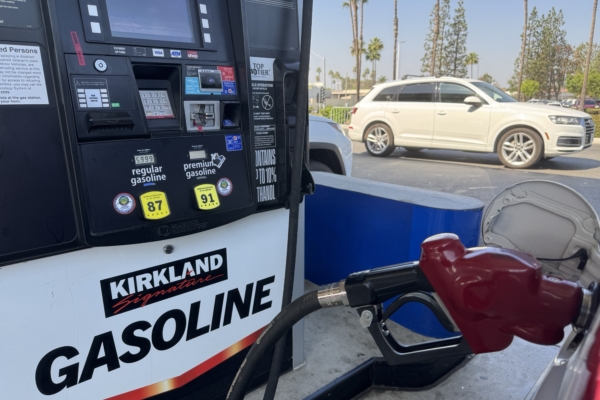
The continuous rise in oil prices in the United States has led to an average of $6.4 per gallon for regular gasoline in California, making it the highest in the country. Experts from the authoritative U.S. consumer magazine “Consumer Reports” recently shared some fuel-saving tips that may help car owners save hundreds of dollars annually.
According to Stef Schrader, an automotive journalist at “Consumer Reports” with over 10 years of experience in car testing, adjusting some simple daily driving habits can effectively reduce fuel consumption, such as reducing speed, smooth acceleration and deceleration, minimizing cargo load, and maintaining proper tire pressure, allowing each gallon of gasoline to go further. Here are some of her fuel-saving tips.
Many drivers have a habit of speeding, even exceeding the speed limit. Schrader pointed out that reducing speed can effectively save fuel consumption.
Testing by “Consumer Reports” found that increasing speed from 55 miles per hour to 75 miles per hour results in a significant difference in miles per gallon, equivalent to switching a small sedan to a large SUV.
While driving at 55 miles per hour on the highway may seem slow, reducing speed by just 10 miles can add an extra 8 miles per gallon. For a car that can run 35 miles per gallon and at $4 per gallon of gasoline, driving at a lower speed could save about $400 annually.
Schrader discovered that the deeper you press the accelerator, the more fuel the engine consumes.
Rapidly pressing the accelerator increases the burden on the engine and transmission. Therefore, when starting and accelerating, avoid pressing the accelerator too hard and try to accelerate slowly to maintain a steady speed.
Sudden hard braking after acceleration wastes the fuel consumed during acceleration.
Testing by “Consumer Reports” found that aggressive acceleration and hard braking can reduce fuel efficiency by 2 to 3 miles per gallon. Frequent hard braking can also lead to premature wear of the braking system. Therefore, drivers should pay more attention to road conditions while driving. If you see traffic starting to slow down, start braking gently to allow the car to slow down gradually.
Many cars are equipped with Eco-friendly fuel-saving modes, but test drivers found that instead of relying on this function, it is more fuel-efficient to accelerate smoothly and brake gently.
According to Schrader, some cars automatically shut off the engine when stopping at a red light and restart when moving again. This is because the vehicles are equipped with a “Start-Stop System.” When driving in the city with frequent stops and starts, activating this feature can save a considerable amount of fuel.
Testing by the Society of Automotive Engineers (SAE International) found that fuel consumption can be reduced by 7% to 26% by activating the automatic start-stop system.
As for whether this feature will increase engine wear, Schrader said there is no need to worry too much because such engines are designed for frequent stops and starts.
The heavier the load in the car, the more fuel it consumes, so it is recommended to clear unnecessary items from the car interior. For example, in the summer, there is no need to keep emergency winter supplies in the car all the time.
Schrader mentioned that roof racks and roof storage boxes increase wind resistance, leading to higher fuel consumption, so it is best to remove them when not in use.
Testing by “Consumer Reports” found that installing a roof rack with two bicycles can reduce fuel efficiency by 7 to 13 miles per gallon compared to an empty car.
With just one roof box installed, fuel efficiency can be reduced by 5 to 9 miles per gallon. Even if nothing is put on the roof rack, fuel consumption can be increased by 2 to 5 miles per gallon.
It was found that if a roof rack or roof box is installed but not used, it could cost an extra $120 to $220 on fuel annually.
Schrader suggests that when the fuel gauge shows half a tank, it is a good time to start looking for gas stations, allowing enough time to compare prices. It is also best not to wait until the tank is only a quarter full before refueling as there may be impurities at the bottom of the tank that can be stirred into the fuel system, leading to costly repairs.
In winter, it is recommended to keep the fuel tank at least half full as low temperatures may cause more condensation in the tank.
In order to save a few cents per gallon by choosing non-branded gasoline, it is not cost-effective in the long run, according to Schrader.
Many reputable brands on the market sell “Top Tier” premium standard gasoline. This type of gasoline contains extra cleaning additives, which help keep the engine clean and prolong the life of the car, as well as improve fuel efficiency.
Therefore, when refueling, it is advisable to check for the “Top Tier” label on the pump.
Research by “Consumer Reports” also found that using high-grade gasoline unnecessarily is a waste of money.
Gasoline types at U.S. gas stations mainly include 87 Regular, 89 Mid-Grade/Plus, and 91/93 Premium, with the main difference being the octane content, with higher octane resulting in higher fuel prices.
To determine which gasoline your car should use, you can check the inside of the fuel tank cap, the door frame label, and the car owner’s manual. Generally, “Regular Unleaded” indicates using 87 Regular gasoline, “Premium Required” means you must use 91 or 93 gasoline, and “Premium Unleaded Recommended” suggests using premium gasoline.
For cars that only “recommend” using premium gasoline, the car owner’s manual sometimes explains the situations in which premium gasoline is suitable and when regular gasoline is sufficient.
Experts suggest that most modern household cars in the United States can use regular gasoline. Unless the car manual explicitly states that “premium” gasoline is required, it is usually unnecessary to spend extra money.
Calculating an extra 88 cents per gallon for high-grade gasoline compared to regular gasoline, a car that can run 25 miles per gallon could potentially spend around $420 more per year.
The U.S. Department of Energy states that maintaining proper tire pressure can save up to 3% of gasoline.
Schrader recommends checking tire pressure monthly, especially when there are significant temperature changes or if the car has been parked for an extended period without being driven.
Additionally, fuel-saving tips include taking advantage of memberships or credit card discounts offered by large gas stations.
This article serves as general reference information, and for specific situations, please refer to the car owner’s manual.