
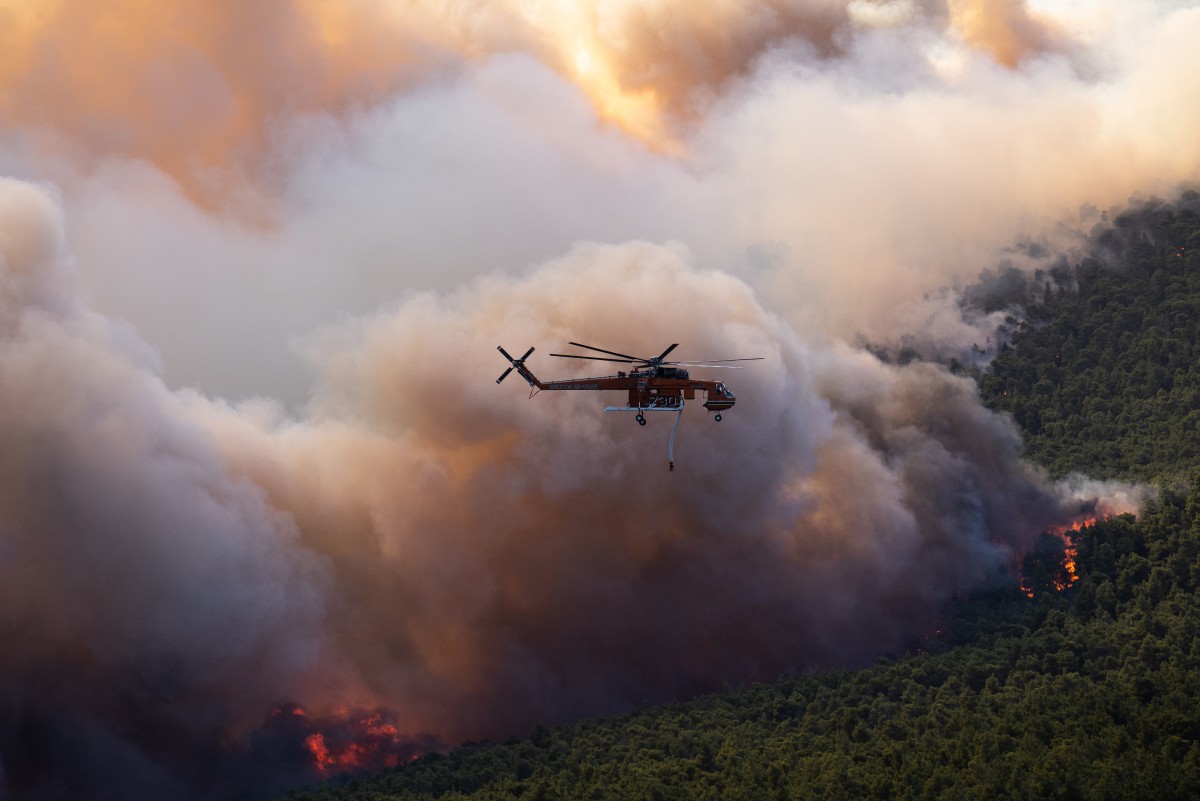
Europe continues to be plagued by wildfires as strong winds, high temperatures, and dry weather persist in Greece, France, and Spain. In these conditions, fires are raging in various locations, forcing some residents to evacuate. The escalating death toll due to extreme heat underscores the increasingly dire climate crisis facing Europe this summer.
According to reports from Reuters, on Saturday (August 1st), Greece was hit by strong gusts of wind, causing wildfires to rapidly spread in multiple areas. In Porto Germeno near the Gulf of Corinth, about 60 kilometers northwest of Athens, the fire quickly expanded, devouring large swathes of forests and shrubbery, with thick smoke engulfing the area. Firefighters, police, and emergency personnel were temporarily evacuated to safety as the direction of the fire continued to change due to the strong winds.
Local emergency doctor Giorgos Doulas stated that wind gusts exceeded 73 kilometers per hour that day, causing the fire to change direction unpredictably, making rescue efforts extremely challenging.
Evacuation orders were issued in areas such as Agia Paraskevi, Kryo Pigadi, and Agios Nektarios in northwest Athens, with firefighting helicopters continuously dousing the flames with seawater and flame retardants. Prior to this, over two hundred residents from Agios Vasileios had already been evacuated by sea.
The Greek government also warned of extreme wildfire risks in regions such as Boeotia, Attica, and Evia on Sunday.
In southeastern France, wildfires in mountainous areas of Var that had been under control three days ago reignited on July 31, forcing nearly 2500 residents to evacuate overnight. As of August 2, the fire had consumed approximately 1800 hectares, with the situation now stabilizing.
In Spain, despite the government lifting the national emergency status caused by large-scale wildfires in the central region two days ago, new ignition points have emerged in Leon, with multiple fires still burning.
In neighboring Zamora province, a major fire that destroyed around 11,000 hectares of land has significantly improved, and 14 previously evacuated towns have reopened. In Castellon province, after a wildfire in Vall d’Uixo burned nearly 10,000 hectares and was brought under control on the 7th day, all evacuated residents have been allowed to return home. Authorities have not ruled out the possibility of arson due to the discovery of two separate ignition points.
Moreover, major wildfires that had burned over 70,000 hectares of land in Madrid and Avila, Spain, have now been mostly contained.
This summer, Europe has been experiencing record-breaking heatwaves, coupled with reduced rainfall, significantly increasing the risk of wildfires. Many climate scientists point out that climate change is intensifying the frequency and intensity of heatwaves, droughts, and wildfires.
In addition to wildfires, extreme heat continues to cause severe casualties. Monitoring and estimation data from multiple countries show that the number of heat-related deaths is still on the rise. In June, Austria’s Food Safety and Health Agency reported a record high of 395 heat-related deaths nationwide.
The UK government estimated that 2877 people have died from heat-related causes so far this year. French official statistics revealed 5764 excess deaths between June 17 and July 2. The Robert Koch Institute in Germany estimated that around 9800 people have died due to heat this year.