
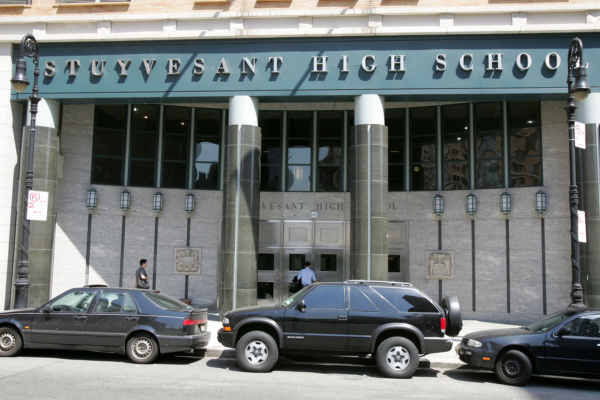
The US Supreme Court has rejected an emergency admission request from a Chinese-American student from Brooklyn. The student was not admitted to Stuyvesant High School due to scoring slightly below the admission threshold of 3 points in the Specialized High School Admissions Test (SHSAT). Subsequently, the student’s mother filed a lawsuit, accusing the New York City government of discriminating against Asian students in the admissions policy of specialized high schools. The main lawsuit in this case is still under review.
Yi Fang Chen, residing in Brooklyn, previously submitted an emergency application to the US Supreme Court requesting temporary permission for her son to enroll at Stuyvesant High School until a final decision is made by the Second Circuit Court of Appeals.
On September 28, Justice Sonia Sotomayor of the US Supreme Court officially rejected the emergency relief application in the case of “Chen v. Mamdani”. In accordance with precedent, the Justice did not provide reasons for the rejection in the ruling.
The lawsuit initiated by Yi Fang Chen targets the quota allocation mechanism of New York City’s specialized high schools. These schools do not admit students based on district boundaries but primarily on SHSAT scores, prioritizing high-scoring students.
However, the city government’s “Discovery Program” introduced another consideration. The program mandates that schools reserve 20% of slots for economically disadvantaged students who fall within a “discovery score range” (scores slightly below the admission threshold) and meet other qualifications. Ms. Chen believes that this policy effectively aims to decrease the number of Asian students admitted while increasing the proportion of African American and Latino students.
Ms. Chen’s son scored 558 in the admission test, just 3 points below the admission line for Stuyvesant High School that year. She pointed out that the “Discovery Program” encroached on the slots originally intended to be allocated based on test scores, thereby raising the admission threshold for regular students.
Dean McGee, the lawyer from the Pacific Legal Foundation representing Ms. Chen, stated: “Ms. Yi Fang Chen’s son was kept out of Stuyvesant High School because the city government turned a program intended to support impoverished students into a tool for racial engineering, even excluding some disadvantaged children. The true essence of equal protection is to view each child as an individual, not as a statistic in demographic data.”
In April, Ms. Chen filed a lawsuit requesting Judge Edgardo Ramos of the Southern District of New York Federal Court to issue an injunction ordering Stuyvesant High School to admit her son. She argued that the school’s “Discovery Program” constitutes intentional discrimination, violating the Equal Protection Clause of the Fourteenth Amendment to the United States Constitution and Section 601 of the 1964 Civil Rights Act (prohibiting racial discrimination in programs receiving federal aid).
Ms. Chen further pointed out that city officials restricted the program’s eligibility to students from middle schools with an Economic Need Index of over 60%; internal data models showed that setting this threshold would reduce the admission slots for Asian students and increase the admission rate for African American and Latino students. However, city officials denied this claim, emphasizing that setting a 60% threshold was not meant to discriminate against Asian students.
Various civil rights organizations, including the American Civil Liberties Union (ACLU) and the NAACP Legal Defense Fund, have also intervened in this case to defend the “Discovery Program”. They argued that the program expands the entry pathways for disadvantaged students in a racially neutral manner and pointed out significant racial disparities existing at Stuyvesant High School, suggesting that discontinuing the program would only worsen inequality.
Following a hearing on July 21, Judge Ramos rejected Ms. Chen’s preliminary injunction request, stating that the program’s provisions did not mention race. The judge applied the “Rational Basis Review” instead of the stricter “Strict Scrutiny” standard, deeming expanding educational opportunities for impoverished students as a legitimate government objective.
Subsequently, Ms. Chen appealed to the Second Circuit Court of Appeals. On September 8, a panel of three judges dismissed her request for a temporary injunction during the appeal period, finding it did not meet the high threshold for emergency relief. On September 15, the panel also rejected her request for expedited proceedings.
Currently, Ms. Chen’s appeal against the rejection of the preliminary injunction on July 21 is still being reviewed by the Second Circuit Court of Appeals, while the main litigation in this case is ongoing at the Southern District of New York Federal Court. Neither the district court nor the appellate court has issued a final ruling on the substantive claims in this case.
Under the rules of the US Supreme Court, since this emergency application was rejected by one Justice, the applicant can reapply to another Justice. However, such refiled emergency applications are rarely successful.