
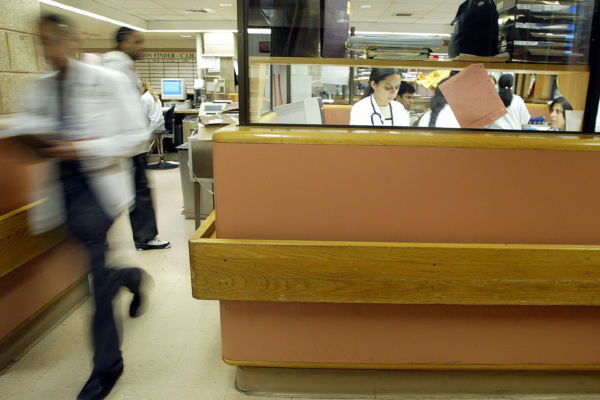
Recently, in New York City’s public hospitals, patients in the emergency department continue to face long waits for admission to hospital beds. At some hospitals, patients are waiting nearly a day on average before being transferred to inpatient wards. Medical experts believe that hospital closures and consolidations have led to a decrease in the number of beds, coupled with an increase in patient volume and factors like staffing and inpatient capacity, putting increasing pressure on emergency departments.
According to data obtained by The City Reporter, from 2022 to 2025, patients in New York City Health and Hospitals (H+H) system hospitals waited an average of 12.8 hours to be transferred from the emergency department to an inpatient bed.
In line with standards set by the Centers for Medicare and Medicaid Services (CMS), the time from deciding to admit a patient to transferring them to an inpatient bed should ideally be within 4 hours, with the total time spent by a patient in the emergency department not exceeding 8 hours.
There is a notable disparity between different hospitals. From January to May this year, at the East Flatbush’s Brooklyn Hospital Center, patients waited an average of about 27 hours for an inpatient bed; while at Elmhurst Hospital in Queens, it was close to 24 hours. Bellevue Hospital in Manhattan averaged around 10 hours, Harlem Hospital about 8.9 hours, and Metropolitan Hospital in East Harlem about 6.4 hours.
The situation at Brooklyn Hospital Center has been particularly concerning in recent years. Data shows that the average wait time from the emergency department to an inpatient bed at the hospital was 18.6 hours in 2022, increasing to 26.7 hours in 2023, further rising to 28.9 hours in 2024, decreasing to 20 hours in 2025, and rising again to 27.3 hours from January to May this year.
Hospital nurses point out that a considerable proportion of patients in the emergency department no longer require urgent care but are awaiting bed placement in inpatient units. Due to prolonged patient stays, some emergency department staff even need to be dedicated to caring for these patients awaiting transfer.
One nurse described the emergency department as a highly hectic environment, filled with the sounds of equipment, alarms, and bright lights, making it quite uncomfortable for patients waiting for extended periods. Another nurse noted that patients are becoming increasingly frustrated due to the delays in transferring to inpatient beds.
Medical experts believe that the long “wait for beds” in the emergency department is not solely an issue of the department itself but reflects a broader problem of inadequate inpatient capacity throughout the hospital.
Dustin Bass, president of the Emergency Department Nurses Association, points out that the so-called “inpatient boarding” actually reflects a capacity issue across the entire hospital. When there aren’t enough inpatient beds available, the emergency department is forced to continue accommodating patients who have been admitted but cannot be transferred to a ward.
The New York State Nurses Association highlights that due to hospital closures and healthcare facility consolidations, Brooklyn has seen a reduction of over 1,600 beds since 2010. Over the past decade, several New York City hospitals have shuttered, including Israel Medical Center in 2025, Long Island College Hospital in 2014, Interfaith Medical Center in 2013, and St. Vincent’s Hospital in 2010.
After hospital closures, patients who would have been served by these institutions often turn to still-operating hospitals, further escalating pressures on emergency and inpatient units.
New York City H+H is the largest public healthcare system in the U.S., providing medical services to about one million New Yorkers annually. Public hospitals serve patients regardless of their immigration status or ability to pay, thus catering to a large population without private health insurance or heavily reliant on the emergency department for care.
However, H+H states that evaluating the overall performance of the healthcare system cannot be solely based on the waiting times for emergency department patients to be admitted to inpatient beds. Some emergency service indicators have shown improvement in recent years. For example, the wait time for patients to see a doctor upon arrival in the emergency department has reduced, and the percentage of patients leaving before receiving treatment has declined from around 4-5% to approximately 2-3%.
Taking Brooklyn Hospital Center as an example, in 2024, the average wait time for patients to see a doctor was 91.5 minutes, which decreased to around 68 minutes in 2025 and up to now in 2026. The hospital has also increased the number of doctors and nurses in recent years to accommodate the growing patient volume.
Nonetheless, experts point out that speeding up emergency assessments does not solve the issue of bed shortages; if there aren’t enough inpatient beds available, patients may still have to wait extended periods in the emergency department after being seen by a doctor. Data from H+H reveals that the number of emergency department visits at Brooklyn Hospital Center has consistently increased in recent years, from about 92,450 in 2022 to approximately 99,200 in 2023, and exceeding 102,000 in 2024.
For some patients, the impact of bed shortages is direct and tangible.
Kai G., a 28-year-old, suffered injuries to his right hand with a fracture and scrapes on his legs in a conflict in July of this year. He went to the Brooklyn Hospital Center emergency department for treatment. After receiving treatment for his hand injury, he was informed the next day that he could be discharged.
Kai felt that his leg was still unable to bear weight properly at the time, believing he needed further recovery and care. Subsequently, the hospital provided him with a cane and arranged for transportation to take him to Bellevue Hospital in Manhattan for continued inpatient treatment.
Mercedes Narcisse, the current chair of the New York City Council’s Hospital Committee, views the prolonged wait times in the emergency department as a warning sign of the overall public healthcare system. Severe federal funding cuts have exacerbated the challenges faced by local healthcare operations.