
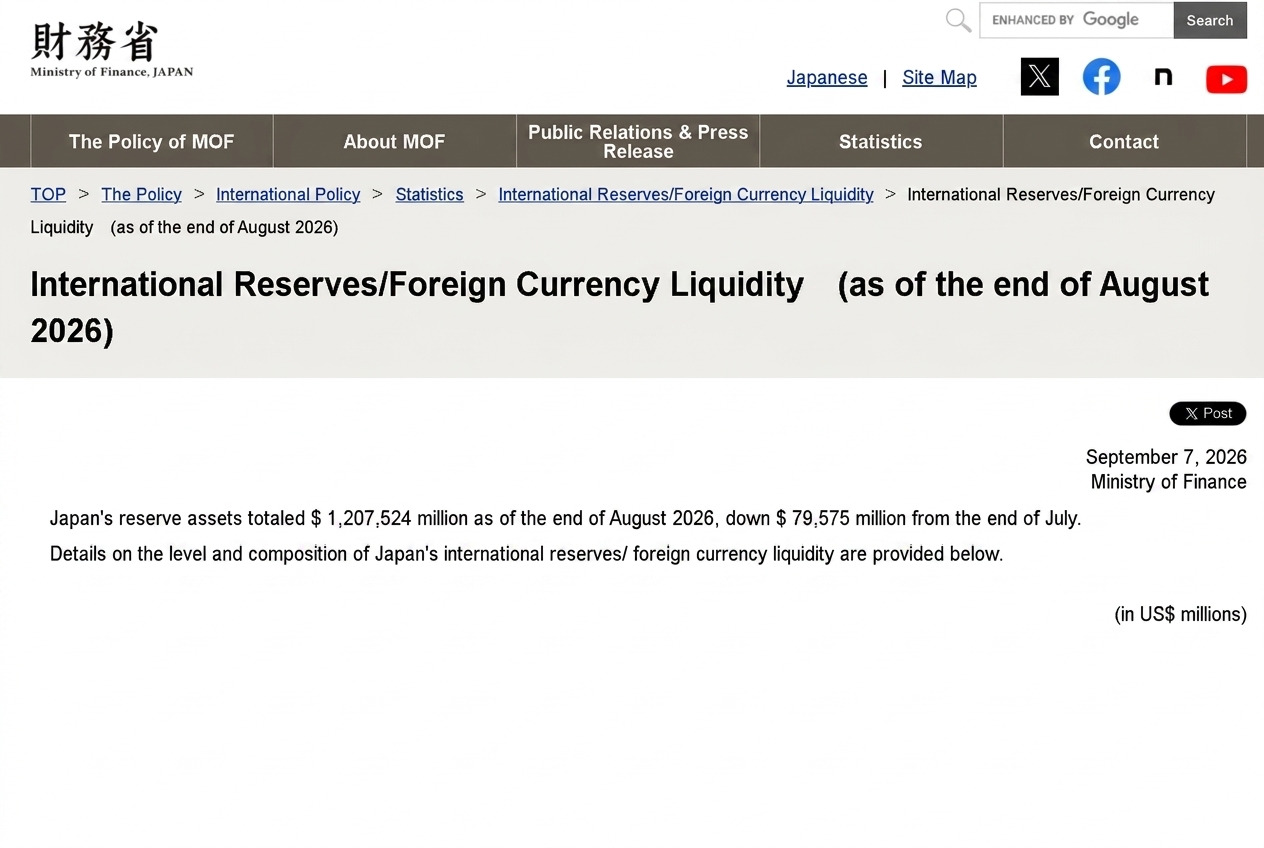
Japan’s Ministry of Finance released data on September 7 showing that as of the end of August, Japan’s foreign exchange reserves had dropped to $1.20752 trillion, a decrease of $79.575 billion from the end of July, representing a record monthly decline of approximately 6.18%.
According to Reuters, the significant decrease in foreign exchange reserves is mainly related to Japan’s recent large-scale intervention in the currency market. Between July 30 and August 26, Japan utilized ¥15.3993 trillion ($986.6 billion) to sell dollars and buy yen in order to stem the continued weakening of the yen, marking the largest monthly currency market intervention in Japan’s history.
Foreign securities in Japan’s foreign exchange reserves are primarily U.S. Treasury bonds. Finance Ministry data shows that securities assets at the end of August amounted to $839.559 billion, accounting for approximately 69.5% of the foreign exchange reserves.
This intervention also involved coordinated actions between the U.S. and Japan. Reuters reported that this was the first coordinated currency market intervention between the two countries since 2011. During the intervention, the yen briefly rose from near 164 yen per U.S. dollar to around 155.20, but exchange rate fluctuations were also influenced by other market factors.
In order to alleviate concerns in the market about the possible impact on U.S. dollar liquidity after Japan’s large-scale intervention, both the U.S. and Japan stated that Japan could, if necessary, utilize the U.S. Federal Reserve’s liquidity mechanism to obtain U.S. dollar liquidity without directly selling U.S. Treasury bonds.
This type of mechanism was introduced by the Federal Reserve in 2020 during the pandemic to ease U.S. dollar funding market pressures and maintain global financial market stability. It can provide support in times of U.S. dollar liquidity stress in financial markets, but should not be equated with the funds Japan has already obtained for intervention in the currency market.
The decline in foreign exchange reserves this time reflects the costs incurred by Japan in supporting the yen through large-scale currency market intervention. The future direction of the yen will continue to be influenced by multiple factors such as interest rate policies of Japan and the U.S., fund flows, and market expectations.