
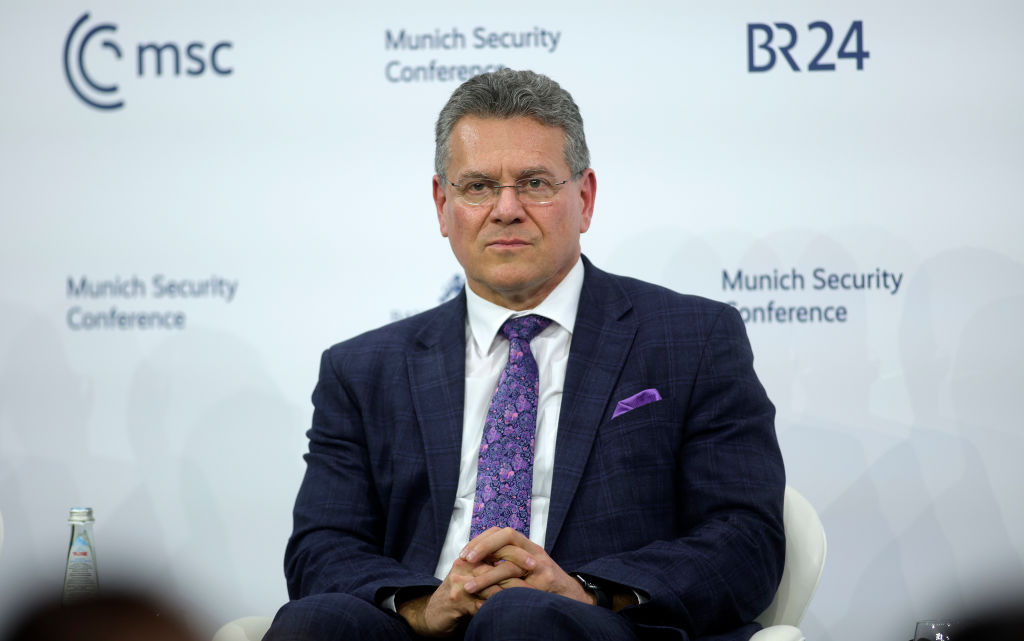
On Wednesday (September 2), European Union Trade Commissioner Maros Sefcovic warned that if the trade negotiations with the Chinese Communist Party do not yield very concrete results, the EU will implement stricter measures. He plans to meet with Chinese Minister of Commerce Wang Wentao in September and continue negotiations in Beijing before October.
According to Euronews, Sefcovic stated in an interview that the time required to resolve market access issues in China will clearly surpass the October deadline, but member states have formed a broader consensus on EU objectives and are aiming to at least achieve a framework for a solution in the autumn.
He mentioned that both the EU and China are intensively searching for solutions in sensitive areas such as automobiles, medical devices, and agricultural food products, with negotiations reaching an unprecedented level of intensity.
Denis Redonnet, former Chief Trade Enforcement Officer of the EU, traveled to Beijing this week as the new head of the negotiating team responsible for China talks.
EU Trade Director-General Ditte Juul Jorgensen confirmed during a hearing in the European Parliament on Wednesday that she will also travel to Beijing later this month to join the negotiating team.
Jorgensen further informed members of the Parliament during the hearing that the European Commission is drafting a “diversification tool” requiring key industry companies to increase suppliers to reduce reliance on China. This is one of the latest trade defense measures to counteract China’s dominant position in recent months.
The Commission also plans to curb excess Chinese industrial product supply and has proposed a draft “Industrial Acceleration Act” that prohibits certain Chinese products from participating in EU public procurement and restricts Chinese acquisitions of European companies.
Jorgensen pointed out that the EU’s increasing serious dependence on China in its relations poses a risk, especially in industries of strategic importance.
She noted that the widening trade deficit is a result of the combined effects of Chinese domestic policies and competitiveness, describing it as a “difficult situation to sustain.”
In July alone, China’s trade surplus with most EU member countries increased compared to the same period last year.
On August 31, Sefcovic told Politico that the EU hopes Beijing will commit to reducing the surge in exports to Europe; otherwise, a tit-for-tat trade confrontation could ensue. The EU is presenting very specific proposals, and if China fails to take concrete actions, negotiations in the future will be difficult.
EU Commission President Ursula von der Leyen similarly warned last week that maintaining a partnership with China does not imply accepting permanent trade imbalances.
She pointed out that over the past five years, EU imports from China have increased by 45%, while exports to China have declined, indicating that unilateral dependence could be leveraged.
In addition, German Chancellor Friedrich Merz’s position in recent weeks has shifted closer to Brussels. He has instructed the Cabinet to propose measures to address issues such as the dumping of plug-in hybrid electric vehicles by China.
German Vice Chancellor Lars Klingbeil also emphasized that when others do not comply with the rules, naivety must not continue, and industries such as steel, automobiles, chemicals, and pharmaceuticals must be protected.