
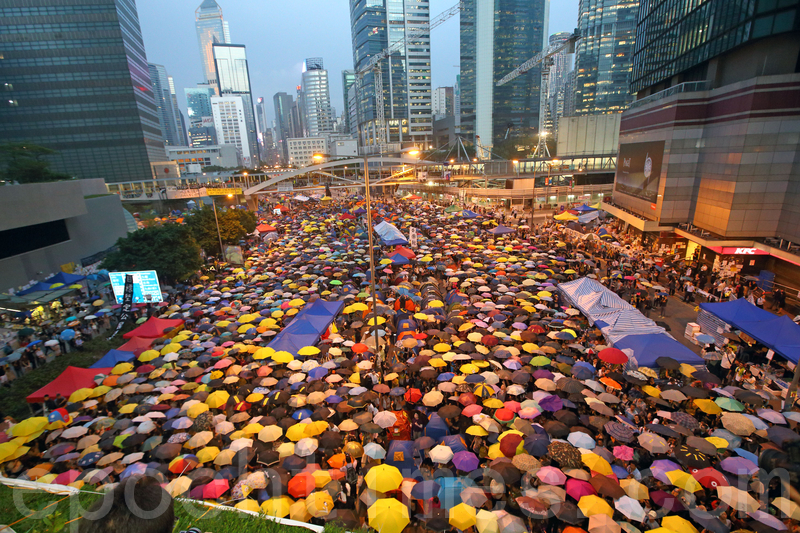
Recently disclosed confidential documents from the Chinese military reveal that during the Umbrella Movement in Hong Kong in 2014, Wei Liang, who was then the Political Commissar of the Guangzhou Military Region, requested military intervention preparations, stating that action should be taken immediately upon receiving orders to suppress the democratic demonstrations in Hong Kong.
According to reports from the Central News Agency citing the Kyodo News, these documents were obtained by Professor Suzuki Takashi from Daito Bunka University in Japan, who studies Chinese politics. The documents are records of speeches during meetings organized by the Chinese military from October to November 2014. Kyodo News mentioned that Chinese Communist Party leader and Chairman of the Central Military Commission Xi Jinping had attended some of the meetings mentioned in these records.
One document dated November 2, 2014, recorded Wei Liang discussing the situation in Hong Kong, emphasizing the need for military preparedness to address what he referred to as an “extreme situation” in Hong Kong. Wei Liang also mentioned that action would be taken immediately upon receiving orders to ensure the situation is suppressed. At that time, the Guangzhou Military Region was responsible for military affairs in southern mainland China, and Wei Liang was one of the top leaders in that region.
Professor Kurata Toru from Rikkyo University in Japan, who studies Hong Kong politics, stated that this is the first time documents have been disclosed showing that the Chinese military had considered intervening in the Umbrella Movement in Hong Kong.
Suzuki Takashi believes that the related documents indicate that the Chinese Communist Party may have considered using the military to suppress the Umbrella Movement at that time.
Reports from Kyodo News mentioned that the military intervention proposal discussed within the Chinese military was not implemented at the time. The analysis suggested that this could have been related to China’s international isolation following the crackdown after the Tiananmen Square protests in 1989.
The Umbrella Movement took place in the fall of 2014, with Hong Kong citizens mainly advocating for genuine universal suffrage for the election of the Chief Executive of Hong Kong.
On August 31, 2014, the Standing Committee of the National People’s Congress of China set the framework for the 2017 Chief Executive election in Hong Kong, stipulating that candidates could only be two to three people and must obtain the support of over half of the nominating committee. Pro-democracy activists in Hong Kong argued that this arrangement allowed China to pre-screen candidates and did not constitute genuine universal suffrage.
In September, the Hong Kong Federation of Students and Scholarism launched student strikes. On the night of September 26, Joshua Wong and other students entered the Civic Square outside the Hong Kong government headquarters, and were followed by a large number of citizens showing their support.
In the early hours of September 28, Benny Tai, Chan Kin-man, and Chu Yiu-ming announced the start of the “Occupy Central with Love and Peace.”
On that day, the Hong Kong police dispersed demonstrators in Admiralty using 87 tear gas rounds and pepper spray. Protesters used umbrellas to shield themselves, hence the umbrella became a symbol of the movement, which was also known as the “Umbrella Movement.”
After the police fired tear gas, more citizens took to the streets, expanding the protests to Admiralty, Mong Kok, and Causeway Bay.
On October 2, 2014, thousands of demonstrators gathered outside the Hong Kong Chief Executive’s Office, demanding the resignation of then-Chief Executive Leung Chun-ying and the withdrawal of restrictions on nominating candidates for Chief Executive. The police increased their presence, wearing riot gear as they entered the Chief Executive’s Office. Leung Chun-ying announced that he would not resign that evening.
On the same day, the Chinese state-run newspaper People’s Daily declared on its front page that the central government had “full trust” in Leung Chun-ying and supported the Hong Kong government and police in handling the “Occupy Central” movement. The article referred to the demonstrations as “disturbing social order.” Prior to this, Xinhua News Agency published an article on September 29, stating that they would investigate the so-called “masterminds behind Occupy Central.”
Protesters occupied major roads in Hong Kong, setting up tents, supply stations, and self-help areas. The occupation continued for 79 days, and the Chinese Communist Party did not withdraw the restrictions on nominating Chief Executive candidates.
In December 2014, the Hong Kong police gradually cleared occupied areas in Admiralty, Causeway Bay, and other locations, leading to the removal of many protesters. The last occupied area was cleared on December 15, and the demands of the Hong Kong people for genuine universal suffrage were not met.