
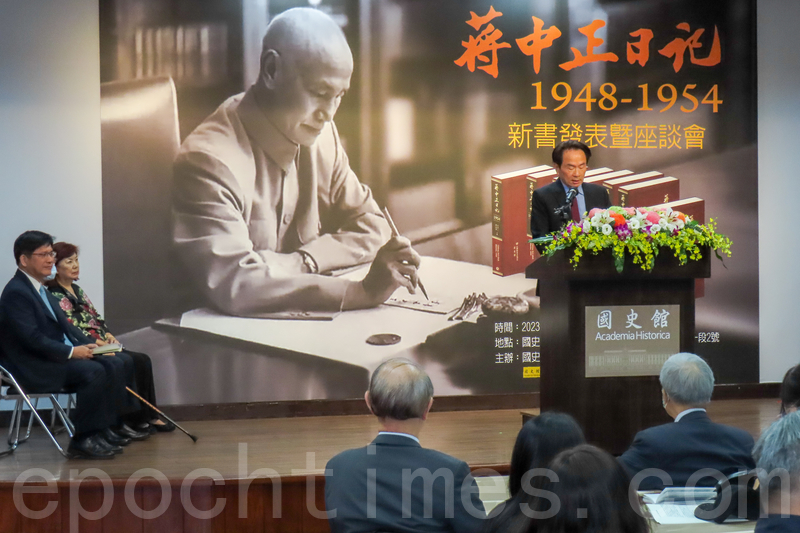
On September 30th, 2026, the National Museum of Taiwan History of the Republic of China (ROC) released the 11th batch of digital files of the diaries of Chiang Kai-shek and Chiang Ching-kuo for public use. In Chiang Kai-shek’s diary from 1955, it was recorded that during the first Taiwan Strait Crisis, the United States had proposed “to jointly defend Kinmen in exchange for the evacuation of Dachen.”
The National Museum of Taiwan History announced in a press release today that since March 2024, they have been gradually making available catalogs and image files of the “Chiang Kai-shek Diary” and “Chiang Ching-kuo Diary” (Diaries of the Two Jiangs) on a quarterly basis, with a total of 66 years open to the public so far. The 11th batch released today includes the diaries of Chiang Kai-shek from 1955 to 1957 and Chiang Ching-kuo from 1961 to 1963, comprising a total of 3048 entries and 5055 digital files.
According to the National Museum of Taiwan History, the retreat from Dachen in 1955 was a continuation of the first Taiwan Strait Crisis. Chiang Kai-shek’s diary entry on January 10th mentioned receiving reports of Dachen being bombed by enemy aircraft, escalating the situation. Despite the “Sino-American Mutual Defense Treaty” not yet being formally effective, a diary entry from the 21st stated that the U.S. was willing to jointly defend Kinmen in exchange for the withdrawal of Dachen. It was decided that the withdrawal would be conditional on the Sino-American Mutual Assistance Agreement taking effect, linking the crisis to efforts by the Communist Party of China and the Soviet Union to disrupt the agreement between the U.S. and China.
On February 6th, 1955, Chiang Kai-shek’s diary noted that the United States had ordered the protection and withdrawal of Chinese military and civilians, and Chiang Ching-kuo was tasked with overseeing the safe retreat from Dachen. With the assistance of the U.S. Seventh Fleet, the retreat from Dachen was completed by the 11th. Subsequent entries reflected on the joint statements of withdrawal from Dachen by China and the U.S., as well as the formal passing of the Sino-American Mutual Assistance Agreement by the U.S. Senate.
However, following the onset of the second Arab-Israeli War (also known as the Suez Crisis) in 1956, Chiang Kai-shek, in his diary entry of February 22, 1957, reflected on the Dachen retreat and criticized Eisenhower for pressuring Israel to withdraw from Gaza and Akaba Bay, likening it to the pressure applied to China to retreat from various islands in 1955. He noted U.S. violations of promises to jointly defend Kinmen and Matsu and the subsequent pressure to abandon Kinmen to deal with appeasing the Soviet Union after the crisis. Chiang Kai-shek believed Eisenhower had too many instances of breach of trust.
In addition, the recently released diaries of Chiang Ching-kuo from 1961 to 1963 recorded issues such as the United Nations “China representation” and Mongolia’s entry into the UN. In 1961, faced with U.S. demands not to veto Mongolia’s entry, Chiang Ching-kuo wrote that there could be no concessions. After multiple negotiations between Taiwan and the U.S., Taiwan’s delegation eventually abstained from voting on Mongolia’s UN entry in a show of strong opposition, maintaining their stance to navigate through difficult international and domestic situations. As a result, the ROC government, after initially advocating for withdrawal from the UN, managed to resolve the crisis through negotiations with the U.S., retaining its seat at the UN until 1971.
The National Museum of Taiwan History stated that the digital files of the Chiang Kai-shek diary can be freely viewed and downloaded online. For the Chiang Ching-kuo diary, which is still under copyright protection, individuals need to visit the reading room of the National Museum of Taiwan History in Taipei to view and transcribe it.