
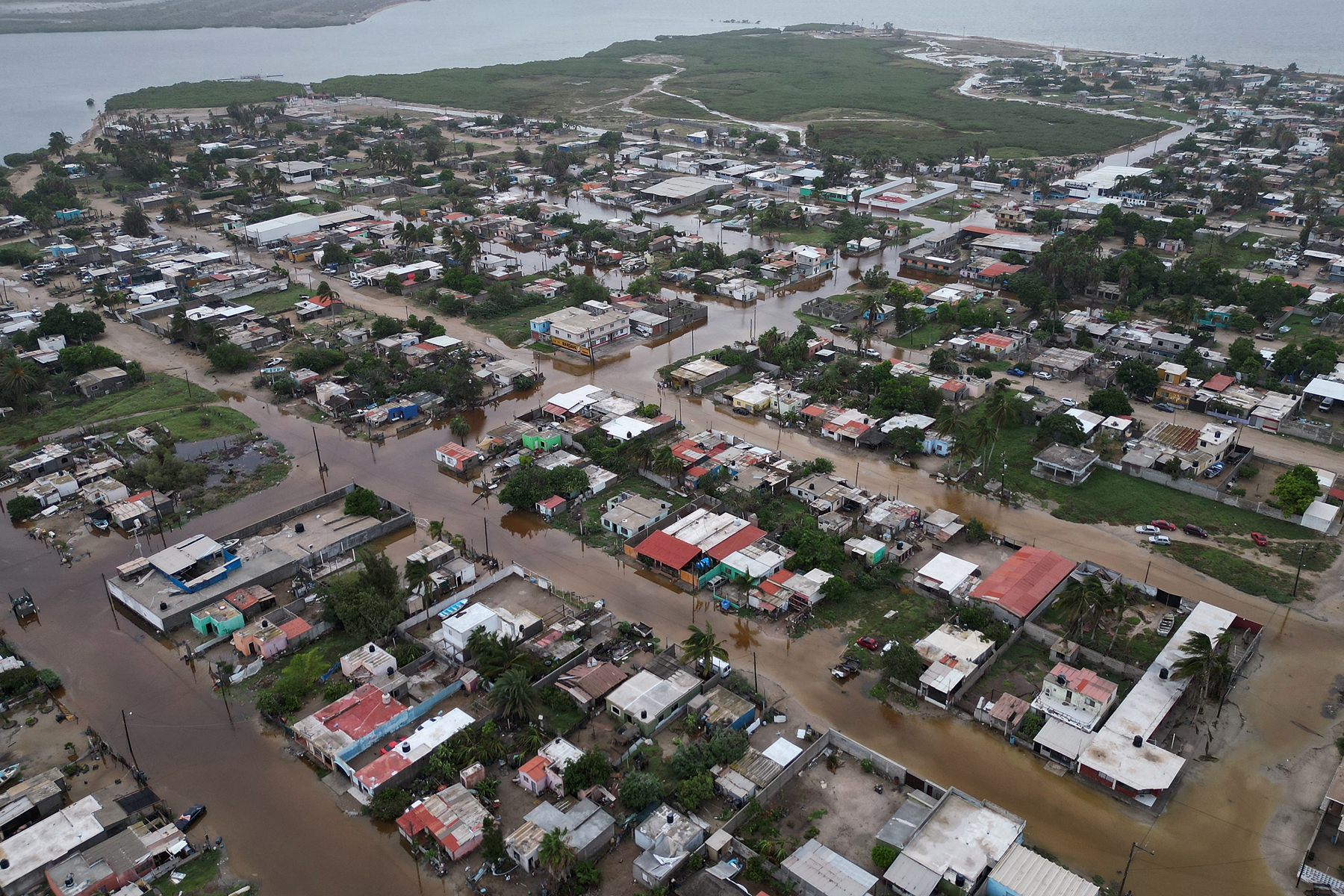
On Monday night (September 28), Hurricane “Polo” swept through the Pacific coast of Mexico, bringing severe storm surges, flooding, massive power outages, and flood disasters to the region. A preliminary assessment by Mexican authorities indicated that although there were some property losses in coastal areas, there were no reports of major casualties.
The U.S. National Hurricane Center (NHC) stated that “Polo” made a strong landfall on the southern tip of the Baja California Peninsula in Mexico as a Category 3 hurricane late Tuesday night, with maximum sustained winds reaching up to 175 kilometers per hour. It then crossed the peninsula on Tuesday afternoon and passed over the Gulf of California as a Category 1 hurricane before making a second landfall on the coast of Sonora state as a tropical storm, eventually weakening as it moved inland across Mexico.
The eye of the storm engulfed the fishing village of Las Barrancas on the Baja California Peninsula, where coastal flood barriers were breached by huge waves, leading to a surge of seawater flooding the streets, triggering severe inland flooding. Multiple areas experienced power outages, fallen trees, and several road bridges collapsed, temporarily isolating the village from the outside world.
The Mexican military deployed nearly 7,000 soldiers for disaster relief and evacuation efforts, set up 169 temporary shelters, and successfully evacuated and relocated hundreds of residents from hazardous areas.
States affected by the disaster like Baja California Sur and Sonora have ordered the suspension of all classes, closure of various coastal ports, and the temporary halt of all non-essential activities such as sports events. Civil servants have been instructed to work from home.
Currently, the U.S. National Hurricane Center continues to issue warnings, reminding inland areas to beware of life-threatening flash floods and landslides triggered by heavy rainfall. Meteorological departments are closely monitoring another tropical storm named “Rachel” over the Pacific Ocean, which is expected to strengthen into a hurricane by midweek and move parallel to the Mexican coast.