
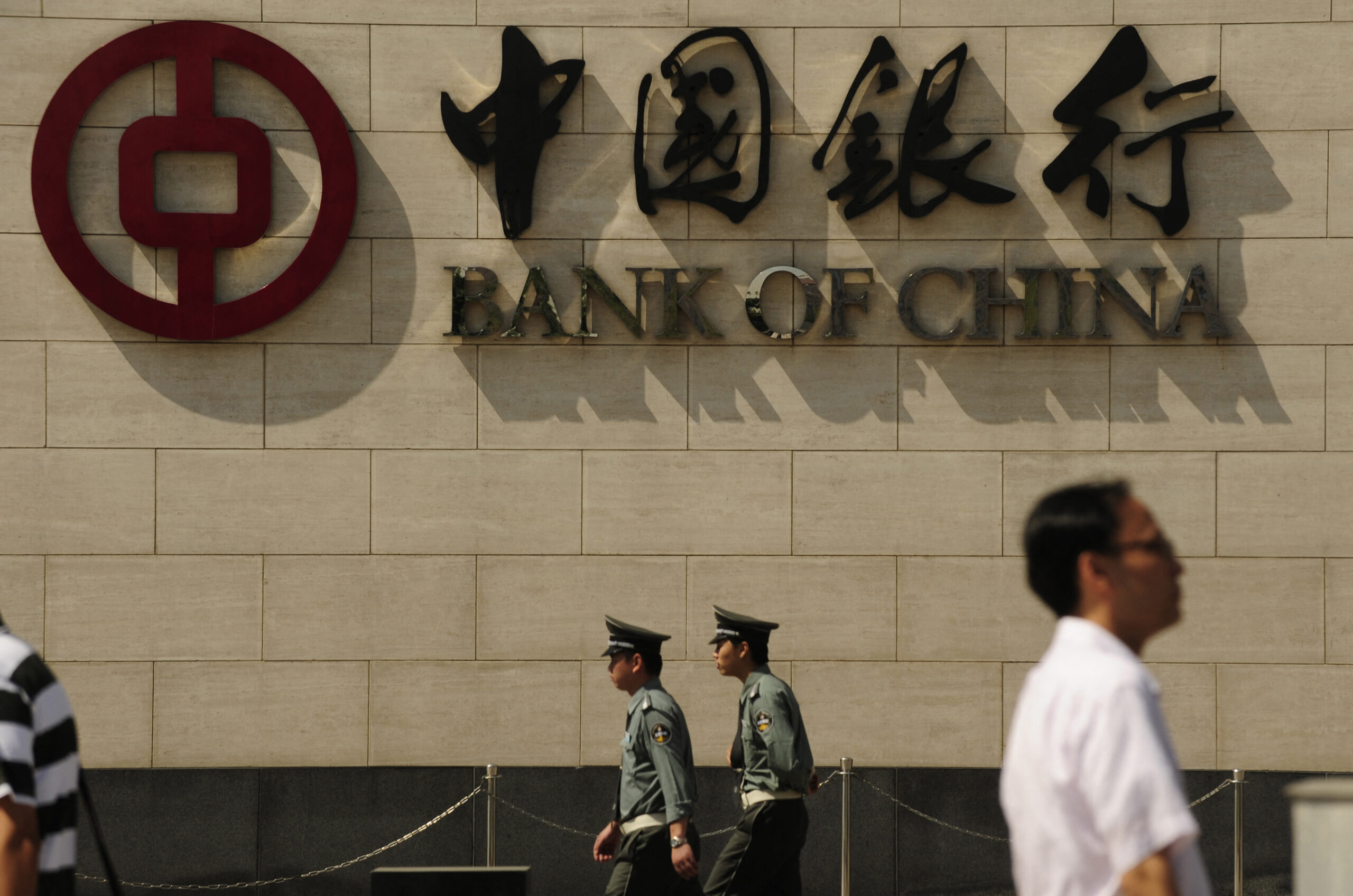
China’s major banks still have capital adequacy ratios higher than regulatory minimum requirements, yet the Chinese Ministry of Finance has injected an additional 300 billion yuan to support 8 financial central enterprises to replenish their capital, totaling an increase of 360 billion yuan. The official stance is that this move is to “prepare for the rainy day,” while Xie Jinhe, Chairman of Taiwan’s Cai Xin Media, believes Beijing is “buying time with money,” seeking time for economic recovery.
Amid narrowing profitability for banks, what exactly will this massive fund be used for? The Chinese Ministry of Finance announced on September 6th that 8 central financial enterprises plan to increase their capital by a total of 360 billion RMB, with the Ministry of Finance intending to contribute 300 billion yuan. This round of capital increase covers banks, insurance companies, and policy-based financial institutions.
In terms of banks, Industrial and Commercial Bank of China and Agricultural Bank of China each plan to raise funds of no more than 100 billion yuan and 160 billion yuan, with the Ministry of Finance planning to subscribe to 70 billion yuan and 130 billion yuan respectively. With the previous capital increase completed by Bank of China, Construction Bank, Bank of Communications, and Postal Savings Bank, the six major state-owned commercial banks have all received capital injections from the Ministry of Finance.
Insurance companies and policy-based financial institutions are also included in this round of capital increase, including China Life with 35 billion yuan, China Re with 15 billion yuan, China Taiping with 7 billion yuan, China Eximbank with 30 billion yuan, China Export & Credit Insurance Corporation with 10 billion yuan, and China Reinsurance Corporation with 3 billion yuan.
Despite this capital increase, the capital adequacy ratio of large banks has not fallen below regulatory requirements. Official data shows that as of the end of the first half of 2026, the capital adequacy ratio of bank groups was 18.31%, Tier 1 capital adequacy ratio was 13.65%, and core Tier 1 capital adequacy ratio was approximately 12.04%, all higher than China’s current regulatory minimum requirements.
Why, then, does the authorities still need to significantly increase capital when the capital adequacy ratio is still higher than the regulatory minimum requirements? Professor Sun Guoxiang from the Department of International Affairs and Business Management at Taiwan’s Nanhua University expressed in an interview with Da Ji Yuan that the key to this capital increase is not whether banks “currently comply” but their “future stress-bearing capacity.” With the net interest margin falling to a low level and the bank’s ability to replenish capital through profits decreasing, pressures such as bad debts in real estate, local debt resolution, and financing needs of the real economy could deplete the banks’ existing capital buffers.
The midterm performance report released by Bank of China at the end of August 2026 showed that the group’s net interest margin was 1.27%, lower than the official prudent assessment standard set by the Chinese Communist Party – requiring a net interest margin of 1.8% to score 100 points.
Xie Jinhe, Chairman of Cai Xin Media, pointed out in his analysis with Da Ji Yuan that the regulation of the Chinese banking industry is not transparent. From the surface data, the banking sector seems “healthy,” but there are still internal funding flow and turnover issues.
He further pointed out that one of the current problems facing the Chinese banking industry is the bad debts left behind after the collapse of the real estate bubble. He believes that “the bad debts that banks bear are often much more severe than the actual numbers on the books.”
In March 2025, the Chinese Ministry of Finance also passed special national bonds to support Bank of China, Construction Bank, Bank of Communications, and Postal Savings Bank to replenish Tier 1 capital. The four banks planned to raise a total of 520 billion yuan, with the Ministry of Finance planning to contribute 500 billion yuan.
Xie Jinhe described the scale and scope of this capital increase as “unprecedented in history.” He stated that from the bank’s balance sheet perspective, there is no immediate need for capital increase, but the Chinese Ministry of Finance is still pouring substantial funds into institutions like Agricultural Bank of China and Industrial and Commercial Bank of China, indicating that “China is now buying time with money” to gain breathing space for the financial system and wait for gradual recovery in the economy and real estate market.
Xie Jinhe believes that the core issue China’s financial system currently faces is the bad debts left behind after the bursting of the real estate bubble, and the long-term impact these problems have on the bank’s balance sheet.
He used cancer treatment as an analogy, stating that if the financial institutions are just continuously receiving capital injections without addressing the “lesions” on the asset side, the injected funds may still be continuously consumed. He likened this situation to “hitting a dog with a meat bun, with no return.”
First Finance Journal quoted a calculation by China International Capital Corporation stating that the 300 billion yuan capital injected by the Ministry of Finance could lever about 4 trillion yuan of asset expansion. According to this calculation, this capital increase may not only increase the capital buffer of financial institutions but also support large banks in further expanding their asset size.
However, in a situation where corporate and household credit demand is weak, why do banks still need to expand their balance sheets? Sun Guoxiang does not believe it is simply because the market needs more credit, but rather hopes to “underpin the economy with the balance sheet of state-owned banks.” He stated that the new credit resources may flow into local government financing platforms for debt resolution, real estate transactions, as well as new energy, high-end manufacturing, and infrastructure sectors.
Xie Jinhe believes that the Chinese authorities still need to clarify how much funding flowed into real estate during the bubble period, and how much of the risks were ultimately borne by the banking system. If the scale of related bad debts lacks transparent information, the true asset quality of financial institutions becomes difficult to assess.
He described that in situations where the accounts are unclear, it’s like “crawling forward in the dark.”