
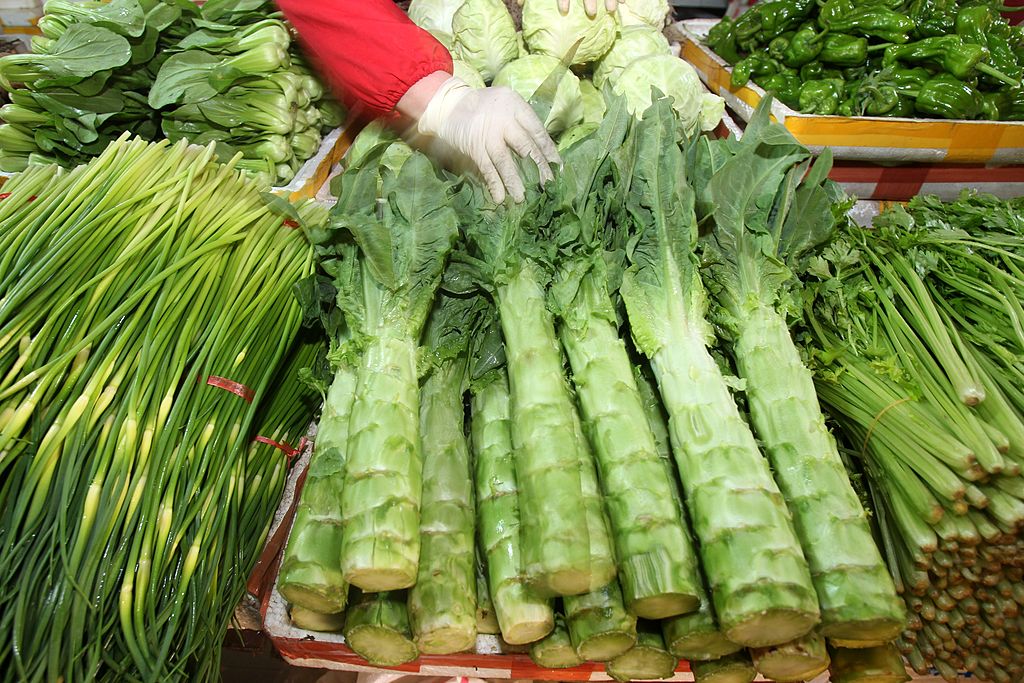
Recently in Yuzhong County, Lanzhou, Gansu Province, colored asparagus has been found following the exposure of “formaldehyde cabbage” in Hebei not long ago. According to reports, several vegetable warehouses have been soaking asparagus in a solution containing lemon yellow and bright blue dyes known as “fruit green” to conceal signs of yellowing and damage.
Food science blogger “Daily Food Science with Da Lei” released a video on September 5, revealing that he visited 13 vegetable warehouses in Yuzhong County and found unidentified liquids being used to soak asparagus in over half of them.
The blogger collected soaking liquid samples from three warehouses, and two of them tested positive for bright blue and lemon yellow dyes. He also discovered a product labeled as “fruit green” with mixed coloring agents, including lemon yellow, bright blue, and salt.
The video’s exposure has sparked strong social concern. One netizen on Weibo commented, “Just when we thought we avoided formaldehyde cabbage, now we encounter colored asparagus. Consumers are forced to become toxicologists.”
Another netizen remarked, “The script is the same every time: undercover investigation, exposure, official notification… and then after a few years, it repeats.”
According to reports from mainland Chinese media, the local Communist Party authorities announced that out of 53 vegetable purchasing and warehousing companies in the county, 6 were found to have illegally used “fruit green” in the purchasing process. Approximately 11.8 tons of the implicated asparagus have been destroyed on-site.
The announcement did not specify how long this practice had been ongoing, nor did it disclose whether colored asparagus had previously entered other markets outside the province.
Quoting local officials, mainland Chinese media reported that the soaking occurred during the distributor’s sorting and cleaning process, with local farmers not involved.
A local distributor mentioned that asparagus could lose its market appeal within three to four days after harvesting, prompting some distributors to soak it in coloring agents to make the skin appear more vibrant green, extending its saleability by about half a day.
Food expert Hu Xiaojia told “China Business News” that Chinese food additive standards permit the use of lemon yellow and bright blue in some beverages, candies, and frozen foods, but not in fresh vegetables. Using additives to mask the quality defects of food itself does not comply with relevant regulations.
After the coloring incident came to light, a local asparagus farmer from Yuzhong expressed that the sale of local asparagus has been severely impacted.
A series of food safety incidents have raised questions and concerns.
In late August, it was exposed that in Kangbao County, Zhangjiakou, Hebei Province, traders were dipping cabbage in formaldehyde solution before shipping to extend its freshness by two to three days. The situation was similarly exposed by a short video blogger through undercover investigation. Following the video’s circulation, the local Communist Party government acknowledged the veracity of the situation.
The issue of “formaldehyde cabbage” has been circulating online for 14 years, highlighting the industry’s unspoken rule of using formaldehyde for preservation. Products such as yam, mushrooms, lotus root, garlic sprouts, enoki mushrooms, tripe, beef omasum, pickled peppers, duck claws, hairtail fish, silverfish, bean vermicelli, tofu skin, and black fungus have all been preserved using formaldehyde.
In addition to formaldehyde preservation, a myriad of “black-hearted toxic foods” have continuously surfaced in China over the past few decades, including melamine-laced milk powder, sewer oil, Sudan red dyed duck eggs, synthetic eggs, poisonous rice, toxic sunflower seeds, clenbuterol-tainted meat, cosmetic shrimp, vomit toxin-infested beer, and transportation of edible oil in industrial tankers, among others.
The Chinese Communist Party is well aware of these issues, which is why they established a special supply system for food, setting up dedicated bases and farms exclusively for the privileged class of the Party to enjoy.
Wu Shaoping, the head of the Overseas Human Rights Lawyers Alliance, pointed out that due to the existence of this exclusive food supply system, senior officials of the Chinese Communist Party have ensured the safety of their own food supply. “They are not eating the same things as the common people, so once their food is safe, the safety of the food consumed by the common people is not a top priority for them. Therefore, I believe the ultimate responsibility lies with the Communist regime.”