
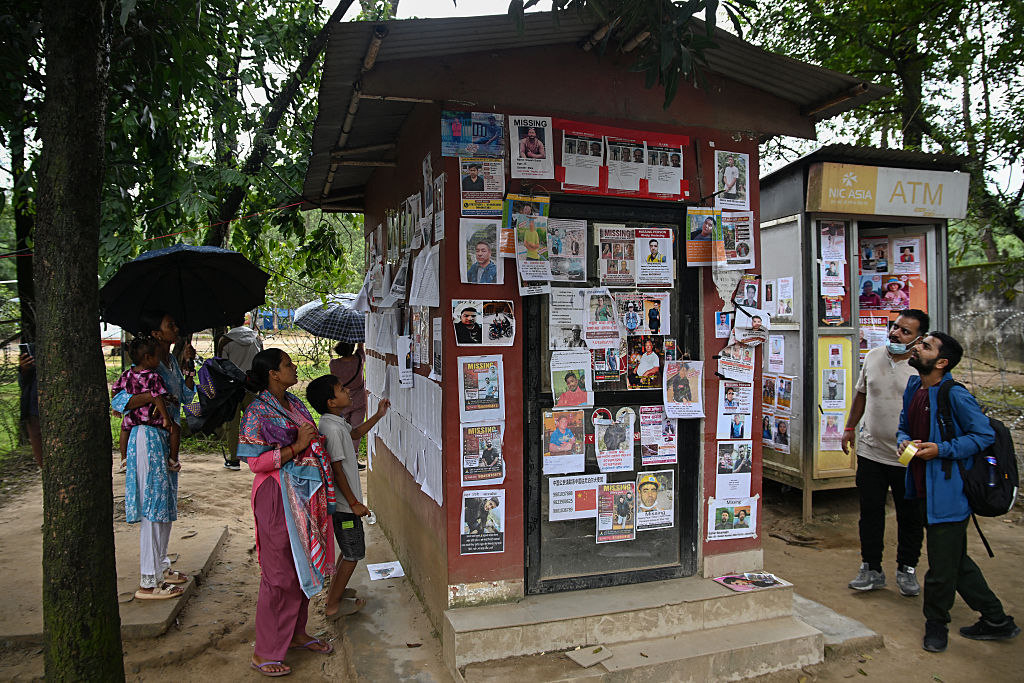
Fan Hong, a woman from Sichuan Province, last heard from her husband Lin Bo on the morning when the Nepal-Tibet flood occurred.
Over a week has passed, and the 31-year-old woman is still anxiously searching for any news about her husband Lin Bo. Lin Bo was working on a highway project in Nepal that was being undertaken by a Chinese company. Unable to obtain any information from official Chinese channels, Fan Hong turned to social media and foreign news outlets for help.
She posted on Xiaohongshu (a social platform) saying, “My husband was working on a project in Nepal, approximately 5 kilometers from the Kyirong Port. I want to know his current situation, but I have been unable to reach him.”
Her post received 18,000 likes and nearly 4,600 comments. Like many others in China, she is struggling to gather information from online sources. Tibetan rights organizations state that the Chinese authorities are suppressing information about the missing.
Lin Bo had been involved in the repair work of the Sharubesi-Rasuwagadhi Highway, which connects Nepal and China’s Tibet, since 2024. The highway passes through the Kyirong Port, and Lin Bo had been staying at the construction site, overseeing the construction of a 16-kilometer stretch.
Fan Hong mentioned that rescue efforts at the construction site have stalled. Families of the survivors are requesting the Chinese authorities to deploy drones or helicopters to search for the missing individuals.
“I am getting more frustrated day by day, and my heart is growing colder,” she told The Guardian. “I have even run out of tears now.”
On Chinese social media, people are expressing grief and sorrow over the tragedy, sharing photos of missing border patrol personnel, but information remains scarce.
The Guardian reported that the families of the missing individuals can only rely on information provided by Nepal, foreign embassies, and social media. Fan Hong confirmed that she primarily relies on information coming from Nepal.
“It seems like everyone has forgotten about the workers on the Sharubesi-Rasuwagadhi Highway project… All the (Chinese) news reports are focused on Nepal’s hydropower plant,” she said.
Last Wednesday, a massive mudslide and flash flood occurred near the border between Tibet and Nepal, leading to significant casualties. Due to the remote location of the disaster area in the highland valley, rescue efforts are challenging, and many individuals remain unaccounted for.
The shocking footage captured by surveillance cameras rapidly spread on international social media platforms and appeared on television screens worldwide, except in China. So far, there has been no coverage of the Tibet-Nepal mudslide on any domestic Chinese TV channel. Videos and discussions related to the event are swiftly censored on China’s tightly controlled internet.
Given the scale of destruction shown in the video footage of the mudslide, the officially reported low death toll by the Chinese authorities has raised concerns.
Up to now, the Chinese official narrative regarding the Nepal-Tibet flood has focused on the official rescue efforts rather than addressing the expectations of civilians awaiting assistance.
In contrast, overseas Tibetan rights organizations confirmed that information on the Tibetan side of the border remains under strict control by the authorities.
The President of the U.S.-based International Campaign for Tibet (ICT), Dorjee Tseten, stated that individuals with information from Tibet are now afraid to communicate with any external organizations. She disclosed that one informant informed ICT that conversations are highly unsafe currently, while another suggested refraining from further contact to avoid adverse consequences.
On Friday, the Foreign Correspondents’ Club of China released a statement indicating that since the Nepal-Tibet flood, over a dozen foreign journalists have applied to enter the Tibet Autonomous Region for reporting purposes but none have been granted permission by the Chinese authorities. According to Chinese regulations, foreign journalists and officials are not allowed to visit Tibet without prior approval from the Chinese government.
On August 30, Tibetan authorities reported that ten individuals were punished for spreading “false information” online about the scale of the disaster according to the authorities.
The families of foreign tourists who have gone missing in Tibet are also anxiously seeking information.
Naresh Goyal, a British citizen, is anxiously awaiting news about his sister Neetu Goyal Tiwari, who disappeared since August 14. Neetu, aged 51, flew from India to Kathmandu, Nepal, to participate in a pilgrimage organized by the Isak Foundation.
“The last update we received is that they had reached the Kyirong Immigration Office. They said they were going to go through immigration procedures,” Goyal said.
He added that he saw his sister’s name on a list of missing persons circulating on social media, but he is unsure about the list’s source because obtaining information from the Chinese authorities is extremely challenging.
“Every time we inquire with the Chinese government, they say they will inform us about the latest through the British Embassy,” he said.
“We have been waiting for seven days now; every minute is torture, it’s really excruciating,” Goyal expressed.
According to the National Disaster Risk Reduction and Management Authority (NDRRMA) in Nepal’s latest update on Saturday, the mudslide last week in Nepal has resulted in at least 1,331 fatalities, with 4,996 people missing, including approximately 589 foreigners.
NDRRMA stated that 13,101 individuals have been rescued from the floods, including 304 foreigners.
Meanwhile, according to the official Chinese news agency Xinhua on Friday, the mudslide in Tibet has claimed the lives of at least 31 people, with 531 individuals missing.
During a press conference last Sunday, Chinese authorities revealed that 261 foreign individuals from 23 countries are missing since the Nepal-Tibet flood. Among them, 104 are from Nepal, 49 from India, 33 from Latvia, 18 from the United States, and 15 from the United Kingdom.
A spokesman for the U.S. State Department stated that as of this Wednesday, around 75 Americans remain unaccounted for.
The U.S. Ambassador to China, David Perdue, has been actively seeking information on the X platform about any American citizens who may have been affected by last week’s Nepal-China flood within Chinese territory.