
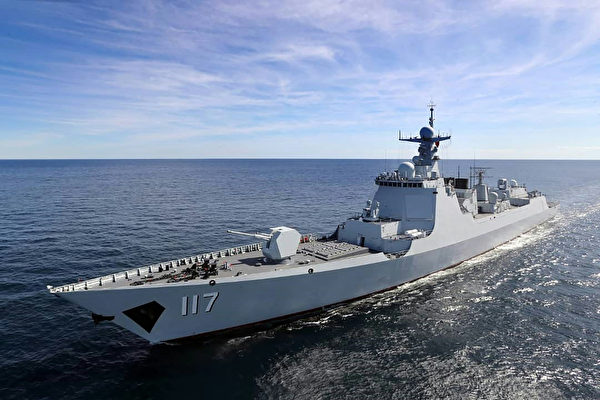
The activities of the People’s Liberation Army Navy (PLAN) in the waters around Japan have significantly increased this year. According to monitoring data from the Japanese Ministry of Defense, Chinese warships have passed through the waters between Amami Oshima and Yonaguni Island at least 10 times this year. In July, Chinese and Russian warships almost circled the Japanese archipelago and conducted shooting exercises in the Japanese exclusive economic zone near Okinotorishima. The frequent military activities of the Chinese Communist Party have prompted Japan to accelerate its defense transformation.
“The Wall Street Journal” Chinese edition’s official social media account on September 3 highlighted that Japan is facing its most severe security environment since World War II. Surveillance records show that Chinese destroyers have passed through the waters near Amami Oshima at least 10 times this year. Local residents were quoted as saying that “if there is a sudden conflict in the Taiwan Strait, Amami will inevitably be involved.”
Japan’s surveillance records also show that in 2025, there were zero such crossings. At this rate, the number of crossings this year is expected to exceed the record of 15 times in 2024.
A report on the China situation issued by the Japanese Ministry of Defense in June pointed out that the activities of PLAN warships entering the Pacific Ocean have been high in frequency, with various entry and exit routes, including the Soya Strait, Tsugaru Strait, Osumi Strait, as well as the waters between Amami Oshima and Yonaguni Island, and between Okinawa Island and Miyako Island. Statistics released by the Ministry of Defense indicate that there were 44 related activities in the 2025 fiscal year.
Previously in July, China and Russia conducted joint naval operations, with the scope of activities extending to the eastern and northern waters around Japan.
Japanese Defense Minister Taro Kono explicitly stated that the joint China-Russia sail was carried out “in the form of circling Japan.” They entered the Pacific Ocean by sailing south between Okinawa Island and Miyako Island on July 16, proceeded west through the Soya Strait on July 27, and confirmed the presence of relevant Chinese naval vessels in the Tsushima Sea on August 2.
The entire operation lasted about 18 days, with the track almost circumnavigating the Japanese archipelago. The Joint Staff Office of the Japan Self-Defense Forces also confirmed that during this time, a Chinese warship conducted shooting exercises in Japan’s exclusive economic zone (EEZ). The joint activities of Chinese and Russian navies are no longer limited to the southwest direction of Japan but are expanding to cover a wider range of the periphery of the Japanese archipelago.
In the face of military pressure from China, the “WaRi” report stated that Japanese Prime Minister Taro Kono is pushing to raise the defense budget to 2% of GDP and relax restrictions on arms exports.
The Defense Ministry this week requested a new fiscal year budget of $56 billion, focusing on missile and drone research and development, drawing on the experience of the conflict in Ukraine to cope with long-term conflicts.
In addition, in July, the Japan Maritime Self-Defense Force successfully launched American-made Tomahawk cruise missiles from a warship for the first time, signaling Japan’s acquisition of long-range precision strike capabilities. The Japanese government plans to procure up to 400 Tomahawk missiles and concurrently advance the development of indigenous long-range missiles. This deployment reflects Japan’s gradual institutionalization of “counterattack capability.”
The Chinese situation report released by the Japanese Defense Ministry in June stated that the activities of the Chinese military in the maritime and airspace around Japan are “rapidly expanding and becoming more active,” and believe that Chinese military activities in the Sea of Japan and the Pacific are tending towards normalization. The report also indicated that such activities are expected to further expand and become more active in the future.
Subsequently, in August, the Defense White Paper for 2026 was released by the Defense Ministry, once again positioning China as the “largest unprecedented strategic challenge” and setting a record-high 2027 defense budget application of approximately $56 billion to cope with new forms of warfare.
Researcher Shen Mingshi from the Taiwan Institute for National Defense Security previously stated in an interview with The Epoch Times that in recent years, the activities of the Chinese Liaoning aircraft carrier have been moving steadily eastward, gradually approaching the Ogasawara Islands and the Okino Torishima Reef. Shen Mingshi believes that this indicates China is extending its “anti-access/area denial” (A2/AD) capabilities outward from the first island chain and towards crossing the second island chain.
The Ogasawara Islands are located between mainland Japan and the US military base on Guam, and are also one of the areas that US and Japanese forces may pass through when moving towards the western Pacific. In the event of a conflict in the Taiwan Strait, the southwestern islands of Japan and the outer waters on the eastern side of Japan could potentially become maritime routes for US military and the Japanese Self-Defense Forces to reinforce Taiwan.
Regarding the connection between these activities and the potential conflict in the Taiwan Strait, military technology channel host Mark previously told The Epoch Times that one of the goals of the series of actions by the Chinese Navy is to prepare for a possible conflict in the Taiwan Strait, including to deter US and Japanese reinforcements to Taiwan.