
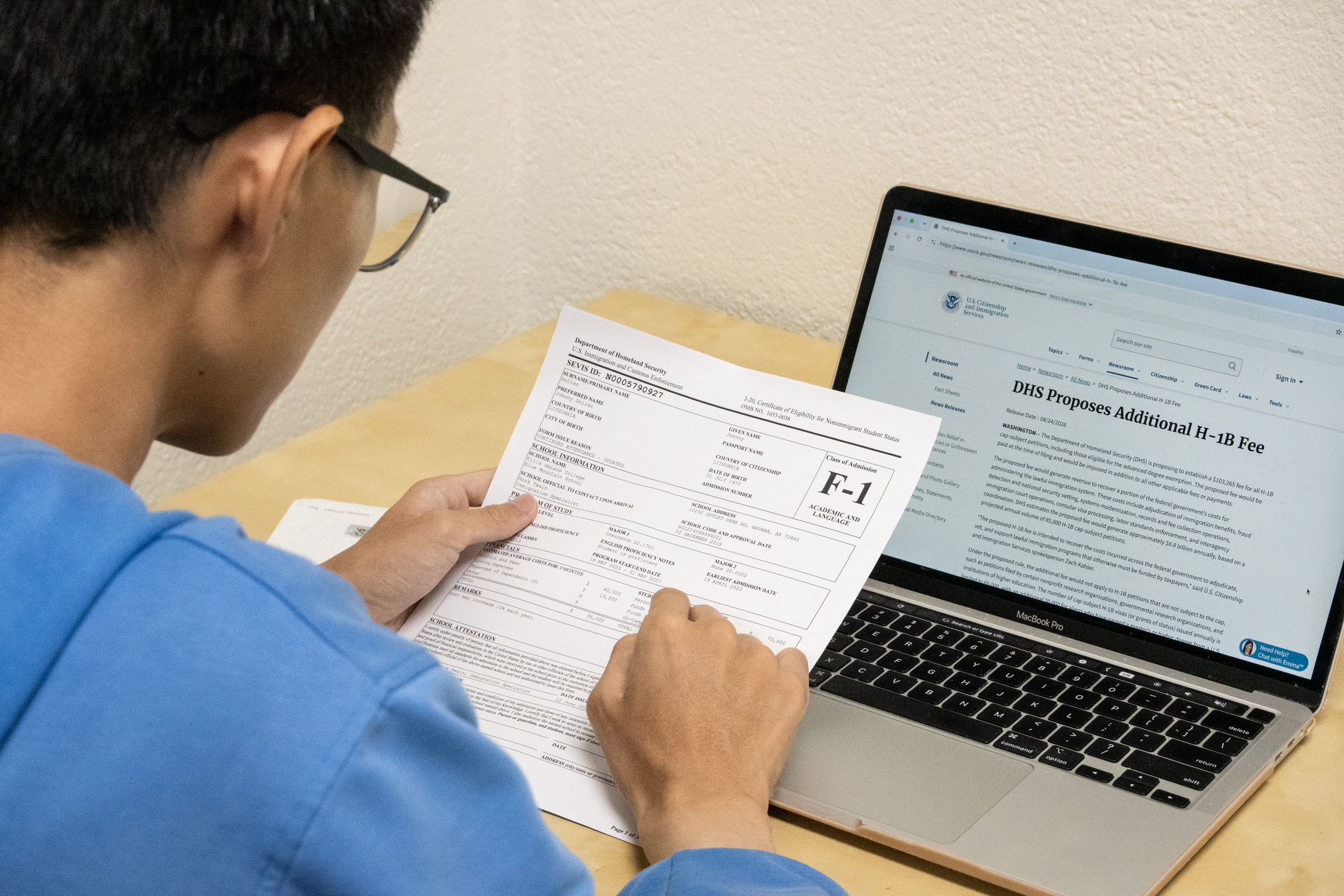
The US government is set to implement new regulations that will revoke the “duration of status” (D/S) permission previously granted to international students and visiting scholars upon entry into the country, starting on September 15. A lawsuit seeking to suspend and overturn the new rule issued by the Department of Homeland Security (DHS) was heard in a federal court in Massachusetts on September 3, but the judge did not make a ruling that day and did not disclose their decision.
The DHS announced the final rule on July 17, tightening regulations on the duration of stay in the US for three categories of individuals, including students. The new rule plans to replace the current “duration of status” policy with a fixed term not exceeding four years.
About a month later, the new rule faced a legal challenge. On August 18, eight organizations, including the Presidents’ Alliance on Higher Education and Immigration, the Association of International Educators (NAFSA), the American Federation of Teachers (AFT), and the United Auto Workers (UAW), jointly sued the DHS, seeking a preliminary injunction to halt and ultimately repeal the rule that cancels D/S.
The lawsuit alleges that the DHS’s new rule violates the Administrative Procedure Act, is arbitrary and capricious, fails to substantively address public opposition, lacks analysis of the potential impact of the regulation, and has not fully assessed the implications for universities, research, international enrollment, and long-term doctoral students.
The lawsuit also accuses the new rule of restricting F-1 students’ academic and transfer directions beyond the powers granted by Congress.
Stephen Yale-Loehr, a retired immigration law professor at Cornell University, believes that the plaintiffs have a good chance of winning the lawsuit. He noted that DHS failed to adequately consider the thousands of criticisms of the proposed rule in its procedures, and canceling D/S could be seen as a violation of the law.
A Chinese student about to graduate from the University of California, San Diego, expressed hopes that the new rule would be stopped. He mentioned the challenges he faces in preparing for his thesis defense while also dealing with immigration concerns due to the successive changes in immigration policies.
According to the new rule published by the DHS in the Federal Register, starting from September 15, holders of F visa for students, J visa for visiting scholars, and I visa for foreign media representatives, along with their spouses and children, will no longer receive the D/S duration of stay on their I-94 arrival records but will have a fixed duration, with F and J visas limited to four years and I visa to 240 days at most. Extension can be applied based on academic and work needs.
The new rule also shortens the grace period for F visa holders to stay in the US after graduation without another status from 60 days to 30 days.
Students can apply for extensions due to academic or research needs but must actively submit an I-539 extension application to USCIS or re-enter the US after leaving. Each extension cannot exceed four years. DHS specifies that students showing a pattern of repeated failures, prolonged inability to complete courses, and frequent requests for extensions may have their requests denied.
The new rule introduces more restrictions on students’ academic changes and transfer directions. Students are generally not allowed to pursue the same or lower level of degree after obtaining one. Graduate students who change majors or degree levels during their studies will face more limitations.
The lawsuit challenges these restrictions, arguing that how foreign students can legally maintain student status should be determined by the provisions of US immigration law. DHS’s restrictions on student academics are alleged to overstep in defining the legality of student status.
In the face of sweeping immigration reforms in the US, there is still a substantial number of international students, including new Chinese students, enrolling at American universities this fall. A resident in San Diego mentioned how her niece successfully obtained a visa to study economics at a local school before the new rule takes effect on September 15, expressing gratitude for the smooth process and affordability of the application.
She further explained that professions like AI and high technology might face stricter scrutiny during the visa application process. The interviewer advised applicants to review and potentially delete any anti-American content on social media accounts to pass the stringent screening process.
The DHS outlined a brief history of the duration of stay regulations for foreign students/scholars in the US in the new rule issued on July 17. Beginning in 1973 and transitioning to unlimited D/S in 1979 after several revisions, the policy has relied on school oversight, allowing students to stay as long as they maintained a lawful student status (such as a valid I-20) without an exit deadline.
The shift from a fixed duration to D/S, as per the DHS, is related to factors such as the increase in student numbers and workload at USCIS, while reverting back to a fixed duration aims to prevent students from indefinitely remaining in the US, posing issues related to overstaying and national security concerns.