
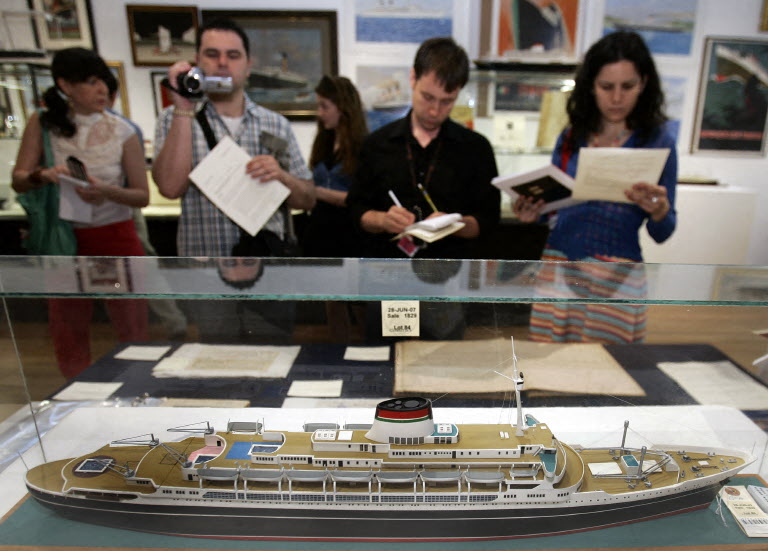
In the depths of the vast Atlantic Ocean near the east coast of the United States lies a steel behemoth referred to by extreme divers as the “Mount Everest of shipwrecks.” This once glamorous luxury liner has now become an extremely deadly labyrinth on the seabed, approximately 240 feet (about 73 meters) below the surface.
So far, at least 18 experienced divers have tragically lost their lives while exploring this underwater site. As the years pass, this underwater ruin is rapidly deteriorating at an alarming rate, signaling its inevitable demise. However, the allure of the luxury relics buried beneath the sea and the challenge of extreme diving continue to attract adventurers from around the world.
The predecessor of this sunken ship was the Italian luxury liner “Andrea Doria,” once a source of pride. On July 25, 1956, near the coast of Nantucket, Massachusetts, it collided with the Swedish liner “Stockholm” in a world-shocking accident. The next morning, this giant vessel capsized and sank to the depths of the Atlantic Ocean.
Fortunately, with the rescue efforts of the Coast Guard and several ships, over 1,600 passengers and crew members were successfully rescued. However, the collision resulted in the loss of 52 lives between the two ships. The sinking of the “Andrea Doria” marked the end of a glorious era in maritime history and marked the beginning of a legendary underwater exploration spanning decades.
For decades, the “Andrea Doria” has attracted some of the world’s top divers. Unlike the depths of thousands of meters required to reach the “Titanic,” which necessitates deep-sea submersibles, the depth of the “Andrea Doria” is at the threshold of scuba diving’s extreme challenge. This means that humans can set foot on this shipwreck using only scuba gear on their backs.
However, proximity does not guarantee safety. The water temperature at the 240-foot (about 73 meters) depth where the wreck lies is extremely low, the currents are complex, and visibility is poor, making any slight mistake potentially catastrophic.
Inside the ship’s hull are scattered debris such as abandoned fishing nets, wires, and metal fragments, making it easy for divers to become ensnared in these “underwater spider webs” and unable to extricate themselves. Additionally, due to the capsized nature of the vessel, the internal staircases and corridors have all turned sideways, leading to disorientation and the risk of getting trapped in dead ends.
Retired Coast Guard colonel Aaron Davenport explained in an interview with Fox News that, in such an environment, losing one’s sense of direction is easy, with what seems like an exit possibly turning out to be another dead end.
According to the Divers Alert Network, as of 2017, the number of fatalities related to exploring this shipwreck had risen to at least 18.
After sleeping underwater for over 70 years, the structural integrity of this colossal wreck is rapidly collapsing. Veteran explorer John Moyer, who has conducted over a hundred dives on the wreck, stated in an interview with the diving magazine “X-Ray Mag” that divers have witnessed the “rot and collapse” of the ship, with the steel hull continuously collapsing inwards, entering the “final stage” of complete flattening.
The Divers Alert Network also quoted data from the OceanGate company, indicating that the “Andrea Doria” is in a state of “accelerated deterioration.” Loose structural fragments drifting with the currents make internal exploration increasingly unpredictable.
Despite the escalating risks, the impending disappearance of the ship has sparked an even stronger desire among extreme divers. The opportunity to witness the wreckage and discover artifacts before this “underwater Everest” completely collapses is the ultimate glory for many adventurous divers.
“If you are an extreme diver, you would want to see the ship before it disappears completely,” admitted Davenport.