
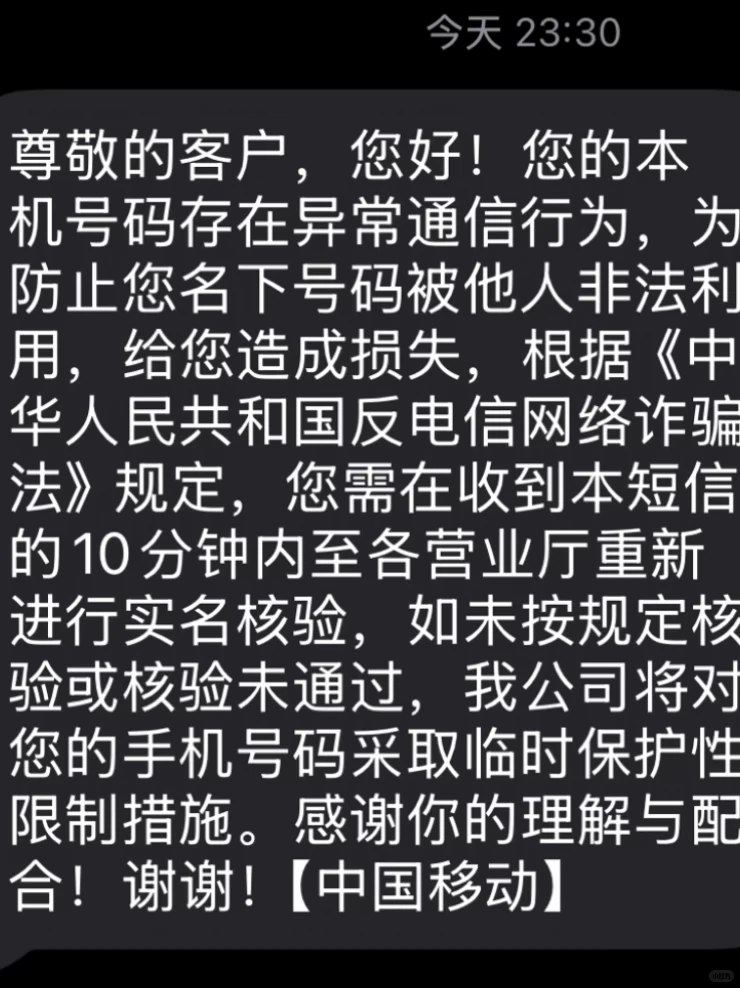
Recently, a netizen posted a screenshot of a text message from “China Mobile,” stating that they were asked to re-authenticate their identity at the service center within 10 minutes late at night, at 11:30 PM, or else their phone number would be restricted. The poster mentioned that their phone suddenly stopped working even though it was in normal use, and there was no way to appeal during the night. Many other netizens shared similar experiences, criticizing the telecom operators for suspending services under the guise of anti-fraud measures, disrupting normal life.
On September 18, a user on China’s social media platform Xiaohongshu posted a question directed at China Mobile: “Are you playing with people’s lives?” The message disclosed by the user stated that the number had “abnormal communications behavior” and users had to go to the service center for re-verification within 10 minutes of receiving the text; failure to verify would result in “temporary protective restrictions.”
The text message displayed “today 23:30.” The poster mentioned that despite their phone being in normal use without making calls or sending texts, it was suddenly shut down. Questioning the rationale of requiring customers to conduct business at service centers late at night, the user asked: “Why would you shut down people’s phones without reasons late at night? How do you expect people to commute to work the next day?”
A netizen from Huizhou, Guangdong named Fengmu (alias) told reporters that state-owned enterprises like China Mobile and China Unicom rely on their strong position in the telecommunications industry to shut down services as they please. He expressed, “When I saw this news, many people raised questions. How can you ask people to go for identity verification at 11:30 PM? In March this year, I also received a notice to go for identity verification within 24 hours with facial recognition, but now they give only 10 minutes. They keep shouting anti-fraud every day, going overboard, and treating ordinary people like monkeys.”
Fengmu further stated that his mobile account had been changed multiple times by China Mobile, switching from cheaper tariff plans to more expensive ones. “I called 10086 to complain, but could never reach a customer service representative, it’s a rip-off,” he added.
In recent years, measures like phone number verification, communication restrictions, and bank account freezes as part of anti-fraud efforts have led to complaints from Chinese netizens about the disruption to their daily lives. While such notifications claim to prevent fraud and misuse of numbers or accounts, those affected often have to appeal on their own and endure waiting for communication or account restoration.
Mr. Zheng, a rights activist from Guangdong, pointed out that while operators demand users to complete verification within 10 minutes, there is no clear timeline provided for the waiting period after a user’s service is suspended. He mentioned, “The most frustrating part is the endless wait after being shut down, especially when you are in a business meeting or at work. This kind of suspension under the pretext of anti-fraud makes people very angry.”
The post also quoted comments from other users. One person mentioned being shut down after 11 PM, with customer service stating they had no authority to resolve the issue, only asking for patience in waiting, which becomes harder on public holidays. Another user stated that their Unicom number had been shut down for two days, and someone else said, “Same here, it’s been two months and still unresolved.”
Mobile numbers are not just for making calls but also for receiving verification codes, using mobile payments, and logging into various accounts. Mr. Zheng emphasized that after a phone number is restricted, the impact could extend to work communications and life arrangements.
The text message disclosed by the user cited the Anti-Telecom Fraud Law of the People’s Republic of China, without specifying the relevant clauses or the basis for late-night verification. The screenshot did not display the sending number, leaving the identity of the sender of the text message to be confirmed. The existing information does not provide specific explanations from the operator about the abnormal situation of that number or indicate the time for the user’s communication to be restored.
Mr. Zhu, a scholar from Shenzhen, stated that “anti-fraud” has become a significant tool for the authorities to control people, restrict their freedom of action, expression, and communication. From freezing bank accounts to restricting phone numbers, the Communist Party’s control under the pretext of anti-fraud has invaded people’s daily lives. He believes that the complaints about late-night service suspensions would bring the responsibility issues of state-owned enterprises implementing these measures to the public eye: requesting users to verify within a limited time frame without providing a clear processing timeline; in case of misjudgment, people not only have to appeal on their own but also bear the losses from interrupted communication.