
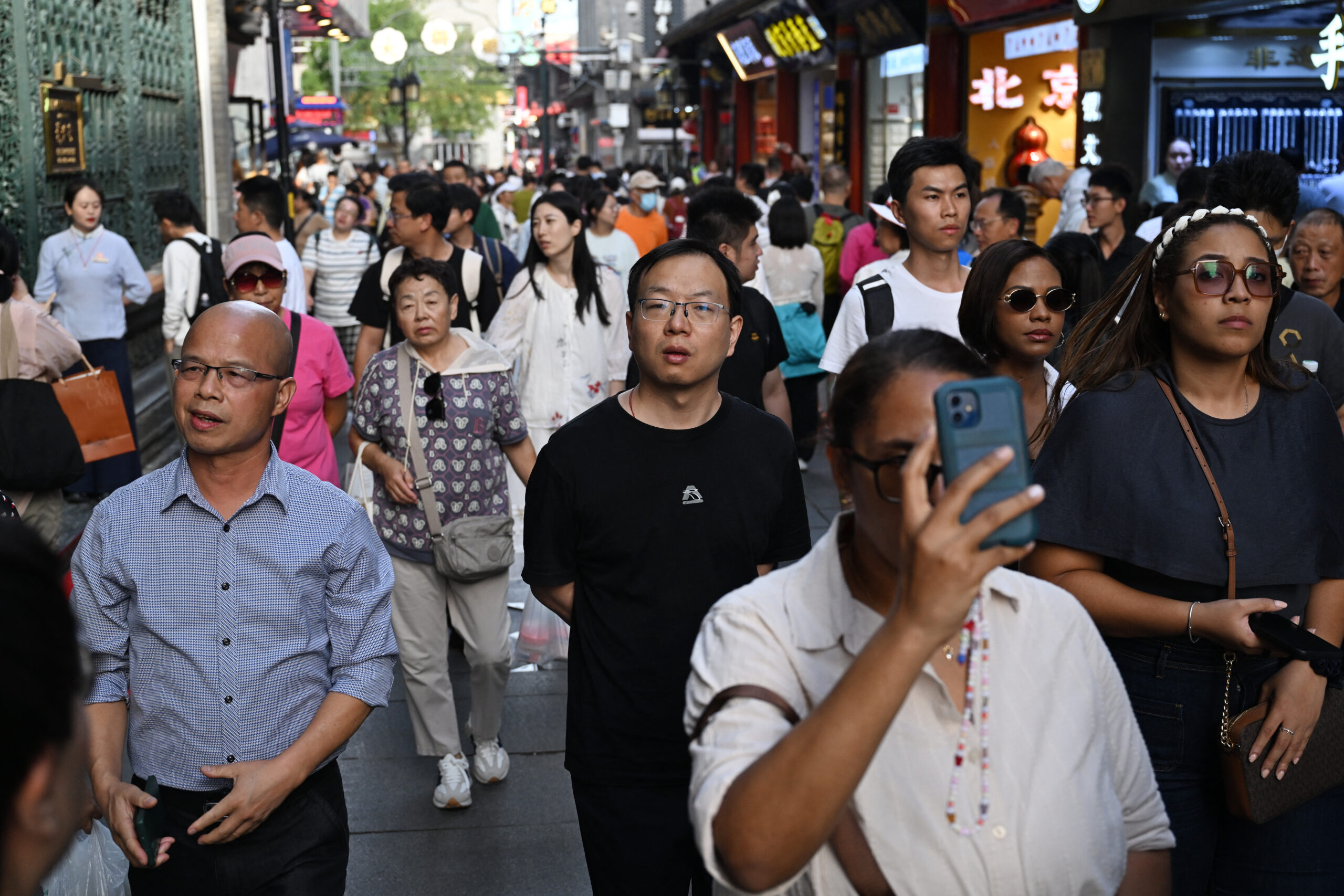
With the upcoming “Golden Week” in China, which combines the Mid-Autumn Festival and National Day holidays, there has been an increase in outbound, long-haul, and multi-destination travel bookings by Chinese tourists. However, the increase in tourist crowds has not been accompanied by a proportional rise in per capita spending. The latest survey shows that Chinese travelers still prefer mid-range and economy accommodations, placing greater emphasis on price and value for money.
This contrast of “rising willingness to travel but still cautious spending” reflects the pressures faced by the Chinese consumer market. Amid a long-standing sluggish real estate market, deflationary pressures, and weak consumer demand, even though analysts anticipate that the tourist numbers during the Golden Week may reach new highs, it may not necessarily translate into an equivalent increase in consumer spending and travel industry profits.
Data released by the Ministry of Culture and Tourism of China shows that the growth in tourist numbers has been faster than consumer spending. In the first quarter of this year, domestic travel grew by 6.0% compared to the previous year, but total expenditure increased by only 2.9%; in the first half of the year, travel numbers increased by 5.4%, while total spending only grew by 2.0%. Accordingly, the per capita spending on each trip in the first half of the year decreased by approximately 3.2% year-on-year.
This year, the Mid-Autumn Festival falls on September 25th, with the National Day holiday starting from October 1st. Some office workers only need to take three days off to combine the two holidays into a 13-day vacation, further extending their travel time.
According to Reuters, Chinese tourists this year not only booked longer holidays but also showed a greater willingness to visit more distant destinations. Shanghai Spring Tour noted a particular popularity in multi-country tour packages.
Spring Tour stated, “The most significant change in outbound tourism is that travelers are willing to go to farther places, which is why this year the sales growth for outbound travel during the holidays is faster than last year.”
Long-haul products for destinations such as Spain, Portugal, the Balkans, Northern Europe, Greece, and New Zealand were sold out before mid-August; routes to Central Asia, the Caucasus, and Australia were also fully booked in advance.
Dragon Trail International, a research organization under the Dragon Trail International, surveyed 1,010 mainland Chinese tourists in August this year. The results showed that as of early August, 77% of respondents had already traveled abroad this year or planned to do so within the year, an increase of 10 percentage points compared to the same period last year. Concerning the Mid-Autumn Festival and National Day holidays, 54% of respondents expressed plans to travel abroad, surpassing the 35% from 2025.
Dragon Trail’s survey predicts a significant increase in outbound travel from China during the Mid-Autumn Festival and National Day holidays this year, with travelers departing over approximately two weeks. South Korea emerges as the primary destination, with Singapore’s popularity on the rise; popular long-haul destinations include France, Iceland, Australia, the Maldives, and Germany.
However, despite the increase in travel bookings, consumers have not significantly loosened their purse strings.
According to Dragon Trail’s survey, mid-range hotels were the most popular accommodation choice during the Mid-Autumn Festival and National Day holidays, accounting for 33%; while lower-priced economy hotels made up 29%, together exceeding sixty percent. In contrast, only 5% of respondents planned to stay in luxury hotels.
The report indicates, “Travelers plan to spend between 10,000 and 20,000 RMB per person for these outbound trips, and significantly favor accommodation in the mid-price range.”
Sienna Parulis-Cook, Director of Marketing and Communications at Dragon Trail, told Reuters, “Compared to the past, the market is more price-sensitive and pays more attention to whether the travel experience is worth the money.”
Data provided by Trip.com Group to Reuters indicates that for outbound flight bookings during this year’s holidays, over half of the departure dates are before October 1st, with an average itinerary length exceeding nine days; hotel bookings for at least seven nights increased by 123% compared to last year’s Golden Week, and multi-destination itineraries increased by 84%.
However, these data primarily reflect the extension of trips and changes in travel patterns, not necessarily indicating a synchronous increase in per capita spending.
The gap between the growth in tourist numbers and consumer expenditure has become a significant indicator of China’s domestic demand. Although the Chinese authorities initiated the “National Day Cultural and Tourism Consumption Month” lasting for a month from September 22nd, in an attempt to boost holiday spending, current market surveys suggest that consumers, while eager to travel, may still be quite cautious in their spending.
Based on official calculations by Reuters, during the 2025 Golden Week period, although tourist numbers increased, the average spending per trip was only 911.04 RMB, dropping to a three-year low.
Ailsa Liao, Senior Analyst at Forthright Securities, stated, “Consumers have a strong desire to travel, but they are still very cautious about how much they spend. This has resulted in a K-shaped spending pattern: even if the number of travelers is strong, the spending of each consumer may still face pressure.”
She pointed out that an extended holiday period may bring about record-breaking tourist numbers, but there is currently no sign of a structural leap in daily spending. Previously, during the 2025 National Day holiday and the 2026 Spring Festival period, per capita travel spending had decreased.
“Just because there are more travelers doesn’t necessarily mean that profits will increase in proportion,” she commented.