
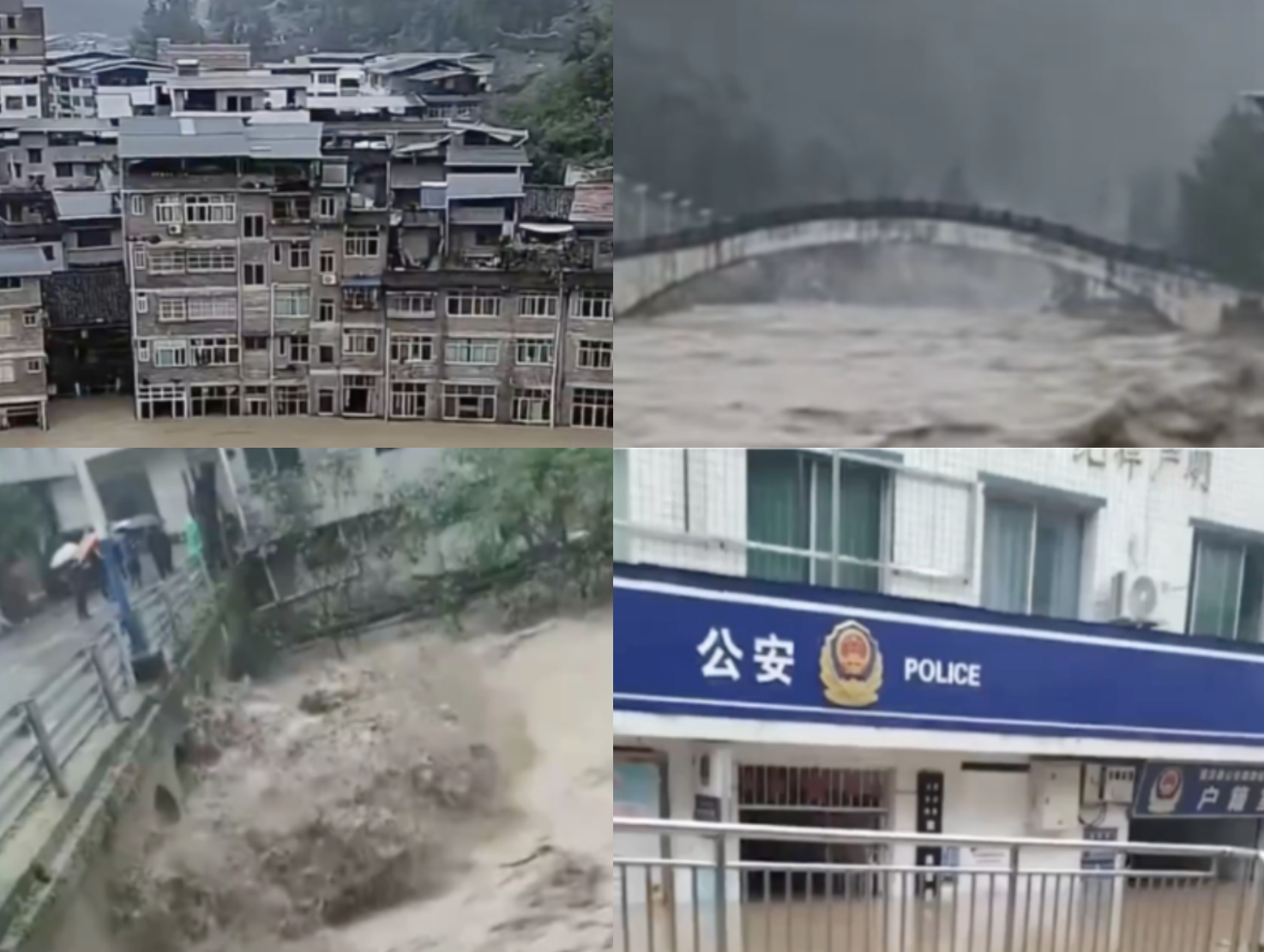
On September 28th, heavy rainstorm hit Sichuan and Chongqing, and rivers overflowed, causing severe damages in multiple areas.
In Sichuan’s Dazhou city, heavy rainstorm submerged a large area of Fankuai town in Xuanhan County, with severe internal floods and water accumulation in the old town area of Nanba town. Many other towns were also affected to varying degrees.
As the downpour struck, river waters surged, causing many homes along the riverbanks to be flooded, with the ground floors inundated.
The streets of Nanba town turned into a vast expanse of water, with ground-floor storefronts submerged, suffering heavy losses. People were urgently rescuing their belongings from the floodwaters.
Videos showed that the police station in Nanba town was inundated by the floodwaters.
A female shop owner affected by the disaster recorded a video, saying, “In half an hour, the riverside road was completely flooded, you can see I didn’t move any of my belongings.”
The footage indicated that after the floodwaters receded, there was at least a 10-centimeter thick layer of mud on the ground.
On September 28th, Chongqing’s Chengkou County also experienced heavy rainfall. Viral videos showed river waters overflowing onto the riverside roads, putting residents’ buildings in a critical situation.
“Oh my, how can we go back like this,” a local woman filmed herself by the river, lamenting that due to the surging river and swift currents, she couldn’t return to her home, expressing her distress by the riverside.
According to monitoring data from Chongqing Water Conservancy Monitoring Station, from 8:00 on the 28th to 8:00 on the 29th, Chengkou, Kaizhou, Yunyang, Wushan, Wuxi, Fengjie, Fuling, Wulong, Shizhu, Pengshui, Nanchuan and other 11 districts and counties in Chongqing encountered heavy to severe downpours. The largest rainfall occurred in Furong Street, Wulong District, with 215.0 millimeters.
State media Xinhua reported that as of 6:00 p.m. on September 28th, 22 townships (streets) in Chengkou County had reported disaster situations, affecting 4017 people. The rainfall has caused general damage to 178 households and 229 units of houses, with 7 households and 34 units collapsing. Additionally, 37.06 hectares of crops were damaged (12.79 hectares were a total loss), 32 roads were damaged to varying degrees, 54 kilometers of fiber optic cables disabled, resulting in a direct economic loss of 14.2269 million yuan.
At 5:00 p.m. on September 28th, the Planning and Natural Resources Bureau of Chongqing and the Chongqing Meteorological Bureau jointly issued a warning that from 8:00 p.m. on the 28th to 8:00 p.m. on the 29th, Wuxi and Chengkou in Chongqing were classified as high-risk geological disaster meteorological areas, with a geological disaster meteorological risk level of Level I (red alert).
Due to the rainfall, the rivers of Panhe, Pingba River, Ren River, Shanmu River in Chengkou County, and Tangxi River in Yunyang County, surged by 4 meters, exceeding the warning water levels.
It is understood that Chengkou County has nine types of reservoirs, with the main one being the Bashan Reservoir located upstream of the Ren River, which was not timely released, resulting in heavy losses to people’s lives and properties. Local residents stated that they hadn’t seen such a large flood in decades.
Mr. Liu, a resident of Chengkou County in Chongqing, told NTD Television, “Dozens of townships in Chengkou have been affected, with significant losses. Landslides are happening everywhere, many roads have been washed away. Many houses are flooded, and many have been damaged, especially in rural areas where some places have been entirely washed away, and some people are missing. Fish farms and crops have suffered heavy losses.”
Late on September 28th, water levels continued to rise in Wuxi County of Chongqing, overflowing onto the streets, leaving residents by the riverbanks sleepless, busy relocating their possessions.
According to China Weather Network, over the next three days (September 30th to October 2nd), widespread rainfall will continue from the western regions to the southern part of the Huang-Huai Rivers to Jiangnan, Southern China regions, with localized heavy rainfalls in Guizhou, Chongqing, and other areas. Meanwhile, cold air will affect most areas of the eastern regions from north to south, intensifying the coolness in the north and reducing the heat in the south, leading to a widespread drop in temperatures to new lows in the past six months.