
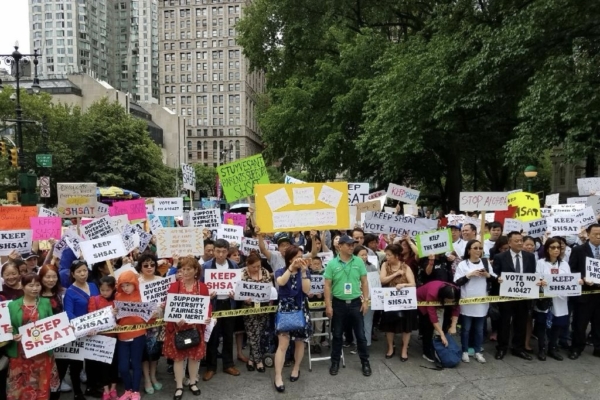
The New York Association of Chinese American Citizens Group (CACAGNY) issued an open letter to the New York City Council on the 28th, strongly opposing Councilmember Lincoln Restler and Vice-Chair Natasha Williams’ proposed “Excellence and Integration Initiative” and Resolution Number 0167-2026. The open letter argues that these measures would weaken the current admissions system for specialized high schools in New York City.
The letter points out that specialized high schools currently admit students solely based on the objective and anonymous Specialized High Schools Admissions Test (SHSAT), a system that has long been proven effective in identifying academic ability and learning potential. These schools enroll only 2% of the city’s public school students but have produced 15 Nobel Prize laureates, showcasing outstanding achievements.
Criticism in the letter suggests that the two council members’ request for specialized high schools to “look like” regular high schools simply translates to “there are too many Asian students” in the ongoing national debate over elite high school curricula and university admissions. CACAGNY emphasizes that council members should explore the secrets behind successful students rather than attempting to undermine the system and oversimplify the admissions issue into a racial proportion problem.
The letter specifically cites a recent article published in City Journal analyzing the controversy surrounding specialized high school admissions. The article highlights Restler and Williams’ proposal of the “Excellence and Integration Initiative” two weeks ago, citing that the current SHSAT system has not admitted enough Black and Hispanic students. However, the proposed initiative offers no assistance in improving the quality of the nearly 1,600 struggling public schools in New York City or addressing the long-term absenteeism of one-third of students; instead, it tries to lower the standards of the eight top high schools.
The article dissects the proposal’s five main points: first, creating approximately 3,000 additional slots in the five specialized high schools established during former Mayor Bloomberg’s term; second, replacing the SHSAT with an opaque process resembling that of private schools, which may consider inflated grades, subjective teacher recommendations, vague definitions of “applicant background,” and application materials that can be bought with money;
third, introducing unverified new math courses at the middle school level; fourth, restricting access to the “Discovery Program” backdoor to 15 of the poorest Asian minority school districts; and fifth, urging the state to repeal the Hecht-Calandra Act protecting the SHSAT system.
The open letter states that neither race nor wealth can explain the performance differences in the SHSAT. Many impoverished Asian immigrant students face language barriers but work hard to prepare for the test using free or low-cost resources. The essence of preparing for the SHSAT lies in compensating for the deficiencies in public school education, cultivating habits of delayed gratification, sustained concentration, and focus on long-term goals, all of which are crucial for academic and life success.
The article emphasizes that the real issue lies in the “artificial scarcity of seats.” With less than 5,000 out of 26,000 applicants admitted last year, the majority of applicants, including Asians, were left out. The best solution is not to lower standards or abolish the test but to follow the experience of adding five specialized high schools from 2002 to 2006, expand and increase slots in specialized high schools within the framework of the Hecht-Calandra Act, allowing every capable student to thrive in a conducive environment.
CACAGNY calls on city leaders to abandon divisive racial frameworks, retain the SHSAT, expand opportunities, and improve basic education to truly benefit New York students.