
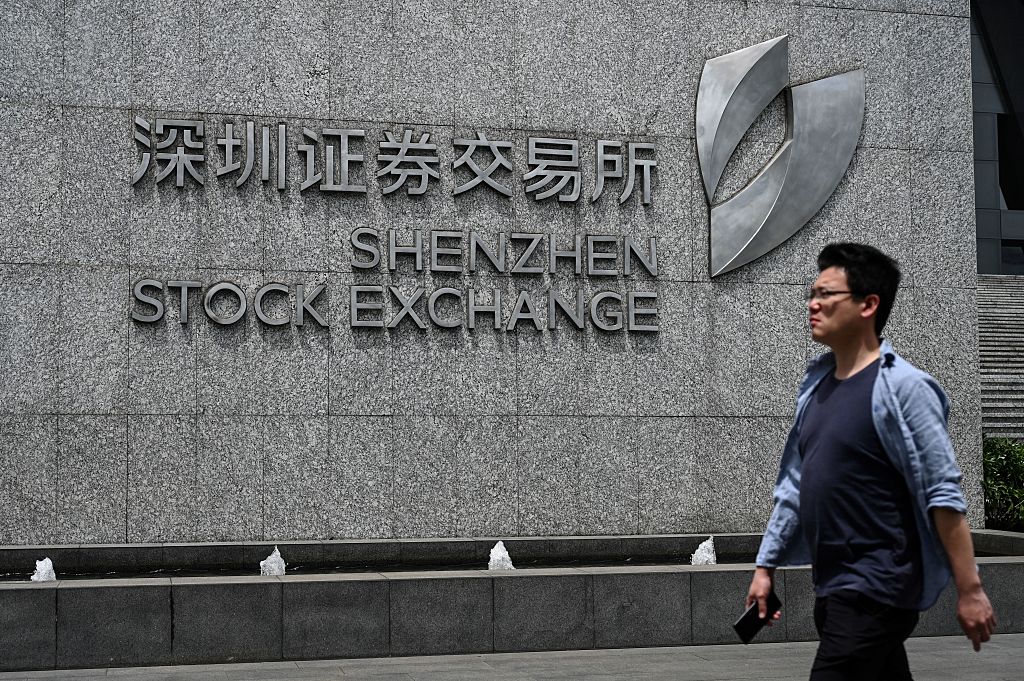
September 28, the first trading day after the Mid-Autumn Festival holiday, saw a sharp plunge across the A-share market in China. Major indexes collectively plummeted, with the ChiNext Index and the Sci-Tech Innovation 50 Index both dropping over 4%. Several key indexes hit new lows in nearly a year, with over 4,500 stocks on the market experiencing a decline.
At the close, the Shanghai Composite Index was reported at 3823.62 points, down 64.75 points, a decrease of 1.67%; while the Shenzhen Component Index stood at 2400.14 points, down 75.94 points, a decline of 3.07%. The ChiNext Index fell by 4.53%, and the Sci-Tech Innovation 50 Index dropped by 4.06%. Additionally, the CSI 300 Index fell by 2.22%, the SSE 50 Index dropped by 2.76%, the Sci-Tech Innovation Composite Index fell by 4.31%, and the Small and Medium Enterprise Index declined by 2.79%.
The total turnover of the Shanghai and Shenzhen markets was 1.7 trillion yuan, significantly higher than the previous trading day’s 494 billion yuan. With over 4,500 stocks in decline, only 896 stocks saw gains. The market displayed a significant loss effect, reflecting a typical pattern of widespread declines on high trading volume.
According to Wind data, the turnover of A-shares has not exceeded 2 trillion yuan for three consecutive trading days. In the 19 trading days of September, only four days saw turnover above 2 trillion yuan. Looking back over time since July, overall turnover of A-shares has been on a downward trend, nearly halving from the previous high of 3 trillion yuan.
Major indices in the market experienced a gap-down opening followed by a sharp decline throughout the day, ending with the major stock indices reaching near year-long lows. The Shenzhen Component Index, the SME 100 Index, the ChiNext Index, and the SZSE 50 Index hit their lowest points in nearly a year.
From a technical perspective, the Shanghai Composite Index’s 120-day moving average has turned downwards, and there are also signs of a downward turn in the 250-day moving average.
On the market front, high-priced stocks faced concentrated selling pressure once again, with many stocks hitting their downside limit. Stocks priced above 100 yuan saw an average decline of 5.41%, leading to a 3.87% drop in the average price index.
At the same time, underperforming and troubled stocks continued to weaken. The price of *ST Lingnan has been below 1 yuan for 15 consecutive trading days, and the number of stocks trading below 1.5 yuan has increased to 30.
“Failure to stop the decline of the Shanghai Composite Index indicates an established large-scale adjustment,” assessed Hong Jian, an intermediate investment consultant at Guotai Junan Securities. He noted that the gap down on Monday directly trapped chips for over a month, and with the decline intensifying and both the 120-day and 250-day moving averages turning downwards, it signals an accelerated testing of the bottom. The market is likely to test and breach the stage bottom of 3741 points, highlighting technical levels at 3731, 3684, 3674, and 3587 points to watch.
“Overall, the market remains in a low position, waiting for stability signals,” said Niu Yang, an investment consultant at Huilong Securities. Although the Sci-Tech Innovation Composite Index did not establish a new low during this round of adjustments, the 250-day moving average, after three previous tests, broke through on Monday, indicating an “effective break.” Hence, high valuation, high-priced, and high-growth stocks are facing significant pressure for long-term value reversion.
The trend of A-shares on September 28 once again became a focus of financial bloggers and investors.
A financial blogger “InvestmentFish” analyzed, “A-shares fell even more sharply today compared to last Thursday, with a total of 60 stocks hitting the limit down and 4554 stocks declining. Many popular stocks experienced significant drops, with some like Yizhongtian plummeting by over 8%, which are institutions’ heavy-weighted stocks. There was news yesterday that the yield on the U.S. 30-year Treasury bond surpassed 5.5%, known as the anchor of the global assets. With such a high rate, money flowed away. Concerns arose about the impact on the stock market, which turned out to be quite significant. Actually, their stock market is fine.”
Another financial blogger “ReviewDuck” reflected, “On the first day after the holiday, the market collapsed directly, with the Sci-Tech Innovation Index dropping by 4 points, and 90% of stocks in the entire market were in the red. The turnover reached 1.7 trillion yuan, real gold and silver fleeing. Institutions are on defense, hot money is withdrawing. The net inflows are into traditional defensive sectors such as power generation, pig breeding, and automotive, meaning survival first. AI hardware, precious metals that were hot before, were hit the hardest, indicating that short-term funding relay games are over, and the previously hyped stocks are now the fast runners.”