
In recent years, China’s economy has been in a continuous slump, with ordinary people experiencing salary cuts, unemployment, debts, reduced consumption, declining business, and other chain impacts. Many interviewees have shared their hardships with journalists. The top officials of the Chinese Communist Party have recently been trying to boost confidence and call for a “correct understanding.” Analysts believe that this exposes the lack of confidence among officials at lower levels, with the Chinese economy already shaken, and the declining trend becoming difficult to reverse.
In Jixian County, Linfen City, Shanxi Province, Mr. Wang, who is in debt of 1 million yuan (RMB), used to run an electrical appliance business and was quite successful. However, he incurred debts after the COVID-19 pandemic in the past few years. Now, he installs photovoltaic systems and manages over twenty workers.
He mentioned that the work of installing photovoltaic systems is unstable: “When there is work, we make some money, but when there isn’t any, no money comes in. Sometimes I have to spend my own money to cover the workers’ expenses.” “This year’s work is even harder. Sometimes we don’t get paid for two to three months.”
Due to the pressure of workers demanding payment, he sometimes has to advance tens of thousands of yuan to cover their living expenses. “Now, there isn’t enough money to spend. The living pressure is too great. Both my children need to pay school fees, which amount to 16,000 yuan per year. I used to worry about this before, but now I manage to pay it.” he said.
Mr. Wang mentioned that he has already downgraded his consumption habits and doesn’t go out to eat with friends as often: “In the past, during good times, we used to eat out every day, spending tens of thousands in one night. Money was easy to come by back then. Now, in a month, I go out to eat with two or three friends only four to five times, spending around four to five hundred yuan each time. I can’t afford more expenses.”
He expressed, “Income does not match the debts you owe. Even if you earn ten thousand in a month, but owe over a million, how much do you have to repay each month? And what about the cost of living? Shouldn’t you support your family, including the elderly and the young ones?”
He added, “In the past, I used to smoke Zhonghua and high-quality cigarettes, a box costing hundreds or tens of yuan. Now, I smoke cigarettes that cost around ten to twenty yuan.”
In Yangxin County, Huangshi City, Hubei Province, a village small shop owner, Yang Huai (pseudonym), stated that business is now slow: “It hasn’t been going well since last year’s Chinese New Year. On good days, we used to sell over three hundred, mainly because of reduced consumption and the impact of online shopping. Businesses are all struggling to do better, so we have to lower prices.”
These types of village small shops now operate as one-stop shops and also sell vegetables. Yang Huai mentioned, “Some of the small shops run from their own houses in our area, a few can still manage, but the majority cannot. I’m struggling too; there’s rental to pay, but no profits coming in.”
He indicated, “Everyone is short of money. You can tell from the cigarettes they smoke. They used to smoke better brands, but now they don’t even buy the expensive ones. Consumption is declining; they avoid unnecessary purchases.” he plans to hang on until the end of the year, and if things don’t improve, he might quit: “I want to go out and make money, but I don’t know what to do. I’m aware that it’s tough to make money outside now. I’ve been working without rest for 365 days a year, it’s exhausting.”
Xiaoying (pseudonym), a female boss of a noodle shop at Majuqiao Dadu Community in Beijing, recently closed down her store and returned to her hometown in Henan. She mentioned, “Business was bad. We were running the shop as partners, but conflicts arose later. The number of people visiting our restaurant has decreased.”
She explained that a bowl of noodles in her shop used to cost around fourteen to fifteen yuan, but due to competition within the industry, with some promoting “6-yuan noodle shops” or offering “all-you-can-eat noodles,” the neighboring noodle shops were all affected. Many shops closed down or changed ownership. Customers now prefer cheaper dining options.”
Hua Shu, a boss selling central air conditioning projects in Nanjing, Jiangsu Province, operated his own company. He commented on the decreasing profits by saying, “I used to make an annual profit of 1 million, which was relatively easy. But now it’s much harder; every industry is facing difficulties.”
Hua Shu mentioned, “My company used to have an annual turnover of over 20 million, but now we only sell a little over 8 million a year. It’s the same nationwide; everyone is facing a lack of business opportunities, and this has been the case since the pandemic. My company is not at the point of shutting down yet, but many others have.”
In Zaozhuang, Shandong Province, a female boss running a mobile phone accessories and repair shop stated that her business is noticeably worse than before: “I’ve been doing this for over twenty years, and it’s evident that it’s not as good as before. It’s just enough to make ends meet. Last year was already worse than the year before.”
She mentioned that there are fewer people shopping, including fewer customers buying mobile phones. In recent years, with the economic downturn and reduced consumption, many businesses have closed down. Previously, it was difficult to rent storefronts, but now there are plenty of vacancies for lease or transfer.
In Huangtang Town, Huian County, Quanzhou City, Fujian Province, a young woman named Aimei, engaged in the tourism industry, works part-time at a supermarket in the evening. “I found a job with meals and accommodation provided to save money. Because the income is low, I work part-time. The combined income from both jobs is less than ten thousand yuan, while grassroots wages generally range from three to five thousand yuan.” She mentioned that the tourism industry is currently bleak, and she barely manages to survive on a basic salary.
She stated: “Everyone is earning less, hence fewer people are traveling.”
Aimei intentionally keeps track of expenses to save money, keeping monthly expenditures around 500 yuan.
“For items like skincare products, cosmetics, and daily necessities, I buy them once last a long time. If they are not purchased, they are not included in the expenses. There are also mobile phone bills, dormitory electricity bills that amount to over a hundred yuan. I wear uniforms to work a lot, and now I rarely buy clothes. In the evenings, I work at the supermarket, often getting some soon-to-expire bread and fruits. I’m too busy to go shopping or socialize. It’s another way to save money.”
Some months require more spending, and Aimei provided the journalist with a bill showing expenditures over seven hundred yuan in August.
“Currently, everyone is solely focused on living their own lives, not socializing much. They will purchase what is necessary, but unlike before, they are more frugal.” Aimei admitted, “When finding a boyfriend for marriage, if I like the person, I will marry. If not, then I won’t. Saving money is to prepare for uncertainties. Having money gives confidence. I’m saving up for retirement to live a comfortable life.
She also noted that Huantang Town, Huian County, is a small town known for tourism and vacationing, where prices are not considered cheap. At the supermarket where she works, at around six or seven in the evening, vegetables are put on sale and many elderlies rush to buy them.
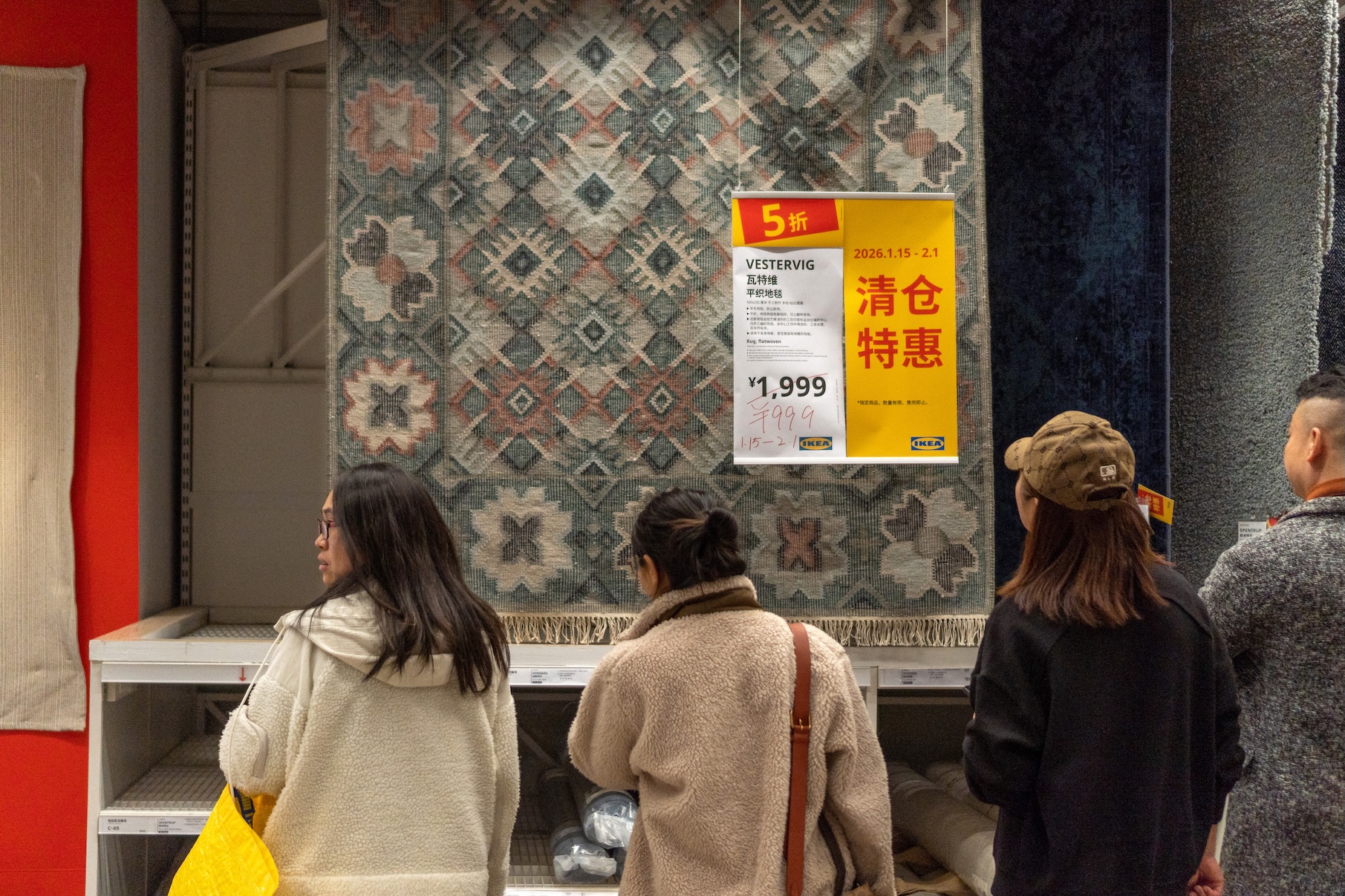
In recent years, a common sight in China is people frantically grabbing discounted items at supermarkets.
On August 26th, inside a supermarket in Huaibei, Anhui, several citizens were captured in a video rushing to grab loose rice at a promotion counter. The crowd was emotionally charged, and the scene was chaotic with many people scooping large amounts of rice with their hands, some even lying on the rice pile to make purchases.
Economic blogger “InTheWild” stated, “Isn’t there someone around you who complains about how hard it is to earn money, but jumps at any bargain they see? While it seems good when prices drop, have you ever considered that the reason behind the drop is that people are genuinely reluctant to spend money? That’s the most terrifying aspect. You might feel happy to save a bit while shopping for groceries, but have you thought about the neighboring store that’s forced to lower prices just to survive?”
It’s not just people complaining about the poor economy. Due to China’s weak economic performance, the Central Financial and Economic Committee of the CCP published articles for four consecutive days at the end of August, attempting to restore market confidence. However, the effectiveness of these actions has been questioned by the public.
Hong Kong’s Ming Pao sarcastically commented that a few articles cannot possibly boost the market or restore confidence; ordinary people continue to experience tough times, with the actual unemployment rate rising, and income decreasing.
Cai Qi, a member of the Central Committee of the CCP and the dual-role Party School principal, emphasized the need to “correctly view” the current economic situation during the opening ceremony of the school’s autumn semester at the end of August. He stressed the importance of “strengthening confidence, stabilizing expectations,” coordinating development, ensuring security, and “correctly understanding and handling the current situation and tasks.”
Chinese issues expert Li Linyi stated that Cai Qi had previously been advocating an optimistic view of the economy, but his recent call for “correct views” and understanding of the economic situation implies that lower-level officials have lost confidence, and the Chinese economy is indeed in turmoil, making it challenging to reverse the declining trend.