
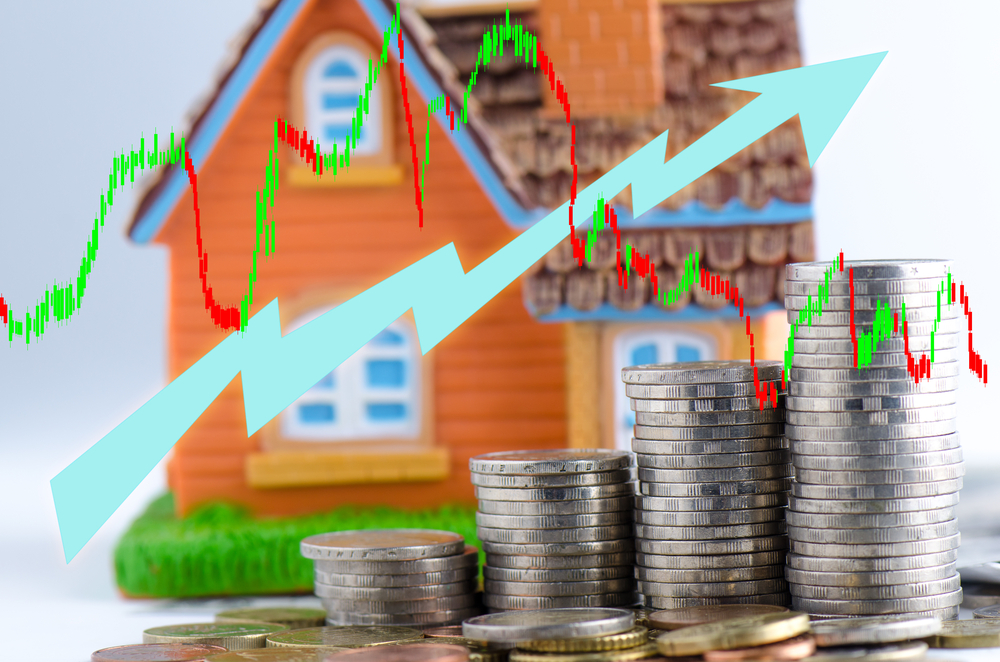
In recent years, there has been a debate between the idea that “renting is more cost-effective than buying a house” and the notion that “investing in stocks yields higher returns.” However, many people have accumulated a significant portion of their wealth through homeownership. So, which argument is correct? For ordinary families, the answer cannot solely rely on the pace of housing prices and stock market growth but needs to consider three distinct financial aspects.
According to a comparison by “Fortune” on September 27, over the past 10 years in the United States, while housing prices increased by 87% from December 2015 to December 2025, the S&P 500 index surged by 235%, without even factoring in dividends.
On the surface, the answer seems obvious: invest in stocks. But for the average person, the calculation is not that simple. Most people do not buy a house with $500,000 in cash; instead, they put down $100,000 as a down payment and borrow $400,000 from a bank. Therefore, the decision between renting or buying a house, or buying stocks, involves three distinct financial considerations.
The first aspect is determining where it is more cost-effective to live at present. The biggest challenge in buying a house in the U.S. currently is the high cost of both housing and borrowing money. The average 30-year fixed mortgage rate reached 7.03% on September 24. Apart from mortgage repayments, there are additional expenses such as property taxes, home insurance, and maintenance. The relative cost of housing compared to rent in the U.S. remains close to historical highs, as noted by the St. Louis Fed in late August.
As of June 2026, national housing prices in the U.S. saw a mere 1.5% year-on-year increase while the inflation rate stood at 3.5%. Although housing prices appear to be rising, the growth rate is trailing behind inflation. Adjusted for inflation, real housing prices have seen a continuous decline for 13 consecutive months.
Therefore, in many markets, the answer to the question of whether it is cheaper to rent or buy for monthly savings might lean towards renting. This is why the notion of “renting is more cost-effective than buying a house” has been gaining traction in recent years. It considers the monthly expenses rather than who will have more assets 20 years down the line.
The second consideration is which investment, housing, or stocks, has performed better over time. Over the past decade, stocks have clearly outperformed.
Suppose that at the end of 2015, one had $500,000 and did not need to borrow money. If $500,000 was used to buy a house, with an 87% increase in U.S. house prices over 10 years, by the end of 2025, the house would be worth approximately $935,000. Alternatively, if the same $500,000 was invested entirely in the S&P 500, with a 235% increase in price, it would amount to about $1.675 million by the end of 2025, excluding dividends.
This comparison does not include deductions for property taxes, insurance, maintenance costs, or transaction fees post-purchase. Therefore, with no mortgage involved, comparing a $500,000 house purchase to a $500,000 stock investment over the past 10 years, the S&P 500 clearly comes out ahead.
However, for ordinary families, purchasing a house typically does not follow this scenario.
Suppose two individuals have $100,000 each. One person invests the entire $100,000 in the stock market, while the other person puts down a 20% down payment of $100,000 to buy a $500,000 house and borrows the remaining $400,000 from a bank.
If housing prices increase by 10%, the $500,000 house becomes worth $550,000, resulting in a $50,000 gain. Despite a modest 10% increase in housing prices, compared to the initial $100,000 down payment, the asset has increased by $50,000. This illustrates the leverage of mortgage financing.
Conversely, if the $500,000 house depreciates by 10% to $450,000, and the $400,000 mortgage remains, the initial $100,000 down payment might only account for approximately $50,000 in equity. Therefore, mortgage financing can magnify both gains and losses.
Moreover, when repaying the mortgage each month, a portion of the money goes towards principal repayment. As the amount owed to the bank decreases, the individual’s net housing equity increases. This is why despite lower long-term price increases compared to the stock market, buying a house can still help ordinary families build wealth.
However, renters can also take a different approach. Suppose the monthly housing expenses for buying a house are $4,000, while renting the same property costs only $2,800. By renting, one could save $1,200 per month. If the $100,000 intended for a down payment is invested in stocks and the monthly savings of $1,200 are consistently invested in stocks in the long run, one could accumulate a substantial asset over ten or twenty years.
The question arises whether the saved money is actually being invested. If $1,200 is saved each month but spent on dining out, traveling, or other expenses, the person who bought a house may have significantly reduced their mortgage over 20 years and possess a sizeable housing equity. In contrast, the renter may not have accumulated a corresponding amount of stock assets.
Therefore, the statement that “renting is cheaper than buying a house” and the assertion that “stock returns surpass housing prices” are both valid. The former considers monthly housing costs, while the latter compares asset growth. However, what truly matters for ordinary families is the third aspect: how much wealth one has accumulated after many years.
Homebuyers leverage a down payment to acquire a larger asset, gradually increasing housing equity through mortgage repayments. Renters, on the other hand, must continuously invest the money not used for a down payment and the monthly savings from renting in the stock market.
Ultimately, the wealth comparison does not solely depend on the pace of housing prices or stock market growth but also factors in mortgage leverage and whether the money saved from renting is actually invested wisely.