
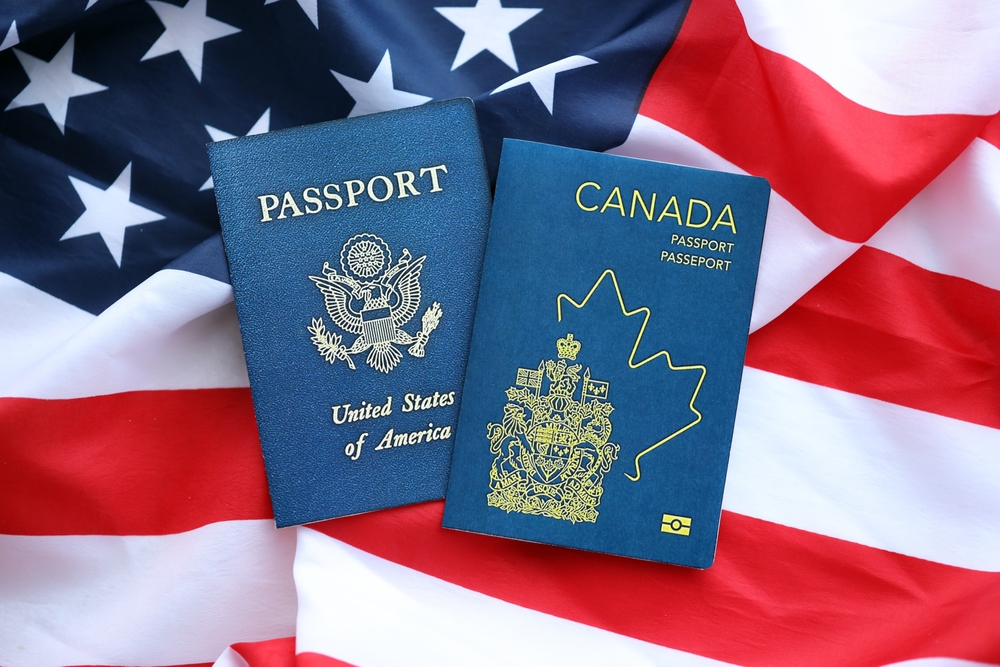
In recent times, despite their children being in their twenties or thirties, some American parents have begun delving into their family history, searching for birth certificates, and even tracing back to great-grandparents, all for the sake of providing their adult offspring with an additional Canadian identity.
According to a report by CIC News on September 27th, after Canada amended its Citizenship Act last year, some individuals who were previously unable to inherit Canadian citizenship due to the “first-generation restriction” may now have become Canadian citizens. Consequently, some American parents have started researching Canadian ancestors within their family lineage, hoping to offer their adult children an extra option for work, study, or living in Canada.
One such individual is 27-year-old Mina, a data analyst living near Detroit. She has long desired to work in Vancouver and spent a considerable amount of time discussing a position there but faced a significant hurdle: obtaining a work permit.
A turning point arrived when her mother came across an article. Mina’s father, Michael, was reminded of a name he hadn’t thought of in decades – his great-grandfather, Josef.
Josef immigrated to Canada from Hungary when he was a teenager and arrived in Eastern Canada in the 1880s. He opened a grocery store locally and obtained Canadian citizenship in Halifax in 1896 when the legal status was a British subject. Subsequently, he relocated to Michigan, USA.
Michael quickly found his great-grandfather in the 1911 Canadian census records. With the new Canadian Citizenship Act in effect, this piece of family history from over a hundred years ago suddenly holds practical significance: Mina could potentially be a Canadian citizen.
While Michael himself wasn’t in a rush to leave Detroit, if both he and his daughter could confirm their Canadian citizenship, it would open up additional choices for Mina, who was initially restricted by work permit regulations.
A key change stemmed from the enactment of the C-3 Act on December 15, 2025. Previously, Canada had set a “first-generation restriction” for foreign-born individuals to inherit citizenship. Simply put, a Canadian citizen’s first-generation foreign-born child could acquire Canadian citizenship, but typically, their subsequent generations couldn’t automatically inherit if they were also born abroad.
The new law has lifted some of these restrictions. The Canadian government stated that individuals born before December 15, 2025, who were unable to obtain citizenship due to the “first-generation restriction” or previous laws may now have automatically become Canadian citizens.
However, having Canadian ancestors does not automatically qualify someone for citizenship. Whether one possesses Canadian citizenship still depends on the specific circumstances of the family and relevant legal provisions, ultimately subject to confirmation by the Immigration, Refugee, and Citizenship department (IRCC) of Canada.
Consequently, these individuals are not undertaking the typical processes of “immigration” or “naturalization,” but rather applying for Canadian citizenship certificates to validate the potential Canadian citizenship they may possess.
This is also why some American parents are willing to delve into generations of family records for their adult children. If a child is confirmed as a Canadian citizen, future endeavors like working in Canada won’t require a work permit, alleviating concerns about employer sponsorship due to citizenship issues.
The distinctions in university studies can be even more direct. CIC News noted that international undergraduate students in Canada may pay over five times the tuition fees compared to local students, with differences exceeding $100,000 over four years. International students typically have a cap of 24 hours per week for off-campus work, a restriction not imposed on Canadian citizens studying in Canada.
For many families, the value of this identity lies not in an immediate relocation to Canada but in providing their children with an additional option for the future.
The new law doesn’t pave the way for the automatic passing down of Canadian citizenship through generations of foreign-born individuals. December 15, 2025, marks a significant dividing line.
The Canadian government stipulates that if children are born on or after this date, and both Canadian parents were born outside Canada, to transmit citizenship to the next generation, the parents must generally prove a cumulative residency of at least 1,095 days in Canada before the child’s birth, equivalent to 3 years.
However, the rules differ for those born before December 15, 2025. If born outside Canada and the parents were Canadian citizens at the time of their birth, in most cases, they have now automatically become Canadian citizens; this also includes some descendants of parents who obtained citizenship as a result of this legislation change.