
In northeast China, the well-known rice brand “Wuchang Rice” has an annual production of seven to eight million tons, but its market sales reach tens of millions of tons, making it a hot topic on the internet again recently. For years, the issue of “fake Wuchang rice” has been ongoing.
According to Dahe Daily, the Wuchang Rice Harvesting Ceremony for 2026 was held on September 17th in Longfengshan Town, Wuchang City, Heilongjiang Province, marking the beginning of the autumn harvest season for 2.53 million mu of rice fields in 24 townships across the city. Zhang Ye, Director of the Wuchang Rice Industry Service Center, stated at the ceremony that this year’s rice production is expected to exceed 800,000 tons, potentially setting a new historical record.
It is reported that the annual production of Wuchang Rice is about seven to eight million tons, while the rice labeled with the “Wuchang” brand in the market reaches over tens of million tons, a difference of more than tenfold. There is an issue in the market of mixing rice from other regions with Wuchang rice for sales, using lower-priced “long-grain fragrance” to pretend to be “Dahuali No. 2,” and counterfeit packaging.
More than a decade ago, the problem of fake Wuchang rice was frequently exposed.
In May 2015, Xinhua News Agency investigated the Wuchang Rice chaos.
At that time, according to estimates by industry insiders, the rice marketed as “Wuchang Rice” nationwide was at least 10 million tons, while the agricultural department of Wuchang City calculated the maximum annual rice production to be around 1.15 million tons based on approximately 2.2 million mu of rice planting area, 1500 catties of rice per mu, and a maximum of 70% milling rate.
In 2018, Workers’ Daily reported the issue of Wuchang Rice again. Yan Chen, the former Director of the Agriculture Bureau of Wuchang City, stated that the actual annual production of “Wuchang Rice” was about 650,000 tons. The report also cited previous media estimates, claiming that over 90% of the “Wuchang Rice” on the market might be counterfeit.
Due to the limited amount of rice that can be produced in Wuchang, where are the numerous products labeled as “Wuchang Rice” in the market actually coming from?
In 2015, an official investigation found that a large amount of rice from other regions was transported to Wuchang, processed by local enterprises, and then sold back to other regions. Some of it was made into so-called “blended rice,” where rice from different sources and varieties is mixed in certain proportions.
It was revealed that “blended rice” mainly includes mixing rice from outside the region with Wuchang local rice, mixing Wuchang local rice with Dahuali, and mixing rice from outside with Dahuali, among others. The influx of rice from other regions into Wuchang has also led to the emergence of a business called “patchwork”: some people purchase rice from other regions and sell it to Wuchang processing enterprises, earning three to five cents per kilogram.
As early as 2010, the media exposed the problem of foreign companies adding flavors to rice and pretending to be Wuchang Dahuali. The 2015 investigation by Xinhua News Agency also listed it as an early case of the Wuchang Rice brand crisis.
In recent years, this issue has extended to live-streaming e-commerce.
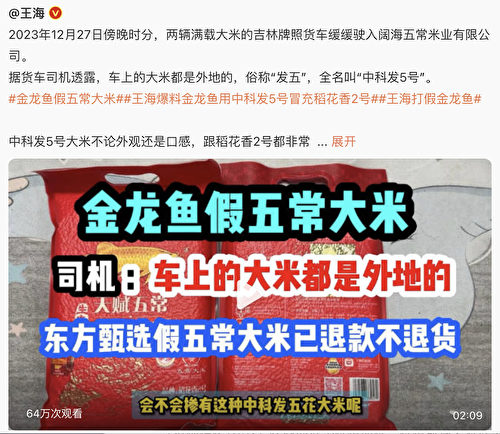
In January 2024, well-known anti-counterfeiting expert Wang Hai publicly reported that after sending samples of Wuchang Rice sold by the “Crazy Little Yang Brother” related accounts for inspection, the DNA genetic similarity with the standard sample of “Dahuali No. 2” was only 71.16%, indicating they were different varieties.
In the same month, “Food Safety China” published a video claiming that after purchasing the same product from the involved brand “Food Bowl Beauty” official flagship store, inspection at the Hainan Yazhou Bay Molecular Testing and Identification Center also showed 71.16% similarity.
The Little Yang Brother denied that the products were sold under their name.
A few days later, “Food Safety China” released test results stating that a product labeled as “Dahuali No. 2 Wuchang Rice” by Oriental Selection had a DNA genetic similarity of 84.23% with the standard sample of Dahuali No. 2, indicating a different variety.
However, the Oriental Selection customer service told Southern Metropolis Daily that the product had been sent to an authoritative plant variety DNA testing institution and was confirmed to be Dahuali No. 2.
It is important to note that these tests only verified whether the variety was Dahuali No. 2 and did not directly determine the origin.
Wuchang Rice is a geographical indication product, while “Dahuali No. 2” is a specific rice variety.
According to an official investigation in 2015, in 2003 Wuchang Rice was designated as a protected geographical indication product, and over 40 varieties produced in the 24 townships of Wuchang City can be called Wuchang Rice under certain conditions. Dahuali No. 2 was named “Five Excellent Rice No. 4” after being approved by the national seed department, and it is just one of the most well-known varieties among them.
Therefore, not all rice produced in Wuchang is Dahuali No. 2, and Dahuali No. 2 does not equate to Wuchang Rice.
Even if a bag of rice is proven through DNA testing not to be Dahuali No. 2, it cannot be solely determined by this result that it is definitely not produced in Wuchang. Conversely, even if a bag of rice is Dahuali No. 2, if the raw materials are not from Wuchang, it cannot be called Wuchang Rice.
This has been a source of confusion in some “DNA anti-counterfeiting” controversies in recent years.
The long-standing counterfeiting of Wuchang Rice is closely related to its brand premium.
Located in Harbin, Heilongjiang Province, Wuchang benefits from cold black soil, climate, and water sources, which combined with specific rice varieties, have formed its rice brand.
Among them, Dahuali No. 2, known for its aroma and taste, has gained recognition in the market. The more valuable the brand, the greater the space for counterfeiting and mixing.
From the 2015 official media report of “producing up to 1.05 million tons annually, with at least 10 million tons on sale nationwide,” to the recent reappearance in 2026 of a discrepancy where the annual production is seven to eight million tons but the market volume reaches tens of million tons, for more than a decade, issues such as influx of rice from other regions into Wuchang, mixing different varieties, false origin labeling, and counterfeit packaging have repeatedly occurred. With the limited amount of rice produced in Wuchang, how many of the so-called “Wuchang Rice” in the market actually originate from Wuchang?