
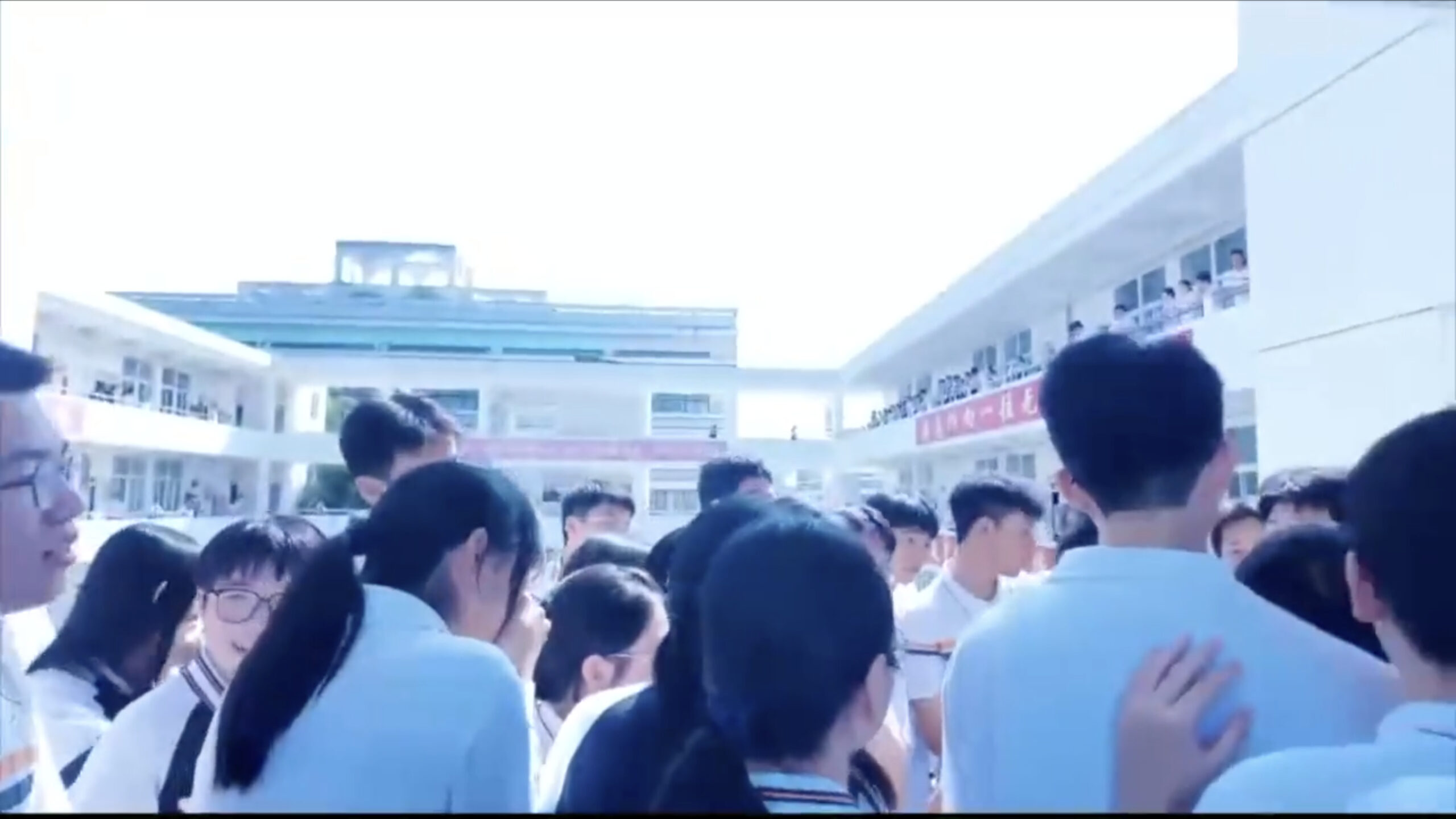
In recent years, protests on school campuses have been increasing in various parts of China. Students at the First High School in Xiapu County, Ningde City, Fujian Province, have been protesting for several days, demanding the cancellation of evening self-study sessions before the Mid-Autumn Festival holiday. Despite the students’ protests, the school ultimately decided to stick to the original schedule. Interviewed students stated that during the protests, thousands of students shouted in dormitories and marched, while the school responded with warnings and on-site supervision.
From September 22 to 24, students at the First High School in Xiapu County, Ningde City, Fujian Province protested collectively because they were still required to attend evening self-study sessions before the Mid-Autumn Festival holiday, demanding that the school cancel these arrangements.
During the protests, students shouted in dormitories, requested to go home, sang the “March of the Volunteers,” held marches, and communicated with school representatives.
On September 24, student representatives negotiated with the school regarding evening self-study, but the school maintained its original arrangement. That day, the school warned students not to cause disturbances, or they might face disciplinary action, and the discipline department staff monitored the situation on campus. That evening, students continued their protests and marches inside the dormitory buildings.
A senior high school student interviewed by the media confirmed, “There were protests at the school, but I was on sick leave and not at school. I am now a senior high school student attending classes as a day student, whereas freshmen and sophomores stay on campus.”
The student mentioned that self-study sessions for his grade usually go on until 10 PM.
Another informed student, Shen Minghao (pseudonym), provided more detailed insights into the events. Shen Minghao explained that the collective protests by students mainly occurred from September 22 to 24, involving a large number of participants.
“There were thousands of students protesting. They shouted in the school dormitories, requested to go home, sang the national anthem, and even held demonstrations during the protests,” Shen Minghao reported.
According to Shen Minghao, the core demand of the student protests was to stop the evening self-study sessions before the Mid-Autumn Festival holiday. The students believed that as the holiday approached, the school’s requirement for them to stay late at night occupied the time they could have used to return home early, thus they hoped the school would cancel such arrangements.
During the protests, student representatives communicated with the school administration. Shen Minghao stated, “The students ultimately did not succeed in getting the evening self-study session canceled. The protest was unsuccessful, and I heard that self-study would still be held on the 30th.”
In the afternoon of September 24, a student directly called the principal to express their lack of understanding regarding the continuation of evening self-study before the holiday. During the conversation, the principal repeatedly interrupted the student and questioned why they were opposed to the self-study sessions.
While the students and school representatives were in dialogue, the school began managing the students’ collective actions.
Shen Minghao revealed that school authorities warned the students not to continue causing disturbances, stating that “otherwise, there would be consequences.”
As the protest continued until the evening of September 24, the school’s discipline department sent staff to the teaching building to manage the situation.
However, the student protests did not completely stop.
Shen Minghao mentioned that on the 24th, students were still marching in the boys’ dormitory and singing the “March of the Volunteers.”
Based on the descriptions provided by the students, this ongoing collective action mainly revolved around a specific demand—cancelling the evening self-study sessions before the Mid-Autumn Festival holiday. The students expressed their demands through shouting in dormitories, singing songs together, marching, and communicating with school representatives. However, in the end, the school did not cancel the related evening self-study arrangements.
The First High School in Xiapu County is a century-old prestigious school with significant influence in Ningde City and Fujian Province. The school has around 300 teaching staff members and offers both junior high and senior high divisions, with approximately 3,000 to 4,000 students enrolled.
The situation at the First High School in Xiapu is not unique. Since 2025, similar collective student actions have occurred in various middle schools and vocational schools across China.
On July 10, 2026, freshmen at the First Senior High School in Anlu City, Hubei Province, launched a massive strike within the school premises, protesting the reduction of their originally scheduled 20-day summer vacation to just 5 days. The students paraded inside the school, displaying banners advocating “anti-autocracy and promoting equality,” while questioning the school administration on the recurring student protests.
On May 16, 2026, over 2,000 students from the First High School in Wenshang County, Jining City, Shandong Province, gathered in the school square, chanting slogans demanding “time off” and protesting against the continuous reduction of their resting time by the school authorities.
On February 1, 2026, students from a fully enclosed anti-addiction school in Dezhou City, Shandong Province, initiated protests due to their dissatisfaction with the oppressive environment, leading to dormitory damages and instructors fleeing, sparking widespread online support.
On October 16, 2025, thousands of students from the First Vocational School in Yulin, Guangxi Zhuang Autonomous Region, converged on the campus, protesting against the school’s upcoming mobile phone control regulations.
On the evening of September 11, 2025, hundreds of students from Yizhong Middle School in Zunhua City, Hebei Province, protested collectively because they disagreed with the school’s unauthorized adjustment of the holiday schedule.
On the night of September 7, 2025, a large-scale student protest erupted at the Weining Vocational and Technical School in Bijie City, Guizhou Province. Residents protested the school’s ban on bringing mobile phones, leading to some students damaging dormitory facilities.
On May 23, 2025, a female student from the Sixth Middle School in Xuchang City, Henan Province, died after jumping off a building following physical punishment by a teacher, triggering a public outcry where emotionally charged students rallied at the school, smashing school properties in protest, resulting in student arrests.
On the evening of March 2, 2025, due to unreasonable school regulations at the Second High School in Shantou City, Guangdong Province, some senior students initiated protests.
On January 18, 2025, thousands of students from Chushui Experimental Middle School, Xinghua Middle School, and Xinghua First High School in Xinghua City, Taizhou, Jiangsu Province, protested, leading to the cancellation of the winter vacation remedial classes planned by the schools.
In addition to these cases, statistics from research institutions also indicate an overall upward trend in similar protest events.
According to statistical research by the Alternative Voices under the Freedom House, there were as many as 1392 protest events in China during the third quarter of 2025 alone, a 45% increase compared to the same period in 2024. The majority of these protests were led by workers, business owners, and villagers. Others were driven by diverse groups including parents, students, investors, consumers, religious minorities, and activists. Schools have increasingly become common sites for protests, as concerns about campus safety trigger large-scale demonstrations.