
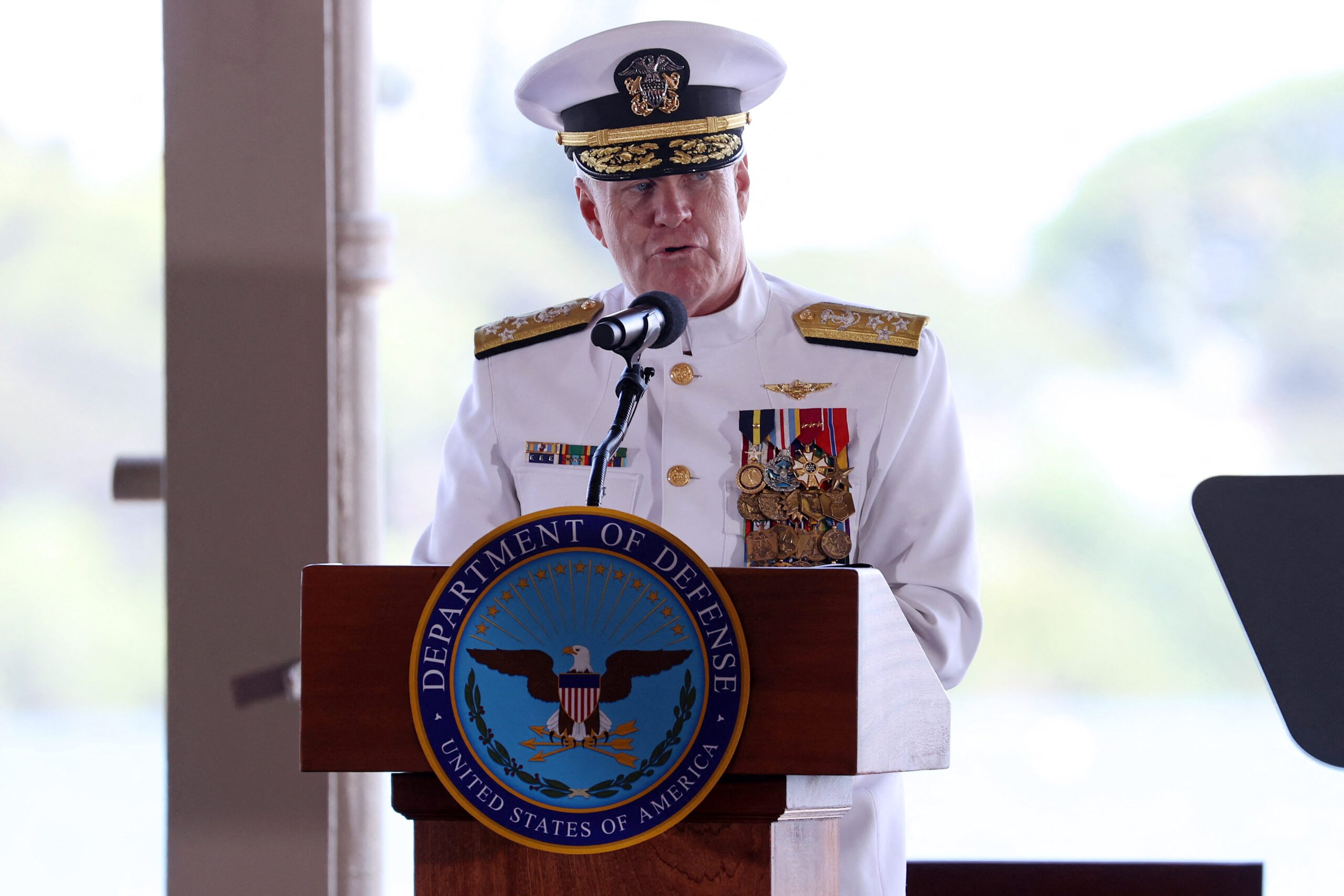
The US Time magazine published an interview on September 24th, planning to feature Admiral Samuel Paparo, the Commander of the U.S. Pacific Command, on the cover of the October 12th issue.
At 61 years old, the American Navy Admiral emphasized during the interview at the Pacific Command headquarters in Hawaii, that his core mission is to prevent any potential aggression from China towards Taiwan through the concept of “deterrence by denial,” aiming to achieve victory without engaging in warfare.
Admiral Paparo quoted Sun Tzu’s Art of War, stating that true success lies not in winning a battle but in possessing both the capability and resolve that make the opponent reluctant to start a war. “We are not seeking to become great wartime leaders, but rather great deterrents in times of peace.”
He mentioned that the key to “deterrence by denial” is to demonstrate credible combat strength, safeguard core secrets, and make the Beijing regime understand that any aggressive actions that threaten direct U.S. interests are likely to be stopped.
In the event that the strategy of “deterrence by denial” fails, Paparo presented the “Hellscape” tactical concept. He explained that if conflict erupts in the Taiwan Strait, the U.S. military would deploy a large number of low-cost, mass-produced precision drones throughout the strait, combined with traditional high-tech missiles, aiming to impede or significantly delay any potential amphibious landing by China, making the aggressor unable to utilize the battlefield space.
He mentioned that this concept was partly inspired by the conflict in Ukraine, as 21st-century technology can significantly enhance offensive efficiency.
A study by the Center for Strategic and International Studies (CSIS) in 2023 indicates that in most scenarios, the U.S. military and its allies could repel Chinese actions against Taiwan, but might face the loss of two aircraft carriers, dozens of warships, and hundreds of military aircraft, potentially leading to the most severe losses since World War II.
Paparo expressed confidence in achieving victory, with the current focus being on minimizing personnel, equipment, financial, and time losses, aiming to reduce consumption to zero.
In June, the Pentagon announced the restoration of the historical name “Pacific Command” to the Indo-Pacific Command.
Currently, the Pacific Command has approximately 400,000 military and civilian personnel. The Pacific Fleet consists of around 200 warships, 5 carrier strike groups, and over 1,000 military aircraft, covering responsibility for about half the earth’s surface.
Paparo pointed out that the Chinese Navy has increased its fleet with many cruisers, destroyers, submarines, and aircraft carriers in the past 18 months, expanding its size to 12 times that of 25 years ago.
Previously, Chinese leader Xi Jinping had called for the PLA to be capable of taking Taiwan by 2027.
A U.S. intelligence assessment in 2026 indicated that Beijing currently does not plan to invade in 2027 but is actively enhancing its capabilities for an attack on Taiwan.
Paparo stressed that U.S. military readiness must be continuous, showcasing credible strength while protecting critical capabilities from being targeted.
Paparo comes from a working-class family, where neither his father nor grandfather had a college education, making him the first in the family to graduate from university.
He mentioned that after watching the movie “Top Gun” in 1986, he was inspired by the character “Iceman” and joined the Navy the following year. He graduated from fighter weapon school and currently has over 6,000 flight hours, with more than 1,100 carrier landings.
Paparo’s office displays the 1942 Time magazine cover featuring Chester Nimitz, as he views Nimitz as a leadership model for adapting to technological changes.
Paparo expressed his hope that all the tactics he plans never have to be implemented. “If I do my job well, history will never know my name. Because the best outcome of service is to prevent that cruel moment from ever arriving.”