
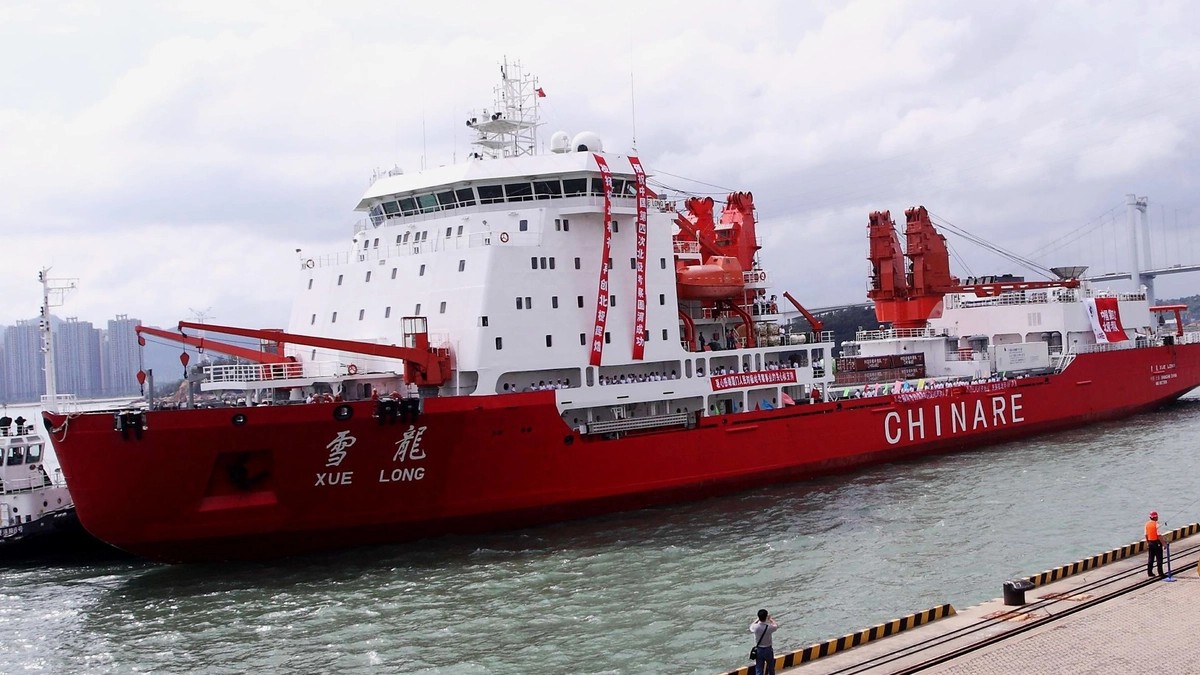
In July, the Chinese icebreaker “Xuelong” quietly crossed the Bering Sea in the northern Pacific Ocean on a scientific research mission. The U.S. Coast Guard cutter “Munro” closely monitored its journey, traversing the U.S. exclusive economic zone and extended continental shelf. Meanwhile, China’s “Xuelong 2” was also heading towards the Arctic Ocean. There were no apparent violations or military conflicts between the two sides during this encounter, making it particularly significant.
China’s Arctic strategy has been advancing through a series of activities, ranging from scientific expeditions to icebreaking operations. These activities, while defensive in nature, ultimately serve Beijing’s long-term goals. Scientific voyages gather data, icebreakers accumulate navigation experience, and cooperation with Russia opens up opportunities in ports, resources, and maritime routes. The Svalbard archipelago in Norway provides China with a established scientific foothold within the territory of the NATO. Chinese vessels aim to transform experimental Arctic voyages into regular commercial routes, enhancing Beijing’s operational capabilities and consolidating its influence.
The U.S. Coast Guard has correctly distinguished between legitimate passage and oceanic scientific research requiring American permission. This distinction must be maintained, without obscuring the underlying patterns.
By 2025, China was operating 5 research vessels in the Arctic Ocean, up from 3 in 2024 and 1 in previous years. The Norwegian Intelligence Service’s 2026 assessment stated that China’s growing fleet of icebreakers allows for more frequent voyages, enhancing its ability to conduct civilian and military surveys in the region and supporting its long-term ambitions for independent actions in the polar regions.
This trend continues as in September, the U.S. Coast Guard reported that during 2026, 4 Chinese research vessels were active around Alaska and the Bering Strait. While still in international waters, U.S. officials suggested these missions could support seabed mineral exploration and potentially provide military advantages to the Chinese Communist Party.
Climate and ocean research are undoubtedly legitimate pursuits. However, Beijing’s repetitive appearances in the region, whether with military mission orders or not, have strategic value. Crews gathering data on seafloors, ice layers, and atmosphere are simultaneously deepening their understanding of the operational environment. Chinese institutions are accumulating specialized technical expertise rarely held by other nations. While capabilities quietly increase, Western governments are left to passively assess when routine research becomes strategically significant.
Svalbard provides a geographical anchor for this expansion. Since 2004, China has operated the Yellow River Station in Ny-Ålesund on the archipelago and considers it a platform for multidisciplinary observatory systems and broader participation in Arctic affairs within its Arctic policy.
Beijing is also working to maintain the political foundation behind this presence. In April of this year, the Chinese ambassador to Norway visited Svalbard, expressing appreciation for Oslo’s support of the Yellow River Station and calling for deepened Arctic scientific cooperation. This move does not challenge Norway’s sovereignty, but demonstrates China’s determination to uphold and develop its position on Svalbard.
The Norwegian Intelligence Service expects China to seek to strengthen its presence on Svalbard, as the archipelago is crucial for future shipping routes, polar research, and China’s consolidation of influence in the Arctic region. The department also warned that Beijing’s interest in Arctic infrastructure is likely to support its national space program.
At present, the frequency of voyages is no longer just a statistic. More voyages mean the accumulation of specialized knowledge and credibility. More engagements provide support for personnel, projects, and access. Western countries should recognize these trends before Beijing normalizes its activities on Svalbard.
Norway seems to have acknowledged this risk. Its 2026 Svalbard research strategy has strengthened the country’s management and placed greater emphasis on research security. Norway still welcomes international scientific cooperation, but a laissez-faire strategic approach may not be necessary.
Despite Beijing’s self-proclamation as a “near-Arctic state,” China is not an Arctic nation. Russia is helping China overcome this geographical disadvantage, providing resources, industrial capabilities, and market demand, while Moscow gains access to Chinese funds and expertise. This arrangement allows Beijing to access resources it couldn’t acquire solely through its geographical advantage and helps Russia alleviate economic pressures from the West.
By August, seven oil tankers had transported around 6 million barrels of Russian crude oil to Asia via the Northern Sea Route, with China as a primary destination. This route enables Russian exporters to bypass European checkpoints and sanctions.
For Beijing, this means more than just energy discounts. Each voyage familiarizes China with the Arctic corridor, connecting Chinese markets with Russian resources while avoiding traditional maritime chokepoints. China is accumulating experience on this route, whose strategic value will soar when other routes face disruptions.
Commercial shipping is undergoing a similar transformation. Shanghai-based Sea Legend Shipping has shifted from a single test voyage in 2025 to planning the opening of the China-Europe Arctic Express in 2026. The company intends to operate 7 vessels through the Russian Northern Sea Route, conducting 8 voyages between China and Northern Europe. A Chinese maritime platform launched in September specialized in Arctic meteorological navigation support, utilizing Chinese meteorological satellites, forecasts, and artificial intelligence technology.
Compared to traditional Asia-Europe trade, the scale remains relatively modest. However, this is not the focus. A successful trial voyage demonstrates feasibility, while established voyage schedules ensure repeatability. Repeated voyages enable the accumulation of crew, data, port access, and attract customers eager to keep this corridor open.
China has legitimate interests in climate science and lawful navigation. Chinese researchers can contribute valuable knowledge, and viewing each expedition as a covert military operation may undermine Western arguments.
Yet, Western governments do not need evidence of hostile intent to protect strategic spaces. NATO now states that the growing Russia-China cooperation poses “strategic and operational implications” for allies. Norway has enhanced monitoring of research activities on Svalbard. The U.S. Coast Guard is investing resources in monitoring Chinese vessels near Alaska.
These responses reflect a common reality: China is developing capabilities at a pace that far exceeds the West’s ability to judge how Beijing will ultimately employ these capabilities.
China does not need Arctic sovereignty to gain influence in the region. It requires opportunities to repeatedly enter the Arctic, institutional legitimacy, operational experience, and willing cooperative partners.
This is the danger of Beijing’s selective strategy. When each scientific voyage, each route, each research outpost is treated as mundane, the accumulated strategic position may no longer be routine.