
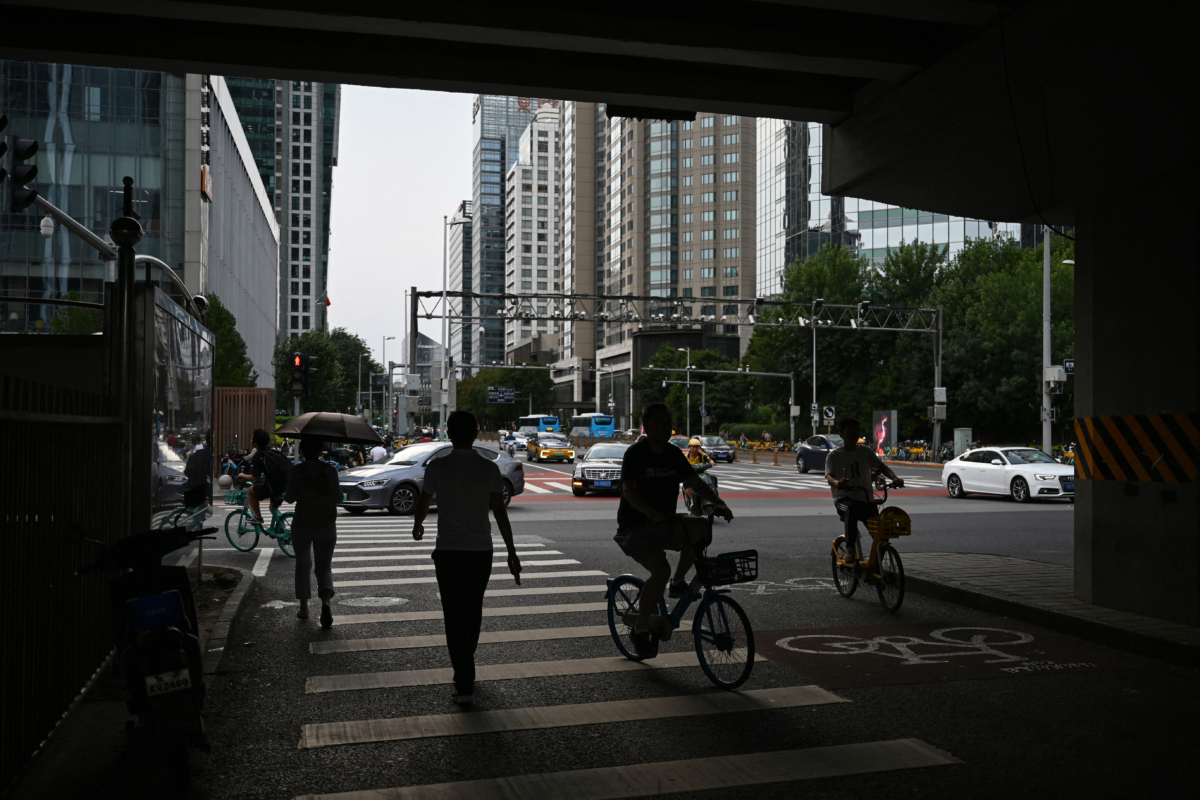
Recent years have seen a stagnating economy and lackluster job growth in China. The latest official data from the Chinese Communist Party (CCP) shows that the number of flexible employees nationwide has surged to 280 million, a 75% increase from 2019.
30-year-old Tu, a food delivery driver, revealed to The Wall Street Journal that he has been delivering food on his electric bike for six years, working 14 hours a day, six days a week. On a good week, he can earn up to $500, which may seem decent locally, but he finds the job exhausting and monotonous, leaving him with no time to indulge in reading novels he enjoys.
Tu expressed that the food delivery industry has become highly competitive, prompting him to consider switching to a different job for a change.
An article in The Washington Post points out that while China’s global influence appears to be on the rise, the country is facing a multitude of issues, with the most prominent being a divided economy. On one hand, the CCP is heavily investing in advanced technologies like semiconductors and artificial intelligence to compete with the United States. On the other hand, the common Chinese people are facing increasingly difficult living conditions.
Author of “The Party’s Interest Above All” and Xi Jinping family history expert Joseph Torigian noted that for Xi Jinping, even if economic growth slows down as a result, the Chinese people could accept it. However, the high costs of competing in the technology sector have led to income growth for Chinese citizens falling far behind the previous generation.
The article points out that while current public discontent toward Xi Jinping’s economic management doesn’t pose a direct threat, his control over the Chinese economy is essentially a high-stakes gamble, weighing on whether the Chinese people and the country’s trading partners will tolerate the consequences of his strategic ambitions.
In the past few decades, China’s double-digit economic growth rate has become history. The authorities predict that this year, China’s economic growth will be less than 5%, with some independent economists even arguing that there has been no growth at all.
Five years ago, China’s real estate market began to collapse, leading to a sharp decline in household wealth and a domestic consumption crisis. Economists attribute the economic imbalance to the economic policies of the CCP, emphasizing heavy subsidies to factories and the tech industry while neglecting to establish and improve social security systems, leaving Chinese citizens predominantly relying on themselves to save money.
Meanwhile, in a bid to stimulate enterprise lending and expand production, China has kept interest rates low for an extended period, making it difficult for ordinary citizens to earn substantial interest on their savings in the bank. The latest data from the World Bank shows that household consumption in China accounts for only 40% of the economy, far below the global average of 64%.
During the 2008 financial crisis, China heavily invested in infrastructure projects across the country, such as roads, bridges, airports, and high-speed rail. However, the focus shifted to the real estate sector, which continued to suppress consumer spending and confidence.
Experts point out that over the past two decades, the Chinese have taken prosperity and high growth for granted. However, the current economic slowdown has forced a shift in expectations, with people tightening their belts and cutting back on consumption.
Since 2021, the Chinese government has shifted investment towards manufacturing, with China’s annual added production capacity now three times that of the United States and Europe combined, largely funded by domestic savings trapped due to capital control restrictions.
Currently, despite various industries in China holding a global lead and increasingly achieving self-sufficiency, there is a significant issue of capital wastage. A McKinsey study found that for every dollar increase in output in China, 70% more capital is required compared to the United States or Europe.
Local Chinese governments and state-owned enterprises have heavily relied on bank loans or bond issuance to finance support projects for most industries, leading to a substantial debt burden. The latest data from the International Monetary Fund shows that China’s total debt has exceeded 300% of the total economic output, with experts highlighting excessive dependence on debt for economic growth, with debt growth reaching historic highs.
China is currently experiencing severe overcapacity issues in industries like automobiles, chemicals, solar panels, steel, and cement, leading to intense competition among enterprises, driving prices down in sectors like electric vehicles. Many loss-making companies rely on government subsidies to barely stay afloat.
A recent report from the European Parliament pointed out that domestic sales in China have weakened, prompting Chinese manufacturers to flood overseas markets with low-priced goods, resulting in discontent from the United States and Europe. As a response, these countries are considering imposing new tariffs and trade barriers on excess capacity.
Jens Eskelund, Chairman of the EU Chamber of Commerce, who has been working in China since 1998, noted that nearly everyone recognizes that many industries in Europe are facing life-threatening challenges, which the CCP will not allow to happen within its own borders.
Many major cities in China today may appear prosperous and modern, with Beijing appearing wealthier and more modern than a few years ago. The income of Chinese people has significantly increased since China joined the global trade system in 2001. However, behind the facade of prosperity lies economic stagnation and slowing wage growth.
The latest data shows that national retail sales in July were almost flat compared to a year ago. Earlier this year, IKEA closed seven stores in China, including one in Shanghai, reflecting a gloomy economic outlook for the country.
A young white-collar worker shared with The Wall Street Journal that while economic development had been rapid in the past, it is now at a standstill. He hasn’t received a raise in two years and dares not even think about buying a house or a car. According to him, anyone you ask on the street would likely echo his sentiments.
The CCP’s heavy reliance on exports and debt to sustain economic development has hit a dead-end. However, on the other hand, they have failed to develop a comprehensive social security system that would allow Chinese people to feel secure enough to spend freely.
Li Daokui, a former advisor to the People’s Bank of China and an economist at Tsinghua University, pointed out that like previous CCP top officials, Xi Jinping only cares about building a strong nation and military, rather than improving people’s livelihoods. In their view, compared to the extreme scarcity of resources in China in the 1950s and 60s, the current living standards of the Chinese have increased multiple times over.
While artificial intelligence and other advanced technologies can potentially drive economic growth, they are unlikely to meet the demands for millions of new job opportunities. Official figures from China indicate that the youth unemployment rate skyrocketed to 18.9% in August this year.
Finding a decent job with stable income and benefits has become incredibly challenging for young people in China today. Many recent graduates struggle to secure employment and are left with temporary jobs like food delivery while continuing their job search.
Moreover, as many young people grow older, they start to worry that employers may prefer fresh graduates over them due to their age. Some are apprehensive that the lack of stable income for an extended period could become the norm, leading them to lower their standards and accept any available job.
An increasing number of young people believe that life may be better now compared to 20 years ago, but the opportunities back then were much more abundant, and now, these doors of opportunity are closing.
A study conducted by Stanford University and Harvard University in 2024 revealed that more and more Chinese people believe that to succeed in China, one must have connections and a network. The optimism for a better life in five years is dwindling, resulting in a growing sense of pessimism about the future.
In conclusion, over the past few decades, the CCP leveraged economic growth and improved living standards to consolidate its monopoly on state political power. However, under Xi Jinping’s leadership, in a bid to fulfill the CCP’s geopolitical ambitions, this implicit political contract is being dismantled.