
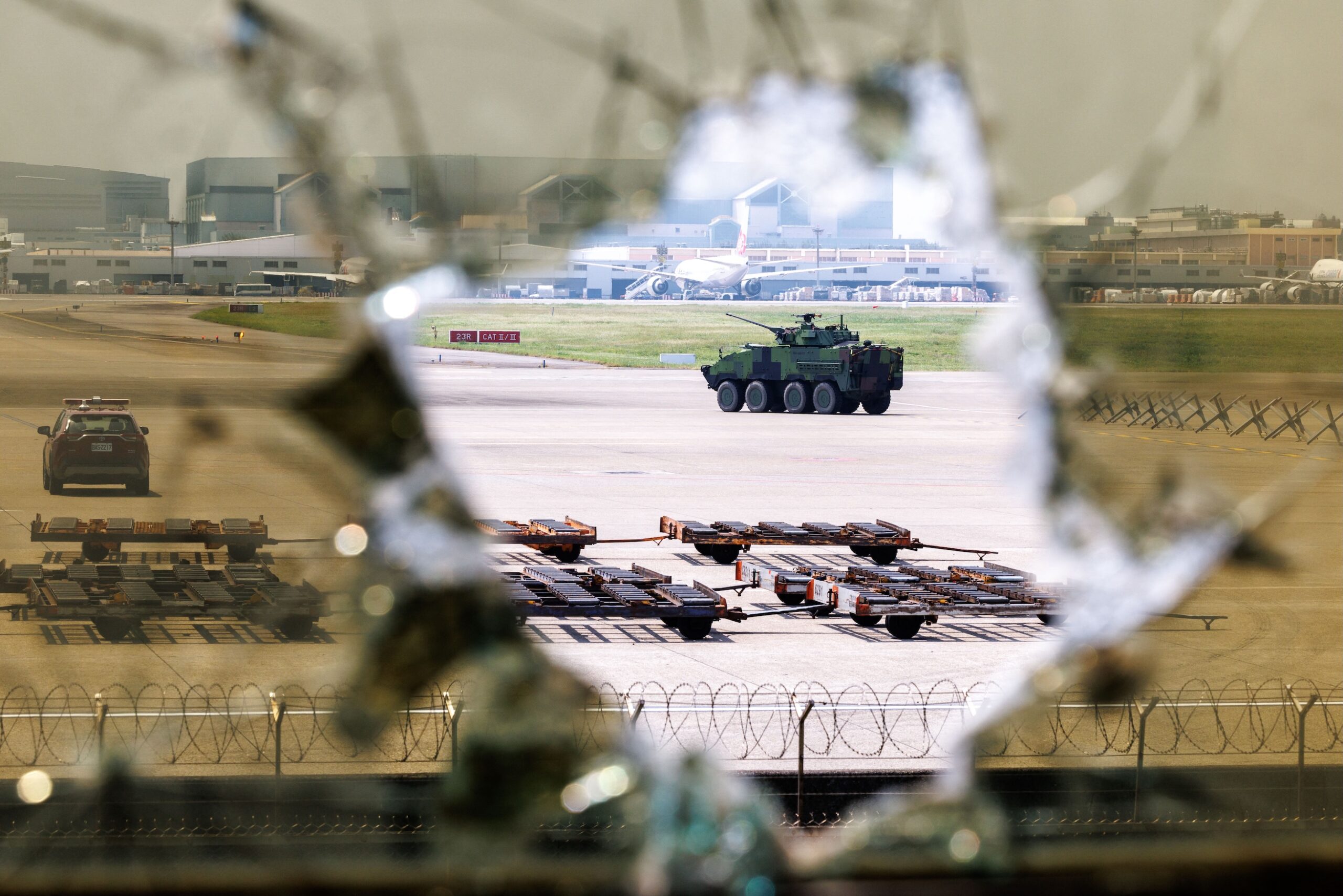
The annual Han Kuang military exercises of the Taiwan Ministry of National Defense for the year 2026 commenced on August 5 and will last for 10 days and 9 nights, mobilizing approximately 20,000 personnel from both regular and reserve forces. Military experts point out that this year’s Han Kuang exercises exhibit five unprecedented features. The increasing openness of US-Taiwan defense cooperation has also captured attention. Political analysts emphasize the need for Taiwan to guard against the Chinese Communist Party’s tactic of “Taiwan opposing Taiwan.”
One of the highlights of this year’s “Han Kuang 42” live-fire drills is the focus on countering Chinese Communist Party’s gray zone provocations and the threat of transitioning from exercises to actual warfare, with the three branches of the military concurrently deploying their combat readiness.
According to the Ministry of National Defense, this year’s exercises not only aim to verify immediate combat readiness but also emphasize five key points: “total national defense,” “counter blockade escort,” “medical treatment and casualty care,” “reserve mobilization,” and “unmanned aerial vehicle composite attack kill chain.”
On the second day of the Han Kuang 42 exercises, various combat zones across Taiwan carried out exercises. The second operational zone in the east, along with the third operational zone in the north, conducted port protection drills, while the fifth operational zone in the central region maneuvered to tactical positions. The fourth operational zone in the south not only performed road block exercises at Kaohsiung Xiaogang Airport but also for the first time extended its forces to Xiao Liuqiu and conducted trans-sea maneuvering.
In Northern Taiwan, the third operational zone executed roadblock exercises on the newly opened Tamsui River Bridge.
Located at the mouth of the Tamsui River, the Tamsui River Bridge provides direct access to downtown Taipei within an hour, depending on traffic conditions.
Former Dean of the Political Warfare College at National Defense University of Taiwan and retired Major General Yu Zongji, in an interview with Epoch Times, highlighted five distinct features of this year’s Han Kuang exercises, unprecedented in previous years:
Firstly, the exercise of a swarm of drones and the kill chain, which represent emerging combat capabilities.
Secondly, the focus on countering gray zone operations, with Taiwan’s navy coordinating with coast guard to counter Chinese Communist Party’s maritime isolation and blockade tactics.
Thirdly, emphasizing societal medical resilience. While similar exercises were conducted in the past, this year’s scale and on-site requirements are unprecedented.
Fourthly, focusing on reserves by mobilizing a combat brigade in the north and south, totaling 5,000 personnel, a record number.
Fifthly, communication resilience. This year, special emphasis is placed on conducting network slowdown exercises in 14 cities and counties. These exercises simulate scenarios where Taiwan faces significant disasters or attacks on its communication systems and tests how to cope with network paralysis affecting areas such as commerce, communication, and logistics.
Yu Zongji emphasized that the Chinese Communist Party’s escalating gray zone harassment tactics increasingly threaten regional stability, posing a potential threat to Taiwan’s survival. However, Taiwan’s proactive responses during the Han Kuang exercises demonstrate readiness and preparedness to counter potential future actions by the CCP aimed at isolating and blockading Taiwan.
“The ultimate goal is to ensure that Taiwan is not suffocated by China’s current isolation and blockade tactics,” he stated.
Yu Zongji noted that all democratic islands in the region are actively countering the CCP’s ambiguous tactics, highlighting the consensus among first island chain countries that unity and collective action by democratic nations are essential to effectively counter China’s expanding gray zone provocations.
The Han Kuang exercises have been held since 1984 and were previously known as the “Taiwan-U.S. Joint Military Exercises” before Taiwan took over independently.
While U.S. military training presence in Taiwan has traditionally kept a low profile, recent years have seen an increase in the visibility of U.S. military personnel or observers participating in the exercises.
Taiwan’s Minister of National Defense, Gu Lixiong, publicly acknowledged that the U.S. Indo-Pacific Command has been assisting Taiwan in enhancing its defense capabilities across various levels, emphasizing that Taiwan-U.S. military cooperation is closer than commonly perceived.
The American Institute in Taiwan (AIT) recently released photos showing U.S. Coast Guard vessels alongside Taiwan Coast Guard Administration ships conducting joint patrols.
Experts believe that the United States is effectively strengthening defense cooperation with Taiwan through its actions.
Yu Zongji noted that the AIT’s public disclosure of joint patrols between U.S. and Taiwanese coast guard vessels demonstrates active efforts to counter China. He anticipates a gradual increase in future joint maritime patrols and reconnaissance operations between the U.S. and Taiwan.
He further mentioned that in response to China’s activities in the South China Sea and Indo-Pacific region’s gray zones, the recent deployment of U.S. Coast Guard forces to Singapore and the expansion of Coast Guard presence in the Philippines suggest possible future locations for increased Coast Guard deployments in Taiwan and Japan.
Chinese affairs expert based in the U.S., Chen Pokong, stated that China’s military threats against Taiwan have evolved from a distant possibility to a constant and urgent risk that requires continuous preparedness. The increasing localization and specificity of Taiwan’s military drills, along with a focus on inner defense depth, are believed to stem from intelligence shared between the U.S. and Taiwan.
Chen Pokong mentioned that both the Democratic and Republican parties in the U.S. view Communist China as the primary adversary. While governments may occasionally show different stances, their core recognition remains consistent.
As of now, there has been no formal response from Beijing regarding Taiwan’s Han Kuang exercises.
With China’s economy showing signs of decline and Xi Jinping continuing military purges, there are concerns that Xi might escalate tensions in the Taiwan Strait to divert attention from domestic issues and consolidate his personal authority.
Yu Zongji stated that Xi Jinping’s unwavering control makes his intentions unpredictable. The preparations being made by the first island chain countries are also in anticipation of deteriorating internal situations within China, which could potentially prompt Xi to take military risks.
Chen Pokong remarked that following the detention of battle-experienced generals like Zhang Yuxia and Liu Zhenli by Xi Jinping, the PLA currently lacks the capability to launch an attack on Taiwan; internal disarray and uncertainties prevail within the military. While an actual invasion of Taiwan by China seems unlikely, saber-rattling could be used to mask internal turmoil. Nevertheless, Xi Jinping might take a reckless gamble, akin to Deng Xiaoping’s invasion of Vietnam, aimed at seizing military authority from opposing factions within the party, which led to external warfare. Hence, Taiwan must remain vigilant regardless of the scenarios.
However, Chen Pokong believes that rather than resorting to military force, China is more likely to employ tactics of division and enticement towards Taiwan. Currently, Taiwan is divided between those who oppose communism and those who are pro-China or lean towards it.
Chen Pokong mentioned that Wang Huning, a member of the Politburo Standing Committee of the Chinese Communist Party, once wrote a book called “America Against America.” He speculated that in the current context, a similar book might be called “Taiwan Against Taiwan.”
“Through the CCP’s so-called united front work, infiltration, and subversion, they aim to divide and disintegrate Taiwan, utilizing democratic processes to infiltrate Taiwan. This mirrors the tactics used during the Chinese Civil War in the 1940s, which is a longstanding strategy,” he elaborated.