
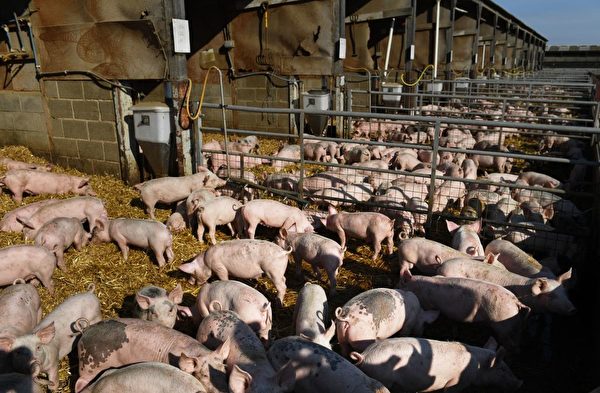
In mainland China, pig prices continue to remain low, leading to many pig farmers facing increasing losses. In order to cut their losses, they have been forced to significantly cull sow herds, abandon self-breeding and self-raising methods, and transition to lower-risk contract-farming models. Some are also exploring ways to reduce feeding costs and shorten the breeding cycle in hopes of weathering the current downturn in the “pig cycle.”
According to a report by the Economic Observer, Xu Ruijie, a pig farmer with over ten years of experience, had long adopted a self-breeding and self-raising model. At its peak, his farm had nearly 2,000 sows and a complete pig farming industry chain.
However, since the fall of 2025, the pig market has been in a prolonged slump, causing Xu Ruijie’s farm to sustain long-term losses. In April and May of this year, he made the tough decision to mass cull sows. Currently, the number of sows in his herd has dropped from nearly 2,000 to about 100; the remaining 9,000 piglets on the farm will be the final batch of products under his self-breeding and self-raising model.
Xu Ruijie stated that once all existing sows have completed breeding and been culled, he will completely abandon self-breeding and self-raising and switch to the lower-risk “company + farmers” contract-farming model.
Xu Ruijie did some calculations: raising a piglet of 15 to 20 kilograms to an output weight of 120 to 130 kilograms requires about 300 kilograms of feed, with feed costs nearing 900 yuan and labor costs around 35 yuan.
If self-breeding is practiced, the breeding costs of sows must also be factored in. The comprehensive cost of a sow for a year, including feed, labor, utilities, amounts to around 6,000 yuan. Additionally, factoring in depreciation of the facility, the total cost per finished pig is approximately 1,350 yuan (based on a standard 250-pound pig, equivalent to about 5.4 yuan per pound).
However, this year, pig prices have persistently lingered below the cost line. According to data from Zhuo Chuang Information, in the first half of 2026, the overall national pig prices have shown a downward trend, with an average price of 10.39 yuan per kilogram from January to June, a 30.02% decrease year-on-year. On April 14, prices even dropped to 8.59 yuan per kilogram, hitting the lowest record in nearly 8 years.
Although pig prices have slightly rebounded from the low point in April, with prices around 5.2 yuan per jin at the beginning of August, a 250-pound pig is sold for only 1300 yuan, still unable to cover the comprehensive cost of 1350 yuan, resulting in a loss of about 50 yuan at the market.
Xu Ruijie pointed out that for pig farmers, the real challenge is not just the daily prices but the long-term scenario where selling prices consistently fall below the comprehensive costs.
Compared to large-scale pig farms, small-scale free-range farmers face even greater pressure. A free-range farmer in Zhoukou, Henan Province, stated that the prolonged low pig prices, combined with the lack of advantages in feed procurement, disease prevention, and policy support for small-scale farmers, has led to many quitting the industry.
Xu Ruijie mentioned that although the self-breeding and self-raising model provides control over piglet sources and disease risks, the fixed costs are relatively high.
The comprehensive cost of a sow for a year is about 6,000 yuan. Considering a sow gives birth to 25 weaned piglets a year, forming approximately 22 finished pigs, the allocated fixed cost per piglet is around 240 yuan. Currently, purchased piglets from the market cost about 150 yuan each.
From a pure purchasing cost perspective, buying piglets externally seems more advantageous. However, Xu Ruijie believes that this mode also carries evident risks. Due to the inability to fully control upstream breeding and disease prevention, uncertainties exist in the health conditions of piglets. In case of disease outbreak, subsequent fattening costs could significantly rise.
Therefore, he currently favors the “company + farmers” model. Under this contract-farming model, the partnering company is responsible for providing piglets, feed, vaccines, and production information, while the farmers mainly handle facilities and labor.
Xu Ruijie disclosed that he currently undertakes contract farming business on a scale of several thousand pigs. According to the company’s requirements, the survival rate must reach 95% to 96%, with a feed-to-meat ratio controlled between 2.5 to 2.6. After meeting these standards, each finished pig can earn around 200 yuan in contract farming fees.
After deducting labor, utilities, and facility costs, each pig under the contract-farming model can still yield about 100 yuan in profit.
Compared to the self-breeding and self-raising model that involves enduring fluctuations in pig prices, sow reproduction, disease risks, among others, the contract-farming model, although offering limited profit margins, significantly reduces risks.
For small-scale free-range farmers, aside from exiting the industry, another option is to explore differentiated markets.
The aforementioned free-range farmer from Zhoukou, Henan Province, indicated that ordinary pig markets are highly competitive, making it challenging for free-range farmers to compete cost-wise with large-scale farming enterprises.
It is reported that feed costs typically constitute 60% to 70% of the total pig farming costs. In recent years, fluctuations in feed ingredients such as soybean meal have further squeezed the profit margins of farmers.
Hence, free-range farmers have started reducing purchases of full-price feed and are experimenting with self-formulating feed.
In the current scenario of persistently low pig prices, the pig farming industry is undergoing a reshuffling.