
In a time when certain urban areas in the United States are eagerly leaning towards socialism, many South American neighboring countries have chosen a different path of development: reducing government size, opening up markets, balancing budgets, and prioritizing growth and stability.
Compared to a few years ago, the political landscape in South America is vastly different now. Countries such as Argentina, Ecuador, Paraguay, Chile, Bolivia, Peru, and Colombia are currently being led by conservative leaders. So far, the market-oriented reforms they have implemented have yielded positive results, bringing about economic stability and growth. Most parts of South America are experiencing robust economic growth.
The challenge now lies in whether the benefits of this economic growth can quickly manifest to offset the impact of political disputes.
In Argentina, liberal Javier Milei won the presidential election in 2023 on a platform that includes significant cuts to government spending and deregulation. In Paraguay, Santiago Peña was elected president in 2023, promising to implement conservative social policies and market-oriented reforms.
In 2025, José Antonio Kast took office as President of Chile, promising to implement economic liberalization and crack down on crime. The same year, Rodrigo Paz became the President of Bolivia, ending the country’s two-decade-long socialist rule.
In June of this year, Keiko Fujimori-led right-wing party “Fuerza Popular” (Popular Force, FP) won the presidential election in Peru, promising to achieve economic stability and security. Meanwhile, conservative nationalist Abelardo de la Espriella took office in Colombia, promising to streamline the government, revive economic growth, and combat drug trafficking.
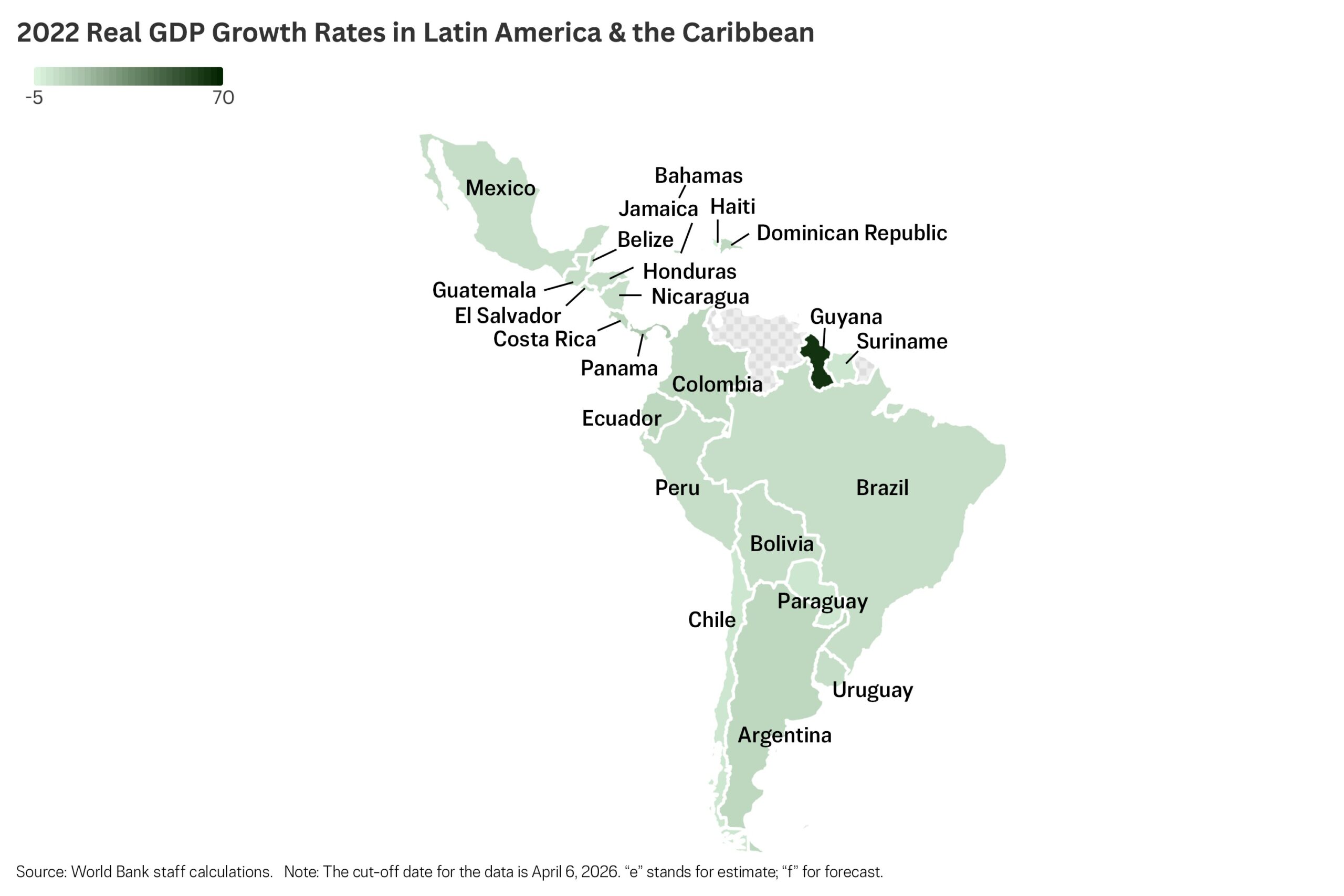
So far, the economic effects of these reforms are encouraging. Data from the World Bank, headquartered in Washington, D.C., shows that much of South America is experiencing strong economic growth, with economic prospects more optimistic than many Western countries.
Paraguay is projected to see a 4.4% increase in GDP this year. Argentina is expected to grow by 3.6% this year, following its over 4% economic growth in 2025.
Peru, Colombia, Chile, and Ecuador are all expected to see economic growth surpassing 2% this year, aligning with the U.S. GDP growth expectation of 2.2%, and far exceeding the European Union’s average GDP growth rate of 1.1%.
Furthermore, countries like Argentina, Paraguay, Ecuador, and Uruguay have seen their sovereign debt ratings upgraded in recent years. Paraguay and Uruguay obtained investment-grade ratings while many European countries, including France, Estonia, Lithuania, and Latvia, were downgraded by Standard & Poor’s due to “lagging regional economic growth.” Similarly, the United States had its AAA rating downgraded by Standard & Poor’s in 2011, Fitch in 2023, and Moody’s in 2025 due to its escalating national debt.
Currently, everything is going smoothly, of course, South American countries have experienced this situation before.
In the 1980s and 1990s, many Latin American countries pursued privatization, trade liberalization, fiscal reform, and freer markets. While these policies helped curb inflation and alleviate debt crises, they often had little effect on reducing poverty or inequality, often leading to wealth concentration among a few elites.
This provided an opportunity for left-wing populist movements that campaigned on strengthening state control, redistributing wealth, expanding social welfare programs, and giving more political power to the poor and indigenous communities. Starting in 1998, the so-called “Pink Tide” brought left-wing governments to power in countries like Venezuela, Bolivia, Ecuador, Argentina, Brazil, Uruguay, and Chile.
Venezuela stands out as an extreme case. The country, with the world’s largest known oil reserves and abundant profits, saw its oil infrastructure nationalized. Due to mismanagement and embezzlement by government officials and associated parties, the infrastructure was left in disrepair. This was followed by a vicious cycle of hyperinflation, plunging the Venezuelan people into poverty.
Today, the winds in South America are shifting towards the right.
Under the leadership of President and economist Milei, Argentina has become a focal point of news for rapidly dismantling administrative machinery. When Milei took office in 2023, Argentina was suffering from years of fiscal deficits, annual inflation rates exceeding 200%, and the central bank printing money in large quantities to support government spending.
In 2024, Milei slashed government spending by 30%. Within a year, Argentina achieved its first budget surplus since 2010.
“Emphasizing what’s happening there cannot be overstated.” Peter Earle, Senior Research Fellow at the American Institute for Economic Research, commented to The Epoch Times. “When Milei took office, Argentina’s economy was in dire straits, with the government monetizing fiscal deficits, inflation accelerating, and approaching levels that truly threaten stability.
“The adjustment was undoubtedly painful at first. Poverty spiked sharply in a short amount of time, followed by initial stabilization, and then a reversal trend, leading to the unravelling of inflation.”
According to data from the National Institute of Statistics and Census of Argentina (INDEC), Argentina’s economy grew by 4.4% in 2025. In May of this year, Fitch Ratings upgraded Argentina’s sovereign credit rating from CCC+ to B-, citing improved fiscal conditions, significant progress in economic reforms, and increased foreign exchange reserves. In July, Moody’s similarly raised Argentina’s rating from Caa1 to B3, with a positive outlook.
Meanwhile, other South American countries are undergoing more gradual transformations. Paraguay, in particular, has avoided the “shock therapy” of radical reforms, gradually moving towards free markets and fiscal accountability.
“Argentina is getting a lot of attention because the starting conditions were extremely difficult, and, undeniably, Milei’s performance has been dramatic; whereas Paraguay is showing what happens when relatively orthodox policies are maintained over the long term, rather than rushed through in emergencies,” Earle said.
“Paraguay has always maintained relatively low tax rates, a high degree of macroeconomic discipline, business-friendly policies, as well as advancing reforms to enhance government efficiency and uphold property rights.”
In its latest report on the Latin American economy released in April, the World Bank pointed out that Paraguay “continues to outperform the regional average supported by robust agricultural exports, expanding electricity generation, and a stable macroeconomic framework.”
In December 2025, Standard & Poor’s raised Paraguay’s credit rating from BB+ to BBB-, stating that “a stable macroeconomic environment and a good track record supporting market-friendly policies have enhanced Paraguay’s economic resilience and improved the prospects for more stable growth.”
Previously, Moody’s upgraded Paraguay’s credit rating from Ba1 to Baa3; currently, both Moody’s and S&P rate Paraguay as investment grade.
Other South American countries are proving that there can be many different paths to breaking free from socialism.
“In Chile, and to some extent in Peru, economic reform processes have been advanced in a rather sudden way,” explained Steve Hanke, an economist at Johns Hopkins University, to The Epoch Times.
While in the short term, these countries experienced “a period of severe economic difficulties” due to these reforms, the situations in Uruguay and Paraguay were different, “these two countries underwent relatively smooth stabilization and liberalization processes.”
“This demonstrates that economic stabilization and liberalization can be achieved without precipitating major transitional economic crises, and ideally, it should be this way,” he said.
Hanke previously served as an economic advisor to former Venezuelan President Rafael Caldera and has advised reform countries in Latin America and Europe. He is currently a special advisor to Venezuelan National Assembly member Antonio Ecarri.
Successful liberalization, whether gradual or radical, requires not only cutting bureaucratic structures.
“When considering reform, it’s important to delineate between policies of economic liberalization (like deregulation, privatization, etc.) and policies of macroeconomic stability. This distinction is crucial,” Hanke explained.
“Effective liberalization necessitates both. Indeed, stability may not be everything, but if it isn’t there, nothing matters.”
Hanke stated that Latin American countries have been striving to achieve both liberalization and stability simultaneously for decades, a challenge that has hindered the region’s development in terms of productivity and living standards.
Maintaining stability requires a multitude of measures, one of which is controlling inflation.
In Argentina, Milei managed to reduce the inflation rate from 211% when he took office to 31% in just two years, reaching its lowest level since 2018. Projections indicate that the inflation rate will further decrease to 20% by 2026, but currently remains high.
In some cases, Hanke suggested that countries abandon their national currencies in favor of more stable currencies like the U.S. dollar or the euro.
Hanke noted that countries like Panama, Ecuador, and El Salvador have already done so by pegging their currencies to the U.S. dollar, but most other South American countries still maintain their national currencies. When countries cannot control inflation, residents tend to shift savings and investments abroad for preservation.
“The scale of capital flight is staggering. For example, for every dollar of external debt in Argentina, over 60% of funds flow out,” he stated.
Achieving a smaller, more efficient government is key to addressing challenges.
“Freedom requires not just low tax rates,” Earle said. “It also demands that the government fulfill certain specific but essential functions such as security provision, maintenance of functioning courts, enforcement of contracts, property protection, and so forth.”
One fatal weakness still prevalent in the liberalization process in South America is wealth inequality.
A 2025 World Bank report noted that Latin American countries are “among the most unequal nations in the world.”
The report stated that the top 20% highest-income families in Latin America receive 54% of total income, while the bottom 20% of families receive only 4%. In comparison, all other regions in the world, apart from Sub-Saharan Africa, see the top 20% highest-income families receive between 40% and 43% of income, and the bottom 20% families receive between 8% and 9% of income.
Despite a reduction in the impoverished population, a recent Mastercard market survey found that the middle class in Latin America remains “financially fragile.”
The report pointed out: “The termination of informal job contracts, unforeseen expenses due to illness, or climate-related sudden disasters can erode savings or emergency funds. The pandemic has further highlighted this vulnerability: within a year, 14 million people fell back into hardship.”
The success of conservative parties in South American elections is largely seen as a backlash by the public against the failures of previous left-wing governments. However, in many cases, the popular support base for implementing reforms is not firm.
In a recent Colombian presidential election, right-wing candidate de la Espriella won by a slim margin of less than one percentage point against left-wing opponent Iván Cepeda. Similarly in Peru, conservative candidate Keiko Fujimori won the presidential position by less than 50,000 votes in a neck-and-neck second-round vote.
Market-oriented reforms have successfully reduced inflation and achieved economic growth. However, unless these achievements can benefit a wide enough portion of the population, countries may be inclined to turn back towards left-wing policies.
“The issue is not whether market-oriented reforms can stabilize the economy; increasingly, evidence suggests that they do work. The question now is whether these reforms can result in significant improvements in a short amount of time to garner political support,” Earle stated.