
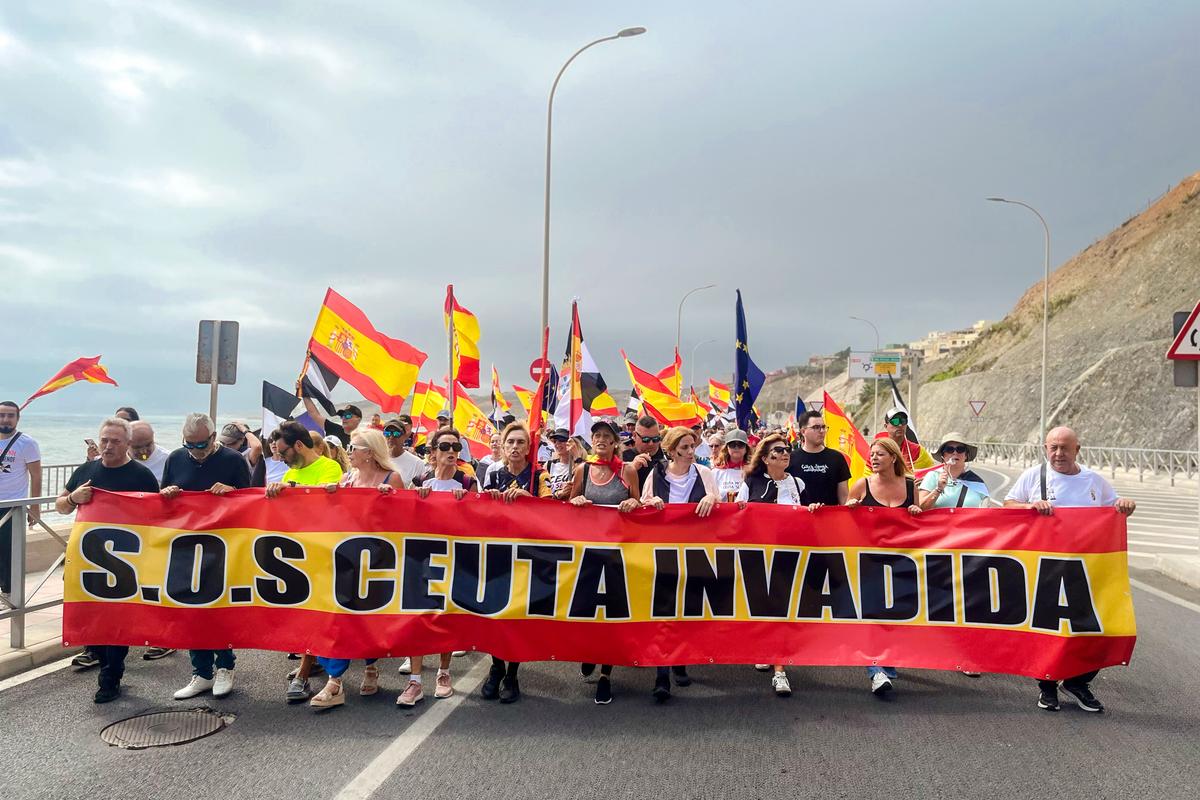
On September 20, in Ceuta, an autonomous city of Spain located on the Mediterranean coast in the northernmost part of Maghreb, Africa, over a thousand protesters held up banners saying “求救!休達遭到入侵!” (SOS Ceuta invadida in Spanish), as they marched towards the border with Morocco demanding the deportation of illegal immigrants currently residing on the beaches, streets, and public spaces of this Spanish enclave.
The protesters, carrying Spanish national flags and the flag of Ceuta, chanted slogans like “Ceuta belongs to Spain,” “I am Spanish,” “Expel the invaders,” and “Sánchez to jail,” in protest against the Spanish Socialist Prime Minister Pedro Sánchez.
Organized by the local community association federation, the march comes two months after over 72,000 people, mostly young individuals, crossed into Ceuta from Morocco in just two days.
While the majority returned to Morocco within a few days, several thousand still remain stranded in the area.
Located in a narrow strip on the North African coast, Ceuta with a population of about 83,000, has been facing increasing pressures in terms of housing, public spaces, and other local resources due to the influx of illegal immigrants, leading to escalating anger among residents. They say their daily lives have been disrupted.
“I am here protesting because our government hasn’t supported us,” said Ramón, a 56-year-old civil servant who joined the march, to El Reportero Epoch Times. “Our streets are no longer safe, and our children are trapped at home afraid to come out.”
Sixteen-year-old Daniel, a participant in the march, expressed feeling “helpless” due to the lack of public safety.
Daniel’s mother Ana Belén, 43, a healthcare worker, expressed extreme dissatisfaction with the Madrid government.
“Our own government has betrayed us,” she told El Reportero Epoch Times. “The government’s primary duty is to defend the nation, not prioritize the rights of invaders over our security and citizens’ rights. We pay taxes, that’s what they are for. In a normal world, the members of this government should be tried for treason.”
There was no response from Prime Minister Sánchez’s office to requests for comments.
In the crowd, protesters occasionally waved the flag of the European Union (EU).
Ceuta, along with Melilla further east on the North African coast, are the only significant land borders of the European Union with Africa. Those carrying EU flags emphasized that the events in Ceuta are not just Spain’s problem.
“We’re waving the EU flag because Pedro Sánchez’s government is not taking action, so we hope other European countries will intervene,” said Ramón.
Several protesters explained to El Reportero Epoch Times that they hoped other European governments would pressure Madrid to take action.
In their plea to Europe, some feel abandoned. “I am Spanish, I am European, we feel completely abandoned by the government, by Europe, by everyone,” said Ana Belén.
During the march, some individuals also expressed anger towards left-wing non-governmental organizations.
Representatives of the NGOs observed the protest, which escalated the tense atmosphere, triggering loud protests from some demonstrators. Several marchers told El Reportero Epoch Times that they believe the crisis has been exacerbated by the policies advocated by immigrant aid organizations that make it easier for migrants to stay in Spain.
“These left-wing NGOs have substantial funding; they pressure our government and politicians to legalize the immigrants,” said Alejandro, a 27-year-old Ceuta resident. “That’s why they come here.”
The NGO representatives from Ceuta did not respond to requests for comments.
The bulk of Sunday’s protest targeted the Spanish Interior Minister Fernando Grande-Marlaska. On September 8, the minister described the sense of insecurity among Ceuta residents as “subjective.”
According to a report by the Spanish EFE news agency, following the large-scale crossing into Ceuta on July 30, the number of incidents handled by the emergency service department increased sharply. The figure increased by 532.6% compared to the same period in 2025.
During this period, the emergency services dealt with over 7,000 incidents and received more than 9,200 calls reporting issues from residents across the city. Assaults accounted for 19.2% of the emergency events, while break-ins made up 11.8%.
Retiree José, interviewed by El Reportero Epoch Times, stated that for residents like himself, they face these changes every day.
“Some neighborhoods are very dangerous,” he said. “Living next to them is unbearable. It’s very difficult, really very difficult.”
He expressed a desire to see these immigrants returned to Morocco, believing that allowing them to stay would only encourage more individuals to attempt the same journey.
Just two days before the protests, a police clearance operation highlighted the pressures brought by the influx of migrants to this enclave.
Shortly before 7 a.m. on September 18, the police began relocating thousands of migrants from two beaches to a new tent camp at the port. What began as an orderly process soon turned into a chaotic scramble. Migrants began running, trying to reach the camp first.
The reason for the scramble was evident: the new camp, according to the city government, can accommodate only 1,700 people, while there were approximately 4,500 migrants camped at the temporary camp on El Trampolín beach.
A group of young people attempted to break through the police cordon and rushed towards the camp’s gate. Riot police wielded batons and fired rubber bullets to disperse the crowd, trying to regain control. Videos of the conflict quickly spread on social media, attracting millions of views.
“We’ve reached our limit,” said Paula, a homemaker living nearby, the day after the incident to El Reportero Epoch Times. “What’s happening here is too terrible.”
The shortage of camp beds reflects the larger challenges facing the city.
According to the Spanish government, of the approximately 72,000 people who entered Ceuta on July 30-31, about 90% returned to Morocco within three days.
Estimates of the number of stranded individuals continue to rise. The Spanish government currently estimates around 10,000 people, while the Ceuta government states that at least 13,000 migrants remain in this tiny 7-square-mile enclave with about 83,000 residents.
Despite efforts to relocate thousands to official shelters, informal settlements within the city remain, becoming part of Ceuta’s urban landscape.
Residents described to El Reportero Epoch Times that in some areas of the enclave, informal camps have taken root and become “their own city.”
At Benítez and El Trampolín beaches, just steps away from the sea, rows of makeshift shelters have been erected. Small, closely packed dwellings made of wicker and reeds frame the shelters, sealed with cardboard, fabric, plastic, and tape.
These refugee camps have developed their rudimentary economic system. Temporary stalls along the beach sell cigarettes, food, drinks, and other daily essentials at affordable prices.
Jalid, a 52-year-old man, runs a small restaurant just a few steps from the Benítez settlement.
“They stole our everyday life, stole our summer, took our children’s parks,” he described to El Reportero Epoch Times. “I don’t call it a crisis; I call it an invasion.”
However, individuals interviewed within the camp by El Reportero Epoch Times explained that their stay in Ceuta is temporary.
No one expressed intentions to settle in this enclave permanently. Instead, they see Ceuta as a gateway to the European mainland and hope to earn more income there, far more than what they could make back home.
Mustapha, 39, who worked as a pizza maker in Morocco earning about $400 a month spoke of seeking a better future in Europe. Similarly, Yassine, a 22-year-old mechanic, and Ahmed, a 23-year-old bricklayer, earning around $350 each monthly back in Morocco, embarked on the journey after seeing numerous trafficking messages on social media.
However, upon arrival in Ceuta, they found the reality significantly different from their aspirations for the future.
They described the unbearable living conditions in the beach camps, lack of hygiene, and numerous safety hazards. Sometimes they could only afford one meal a day. They reported frequent theft incidents and conflicts among migrants.
Jalid said that many of the people living near his restaurant might not intend to cause trouble. Still, for him, their arrival does not change the impact on local residents.
“Perhaps many of them are good people,” he said. “But they only think of their own interests, never consider their presence’s impact on local residents, and do not acknowledge that they are illegally entering and forcing themselves in.”
This sense of frustration permeated the Sunday protest. After enduring the consequences of seven weeks of mass crossings, many protesters expressed fatigue with waiting for the government to address the issues.
“We can’t take it anymore, so we came to the border hoping they will listen to us,” said Miguel Ángel, a salesperson, to El Reportero Epoch Times. “But if nothing happens, will we have to take matters into our own hands?”
For Ana Belén, the city has reached its breaking point.
“When someone illegally enters your country, they should be deported within 48 hours,” she said. “We need action, not just words. The residents here are tired of listening to long speeches. If the government does nothing, there will be a rebellion.”
For her, the recent changes in Ceuta can be summarized with a simple analogy.
“We, the people of Ceuta, now feel like we are living in a massive refugee camp,” she concluded.