
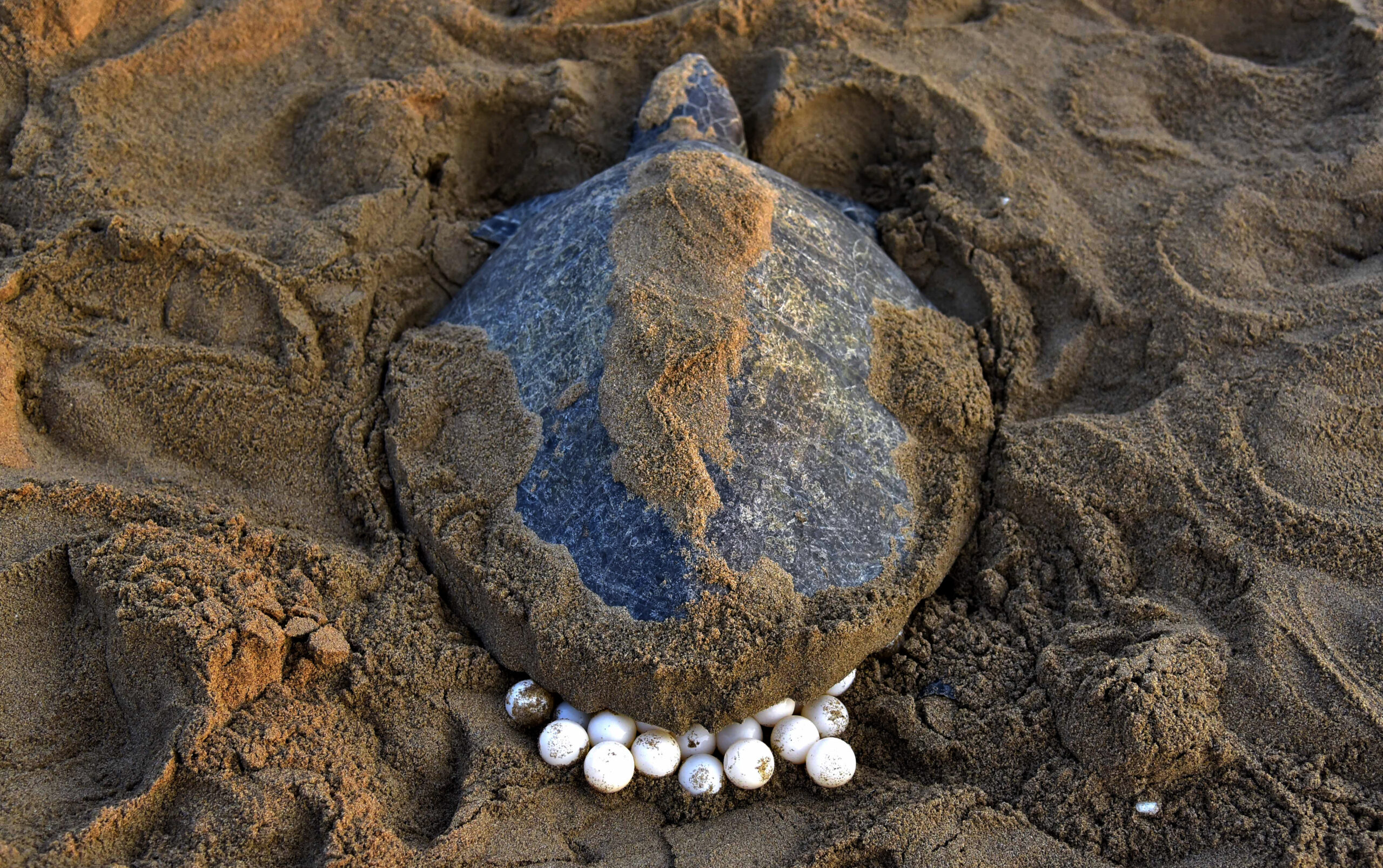
The state of California in the United States recently witnessed a historic moment with the arrival of the Olive Ridley sea turtle on the coastline of Orange County in Southern California. This is the first recorded instance of these sea turtles naturally nesting on the West Coast of the United States, a species that was previously only found in tropical waters.
On September 16, the first Olive Ridley sea turtle was spotted nesting near Seal Beach, with another sighting of the turtle laying eggs near Huntington Beach Pier just three days later on September 19.
Initially, experts from the National Oceanic and Atmospheric Administration (NOAA) and wildlife specialists suspected that it might have been the same turtle nesting twice. However, after comparing shell patterns, physical characteristics, and the distribution of barnacles on their bodies, it was confirmed that these were two different Olive Ridley sea turtles.
According to experts from the Aquarium of the Pacific as reported by CNN, sea turtles typically lay eggs multiple times during the breeding season, so it is possible that more turtles could come ashore within the next 30 to 90 days.
Olive Ridley sea turtles are primarily found in tropical regions like Mexico and Costa Rica. Jeffrey Seminoff, an expert from NOAA, and his team have proposed several hypotheses, including the influence of super El Niño events and rising sea temperatures, which attract tropical sea turtles to migrate northward due to abnormally warm seawater.
Another possible reason for this unusual behavior could be a malfunction in the turtles’ biological navigation system, often referred to as their “biological GPS.” Changes in factors such as magnetic fields, water temperatures, and wave patterns could lead to miscalculations in their internal navigation, causing them to mistake California for a beach in Mexico.
Some experts speculate that another reason for this migration could be the excessively high temperatures in their original tropical nesting sites (above 31°C/87.8°F), resulting in the production of all-female hatchlings. The sea turtles may be seeking alternative nesting grounds due to this phenomenon.
Additionally, the recent frequent storm activities in the Pacific Ocean may have disrupted the turtles’ natural migratory routes, pushing them off course.
A multi-agency team has already set up protective barriers on-site for 45 to 60 days of monitoring. However, due to the storm surge and dangerous waves brought by Hurricane Polo, there is a risk of the nesting sites being washed away. Wildlife conservationists have taken emergency measures to carefully excavate and transfer over 200 turtle eggs to a controlled environment at the Aquarium of the Pacific for incubation.
If these eggs successfully hatch in early November, the new hatchlings may eventually return to California beaches to reproduce after reaching maturity.
NOAA and wildlife authorities emphasize that the Olive Ridley sea turtles are protected under the Endangered Species Act in the United States. If the public encounters stranded or nesting turtles on the coast, they are urged to maintain a distance of at least 10 to 15 meters.
In case of any sightings of stranded or nesting sea turtles along the coast, individuals are advised to immediately contact wildlife authorities or call the NOAA hotline at 562-506-4315 for reporting.