
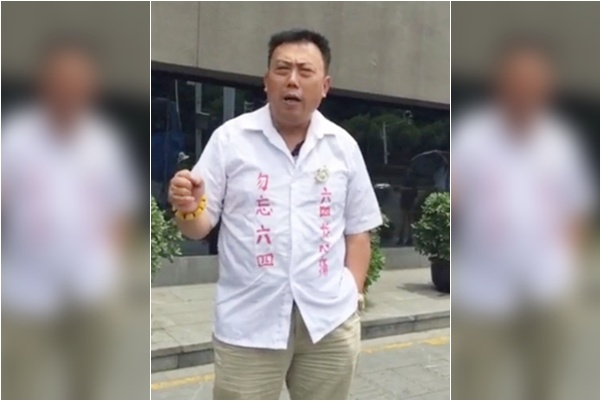
On September 22, the sudden death of rights activist Shi Tingfu in prison in Nanjing has sparked public attention. According to information released by Shi Tingfu’s son, the prison authorities claimed that the cause of death was a “heart attack.” However, the family members have doubts about this explanation.
Shi Tingfu’s son recently visited his father and felt that his father’s condition was good at that time, with no complaints of illness. Therefore, the family cannot accept the explanation of a “sudden heart attack” leading to his death.
As of the time of writing, there have been no further updates on the matter.
Wu Shaoping, the head of the Overseas Chinese Human Rights Lawyers Alliance, told Epoch Times that in the event of Shi Tingfu’s death in prison, it is the prison’s obligation to thoroughly investigate the true cause of death: how he died, whether there was timely discovery and rescue, and what measures were taken; the prison is obligated to provide the family with 24-hour surveillance videos from the prison.
“The actual cause of death cannot be determined solely based on the prison’s side of the story. The prison has the responsibility to thoroughly investigate the true cause of death and provide clear explanations to the family and the public,” Wu Shaoping said. “If the prison fails to fulfill its responsibilities, it indicates mismanagement.”
He pointed out that under the rule of the Chinese Communist Party, China lacks a fair and independent judicial system. Authorities engage in illegal crackdowns, sentencing, imprisonment, and even physical abuse against human rights activists and dissidents, causing severe physical and mental harm.
“The authorities use methods and powers beyond the law to control these individuals seeking justice and fairness, causing significant harm to their physical and mental well-being through long-term repression and illegal detention. It cannot be ruled out that the authorities may have caused deaths during the process of maintaining stability,” Wu Shaoping stated, adding that when faced with such incidents, the CCP authorities first conceal the truth and prevent the outside world from knowing the actual situation.
“If there were a fair and independent judicial system, ordinary people wouldn’t resort to petitioning, nor would they vigorously pursue justice along this path, which would eliminate the need for stability maintenance and prevent cases of petitioners being framed, beaten, tortured, or placed in illegal black jails,” Wu Shaoping remarked.
Shi Tingfu, aged 65, was an ordinary petitioner who gradually awakened on the long road of petitioning. He advocated for freedom and democracy online, participated in protest activities on the streets, openly commemorated the Tiananmen Square incident, supported human rights lawyer Guo Feixiong, and spoke out for rights lawyers in distress, resulting in multiple arrests.
In 2017, he was sentenced to one year in prison for “provoking trouble” for speaking the truth about the Tiananmen Square incident, with a suspended sentence of one year and six months. He was released on February 11, 2018.
He was also arrested on January 15, 2024, for sending materials about Xinjiang’s Akso fruit farmers to foreign media journalists, sentenced to three years in prison for “provoking trouble,” and sent to Shaho Prison in Xinjiang, with his term lasting until January 14, 2027.
In 2025, Shi Tingfu was awarded the Cao Shunli Human Rights Defender Award.